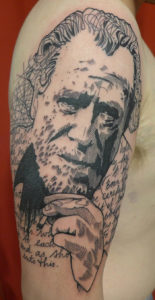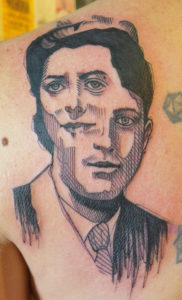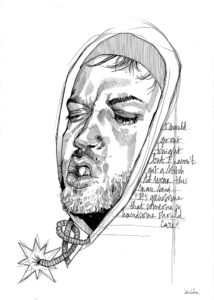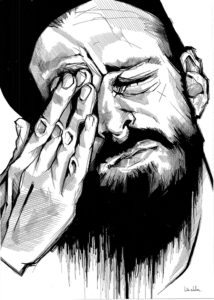
Jamie et Ronny Ris: Dogstar tattoo, a family story
Report by DHK, James C., Sid L-Boy
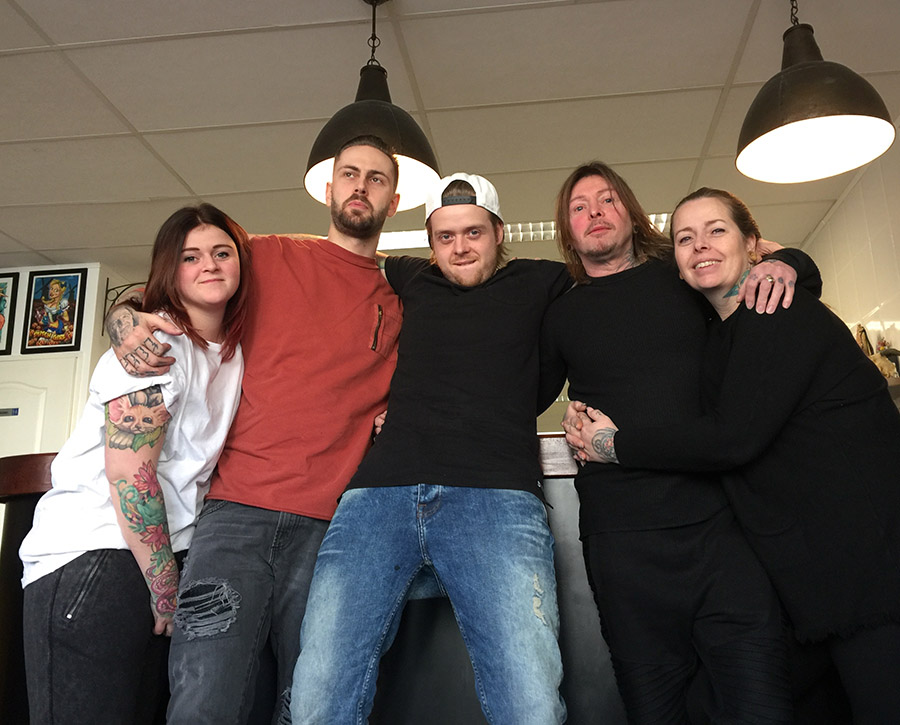
At least 20kms from Amsterdam, in Aalsmeer, we can find Ronny (the father), Jamie (the son), Manuela (the mother) and Dana (the daughter). A pleasant atmosphere over tea and coffee and punctuated with numerous jokes on the interview to come.
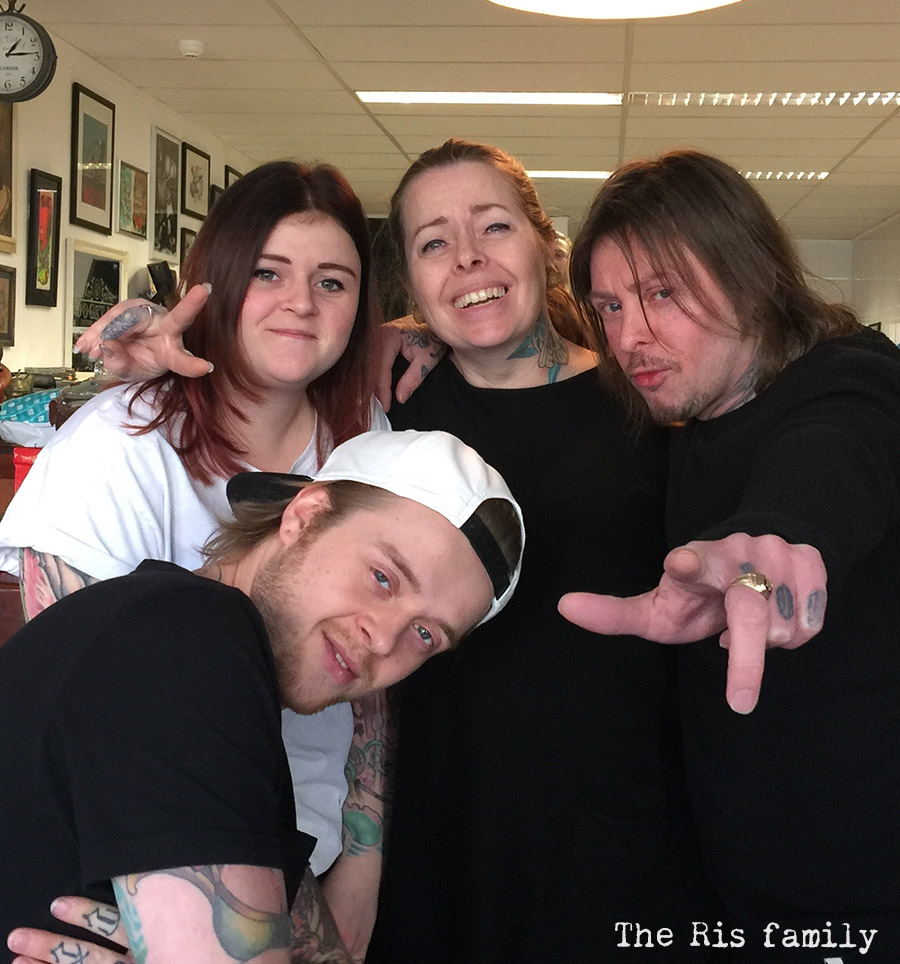
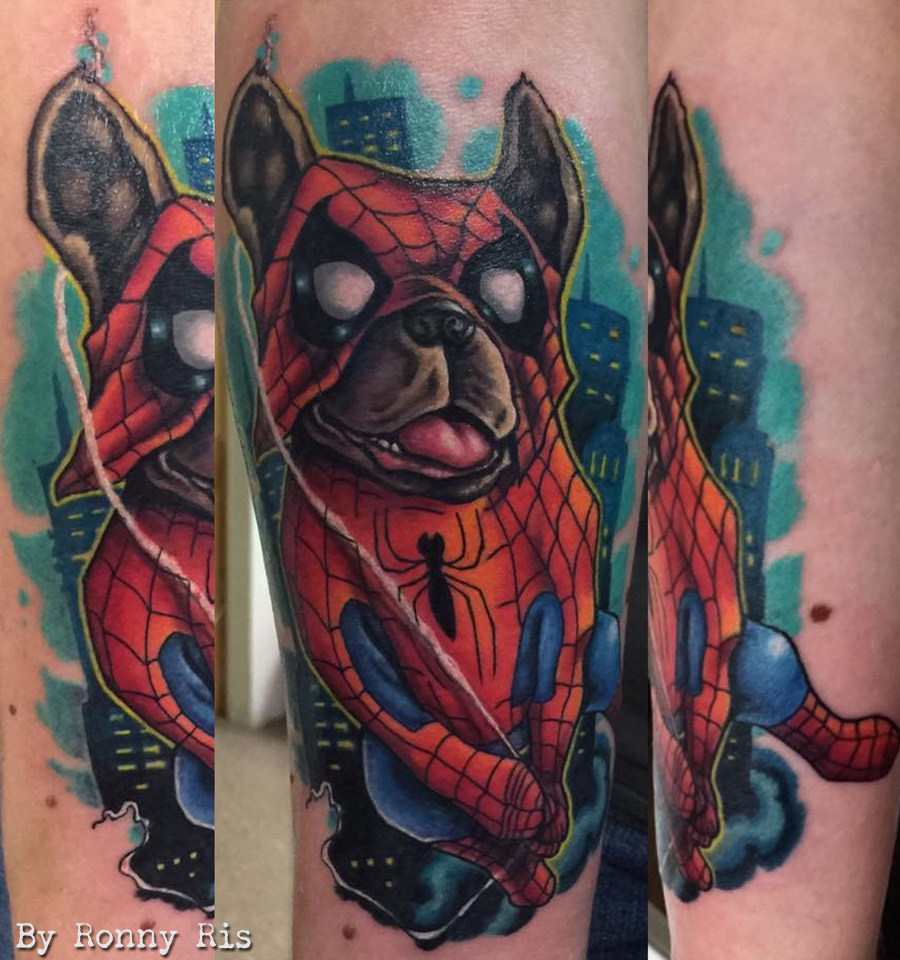
Ronny, the patriarch, studied graphics and spent a few years in an advertising agency creating illustrations and story-boards. When he finally got bored, he ditched everything and got into sculpting and painting. At the same time he started drawing for tattoos that himself and his friends got inked. The tattooist, Rob Deut who does ethnic tattoos, tribal and polynesian in his shop « Seven Seas » noticed his work and motivated him to start tattooing. We’re in 1996, more than 20 years ago : Ronny’s tattoo adventure is about to begin.
He did his first tattoos in a private workshop in Amsterdam. He moved to Aalsmeer. Worn out by the constant trips between the two cities, Ronny then decided to open his first shop in 1999 in Aalsmeer, a tiny place of 18m².
After moving twice, the shop is still in the same street but is now 100m².
Manuela, his spouse helps him run the shop, she takes care of management, solders the needles and welcomes the customers. She also has an artistic sensitivity, she started tattooing for 4, 5 years but a wrist operation stopped her career.
She continues helping out at the shop and does some piercings. On another note, she also takes care of their 3 children.
When their fourth child arrived, Cody, both activites got more complicated. Ronny who needed somebody to help out, asked 16 year old Jamie who wasn’t the scolarly one to help him out at the shop.
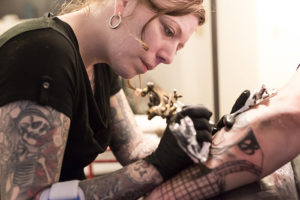
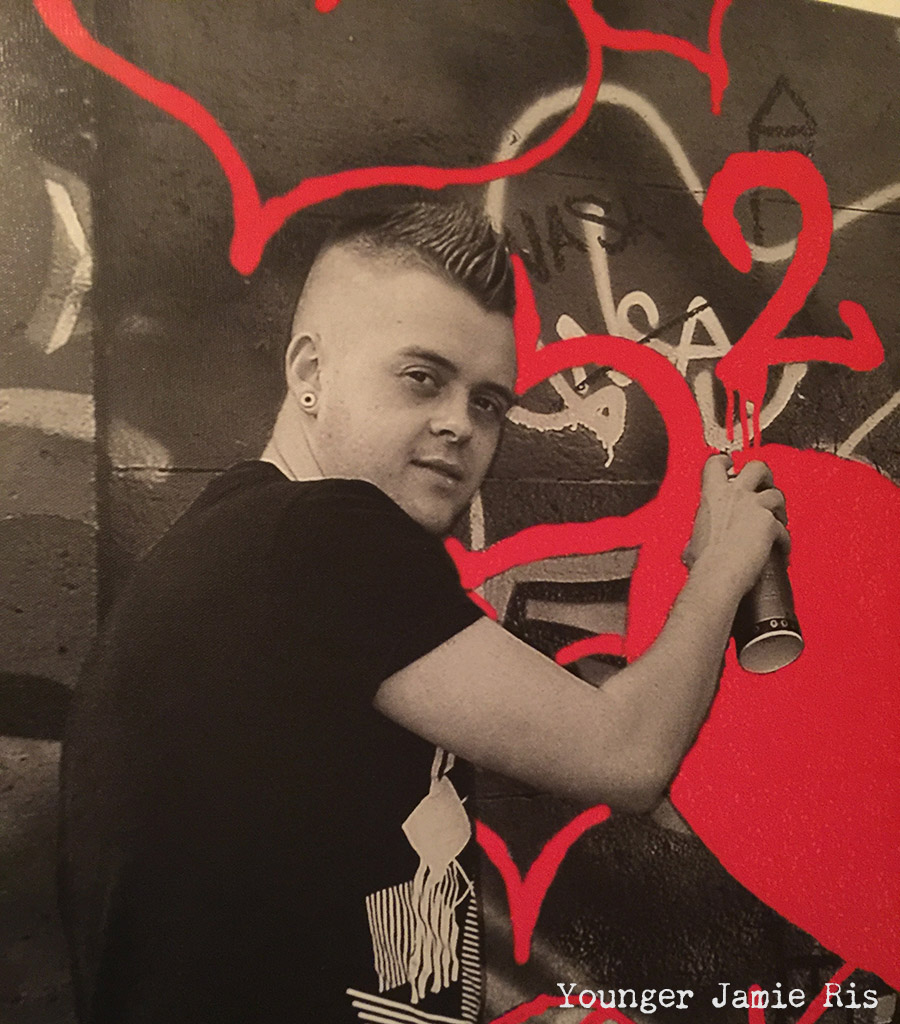
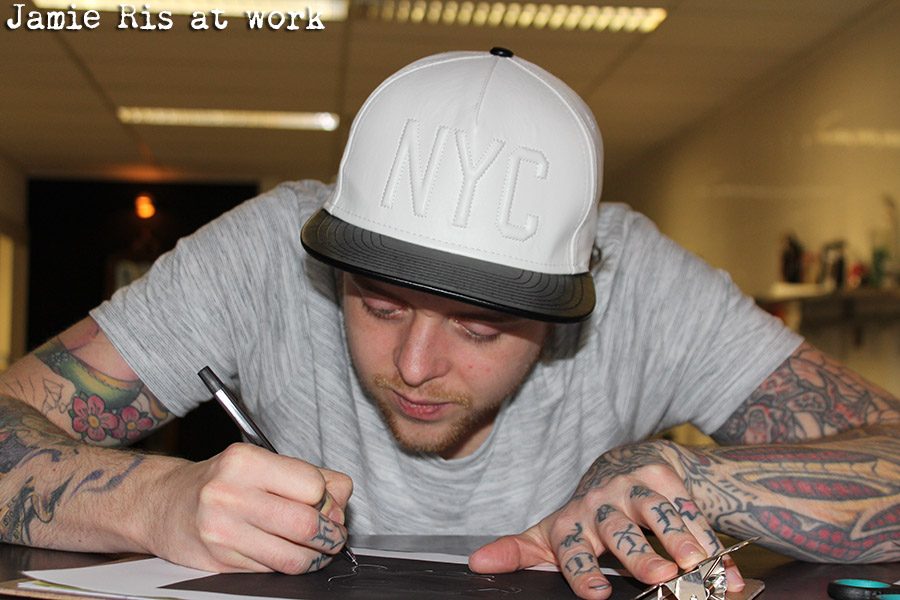
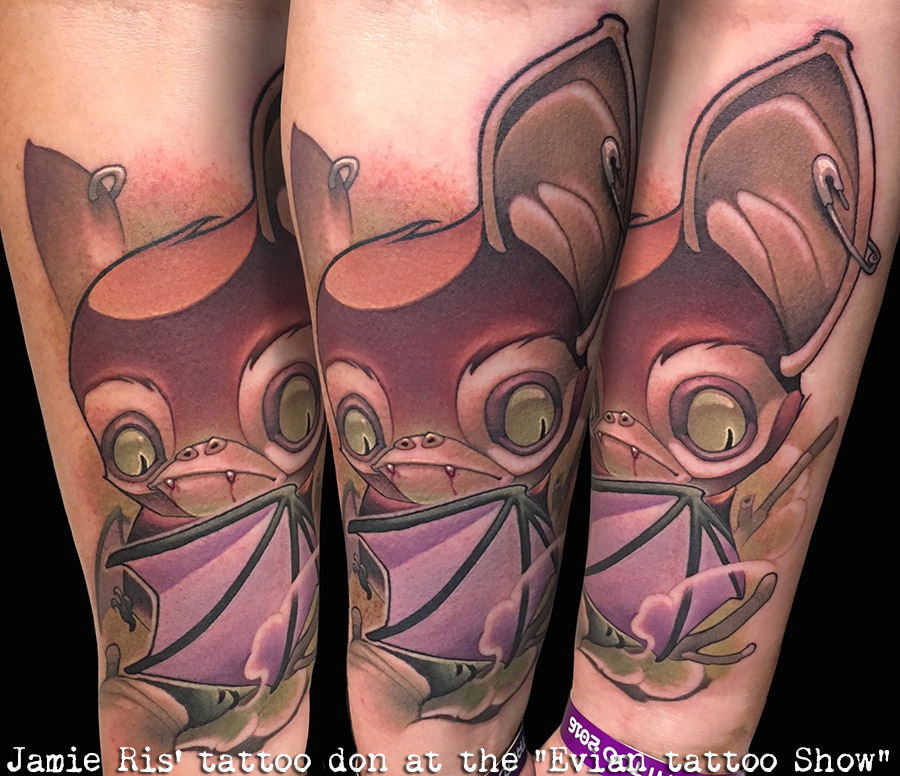
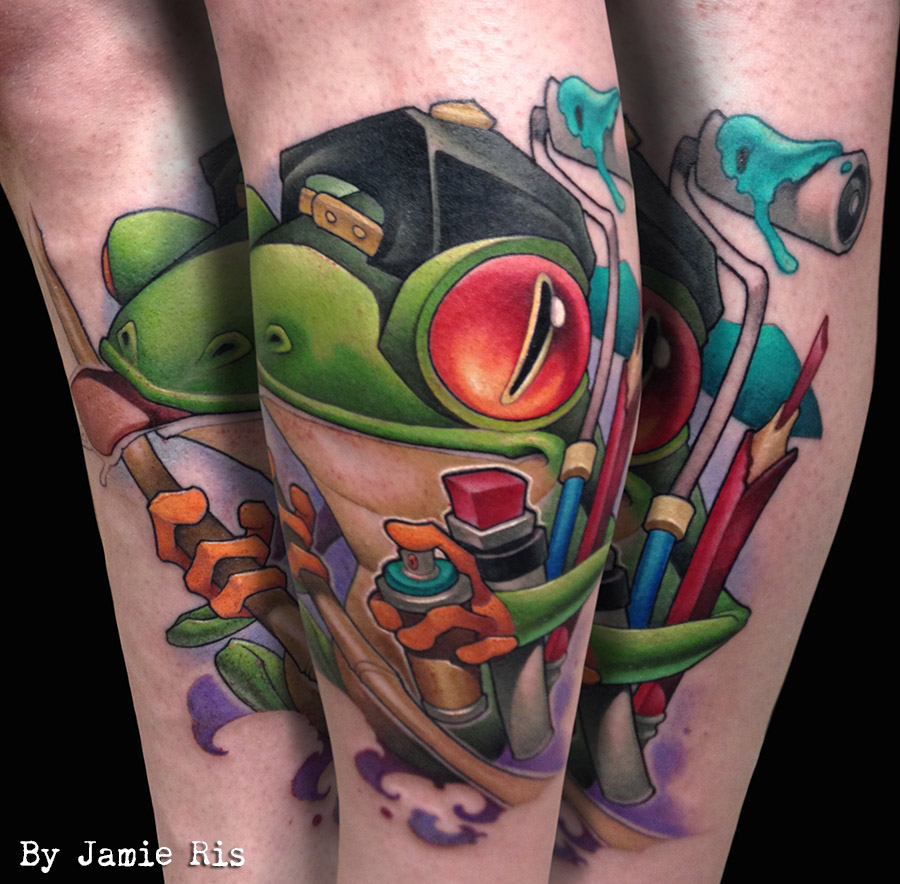
Jamie tattooed for the first time at the age of 10, on his dad. When he was a kid, he lived in Amsterdam and admired the graffities he could see passing by on the trains and quickly had an interest for this art more than tattooing. At nearly 13 years old, he started spraying everything he could, he also joined a crew but we won’t speak of that, as a precaution to avoid the cops showing up at Dogstar Tattoos. From 16 to 20 years old, he helped out his dad at the shop and started drawing for the customers without really getting into the tattoo world.
But one day, a regular customer asked him « Since you did the drawing, why don’t you do the tattoo as well ? » Jamie then went from pencils to the tattoo gun.
At around 23/24 years old, he really took an interest in tattooing, with the birth of social networks. He discovered on « Myspace » the work of Bez from the studio « 666 » in England and other artists from all around the world. « It wasn’t really about the inspiration but more about their technic which was a breakthrough » he tells us. With tattooing taking more of his time, Jamie gave up graffiti.
Ris family
His father is his mentor: he taught him how to tattoo, showed him lots of tattoo artists, but also comics artists and sculptors. Jamie searches most of his inspiration from other forms of arts than tattooing.
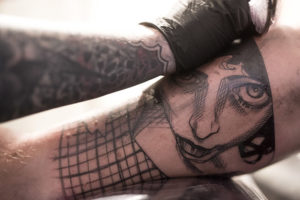
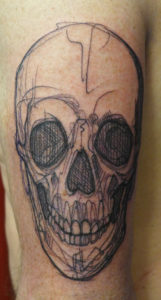
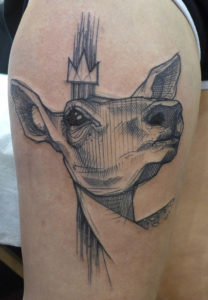
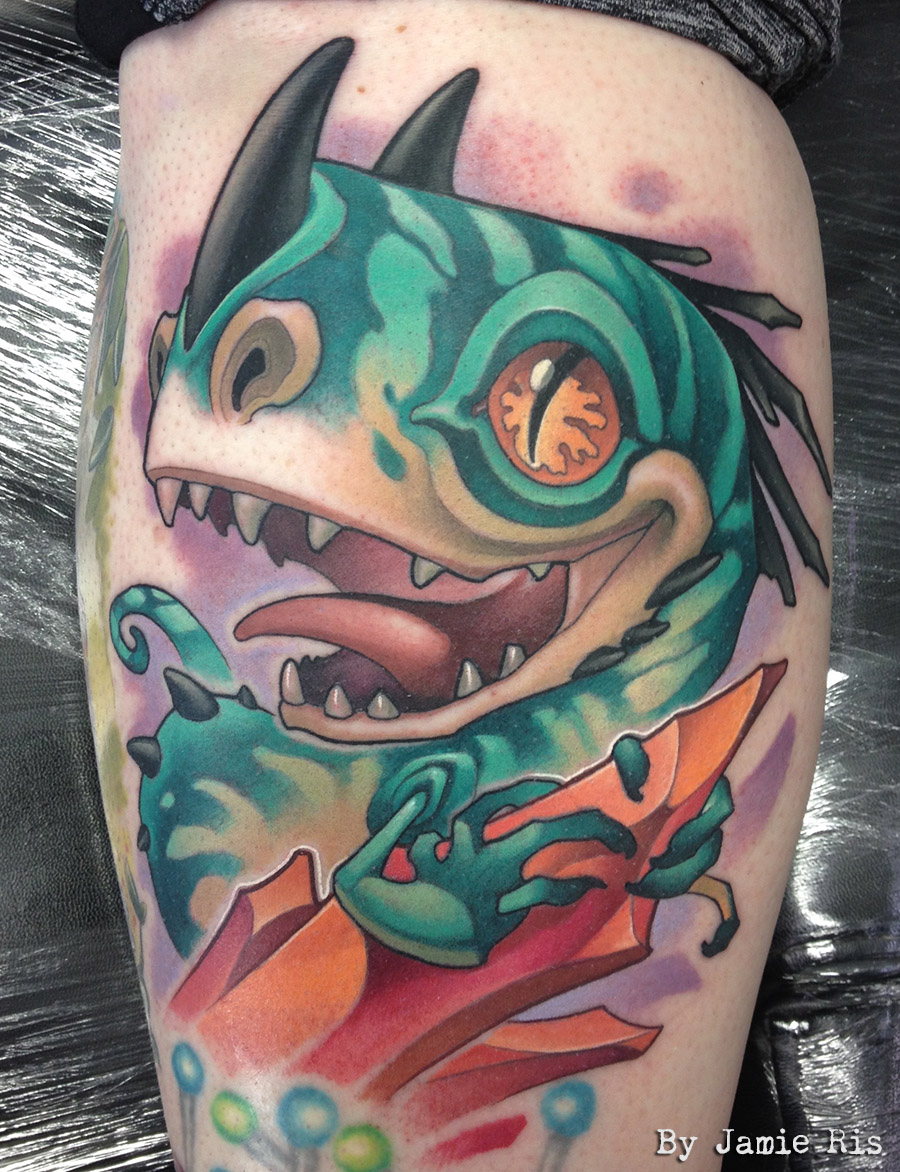
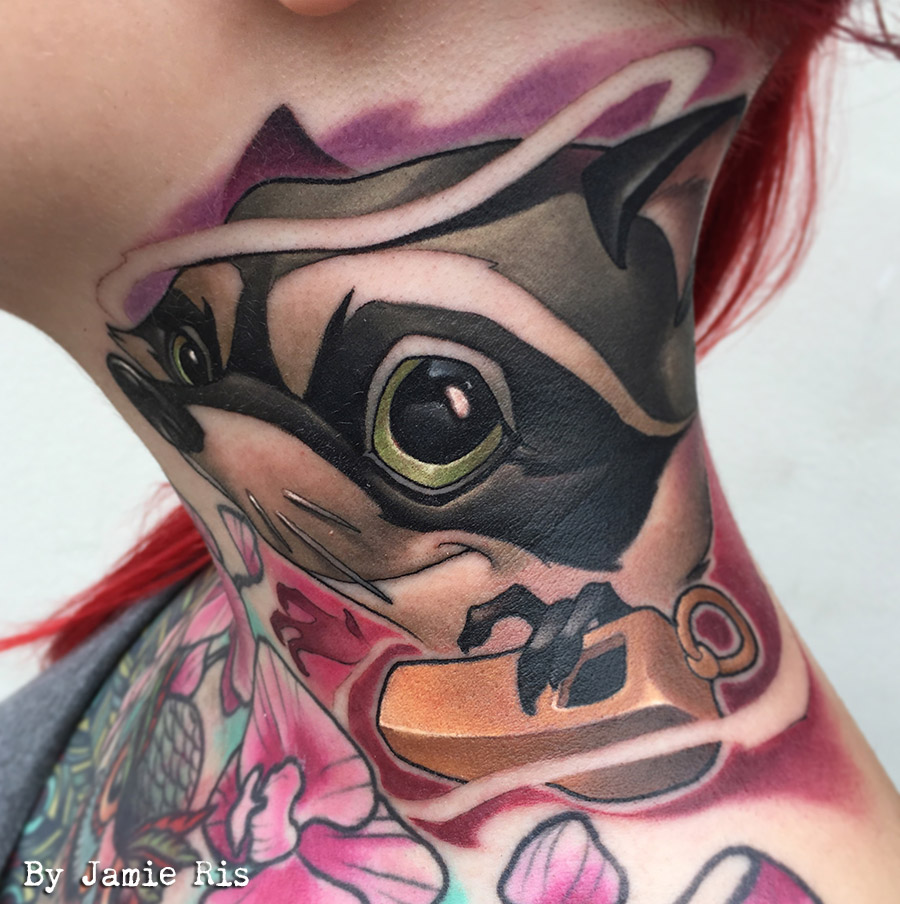
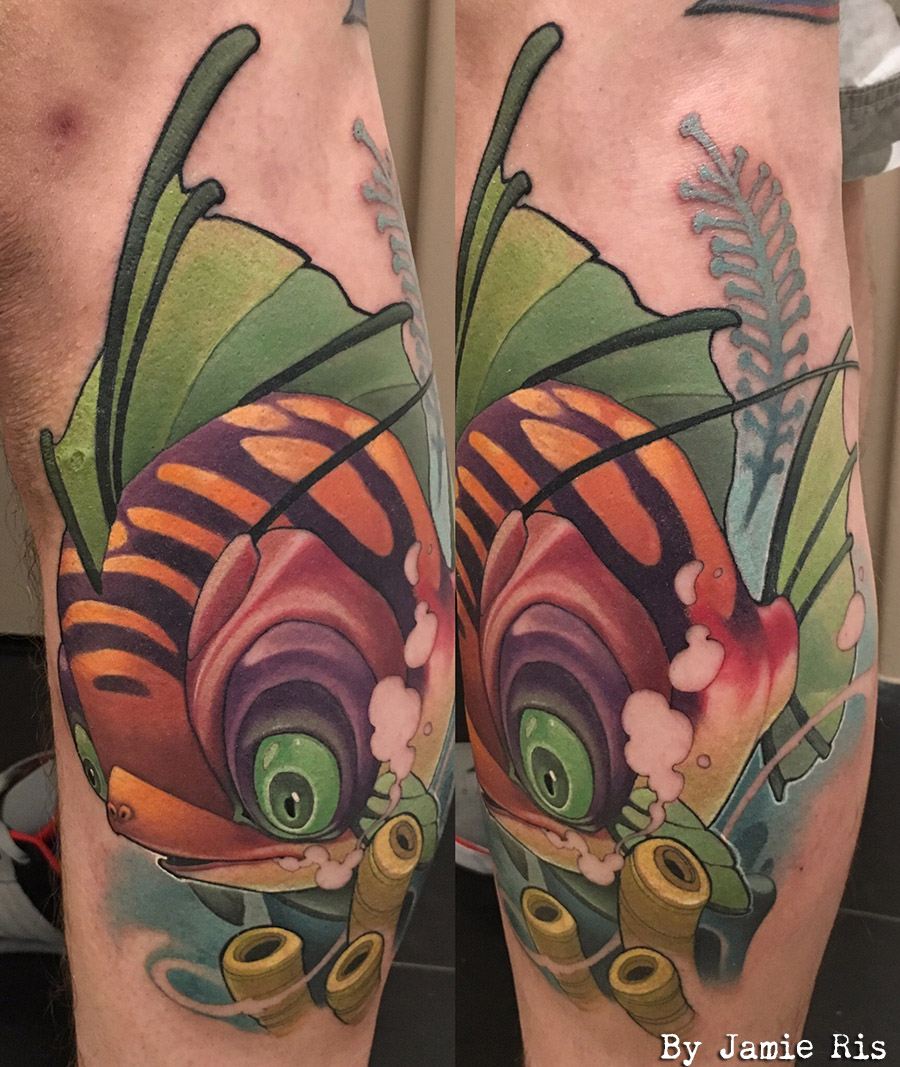
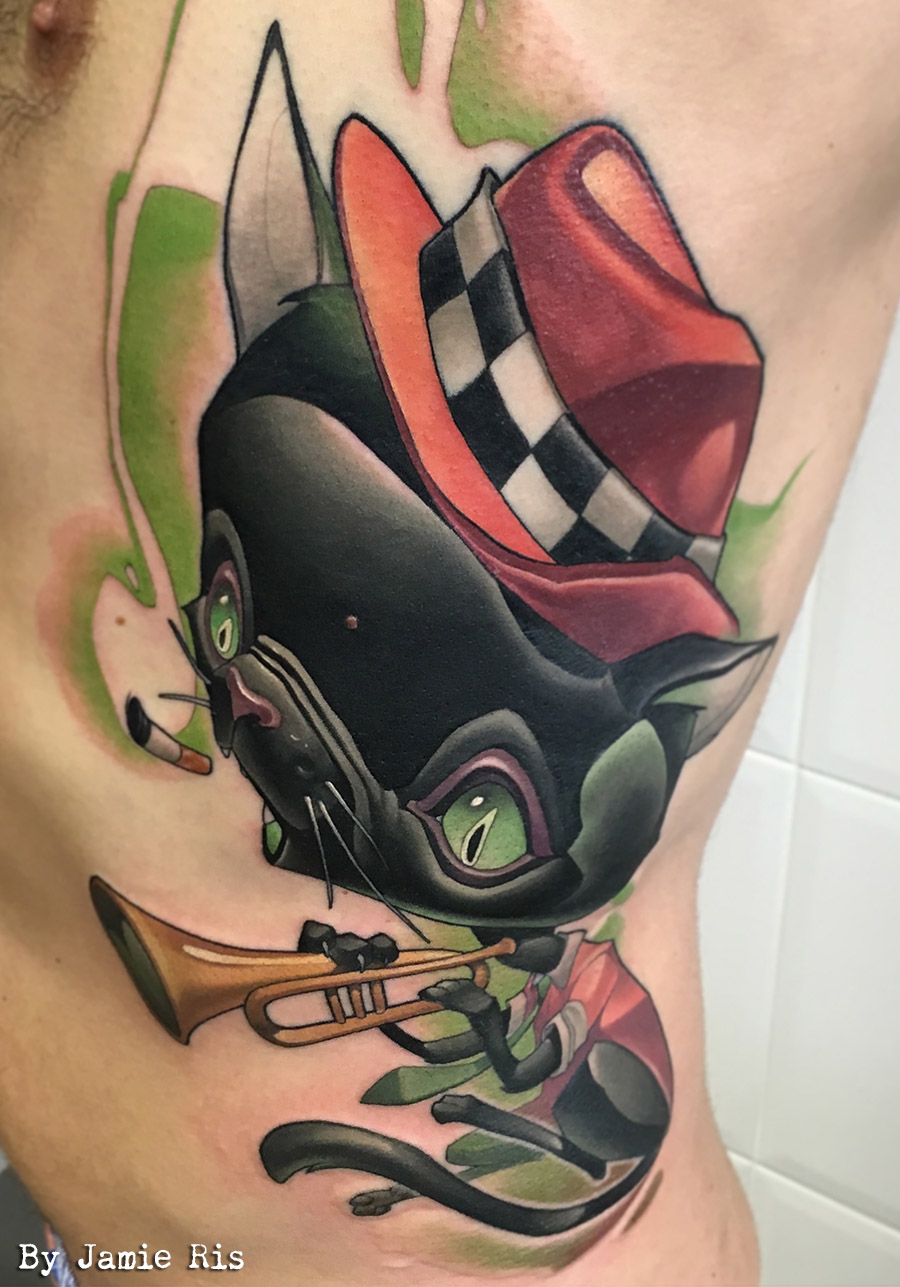
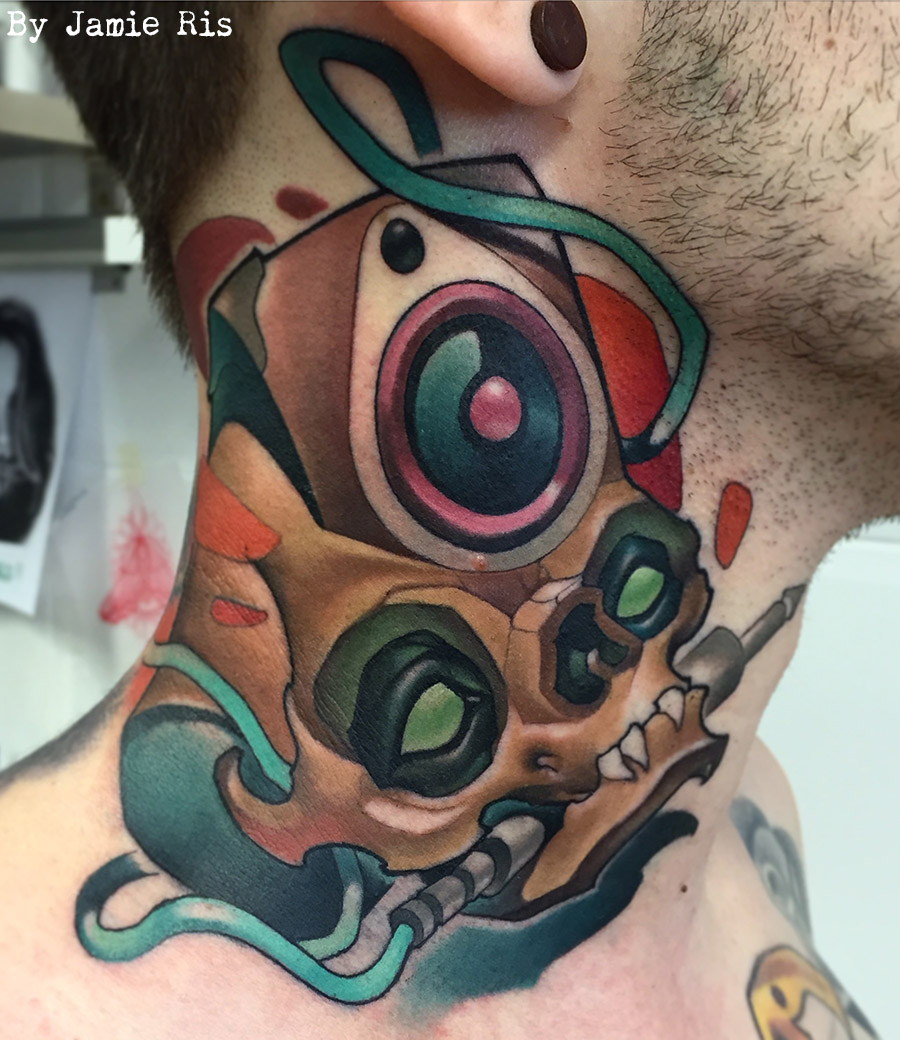
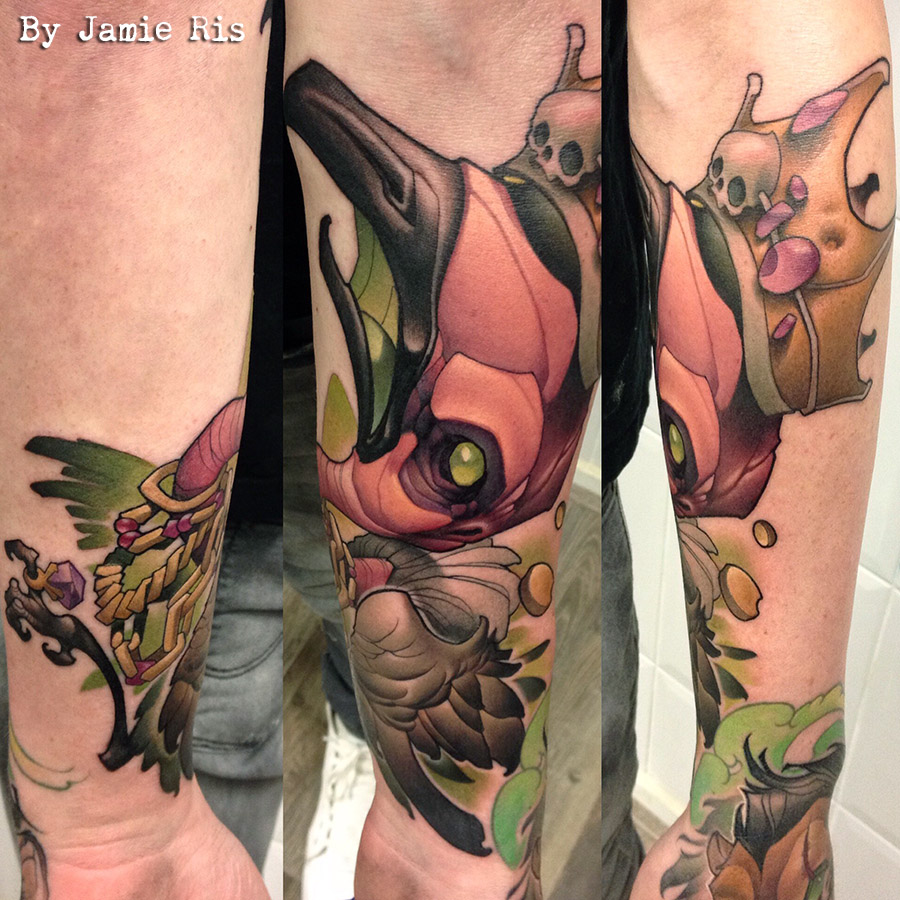
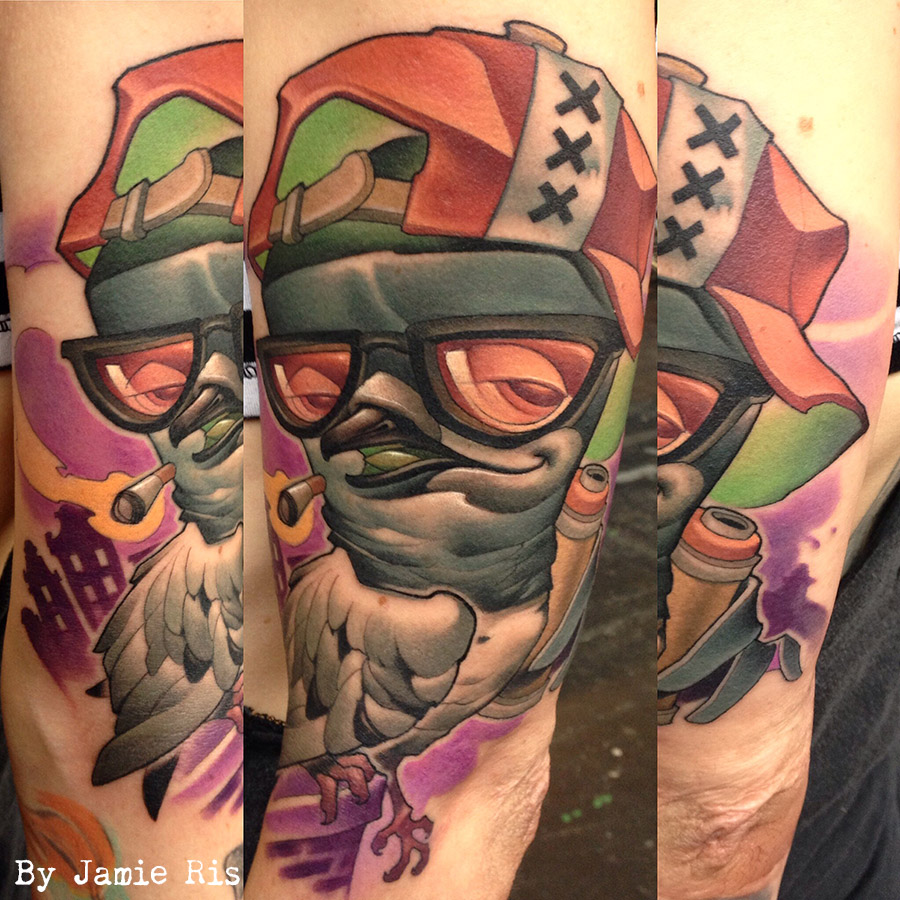
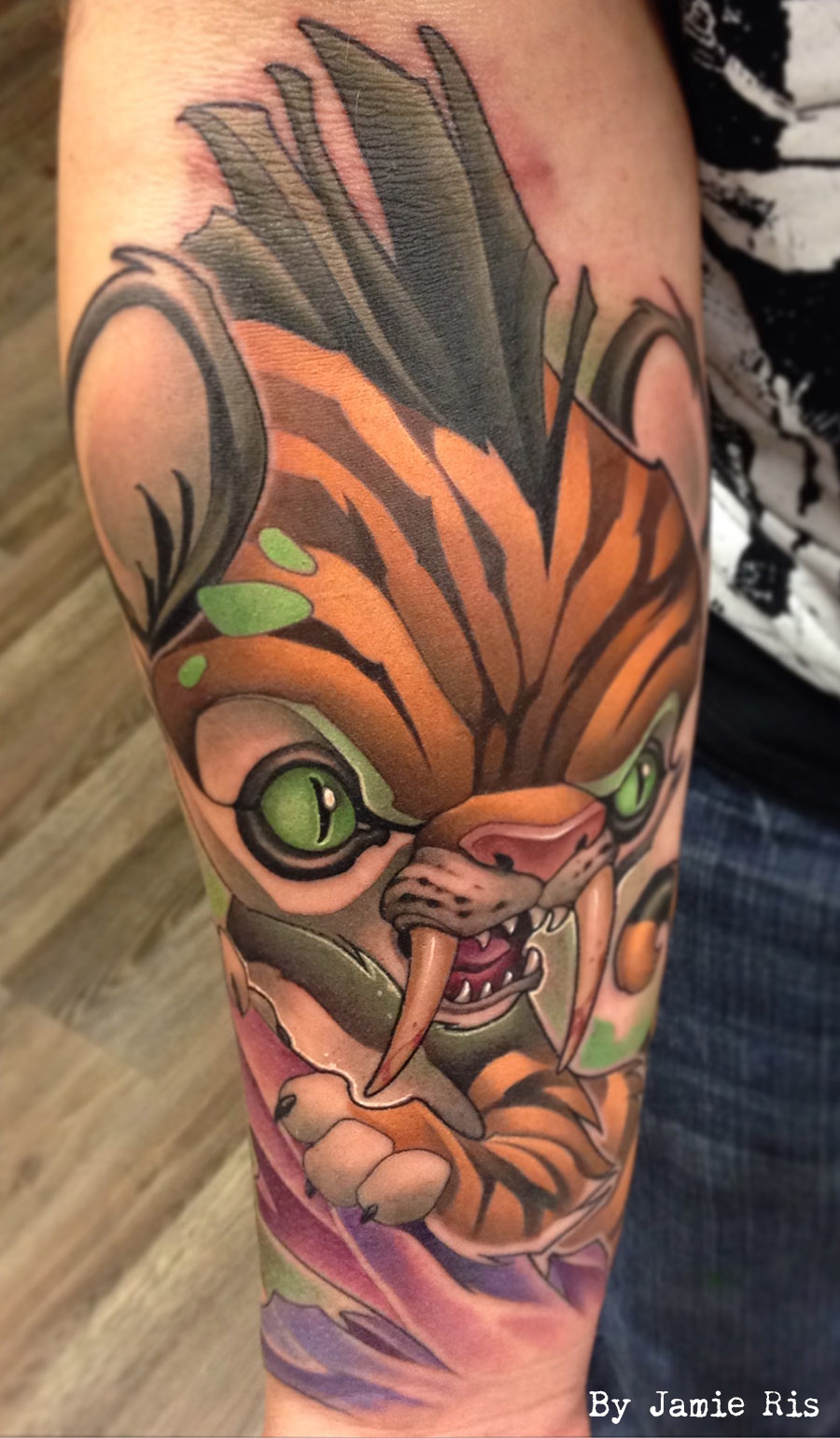
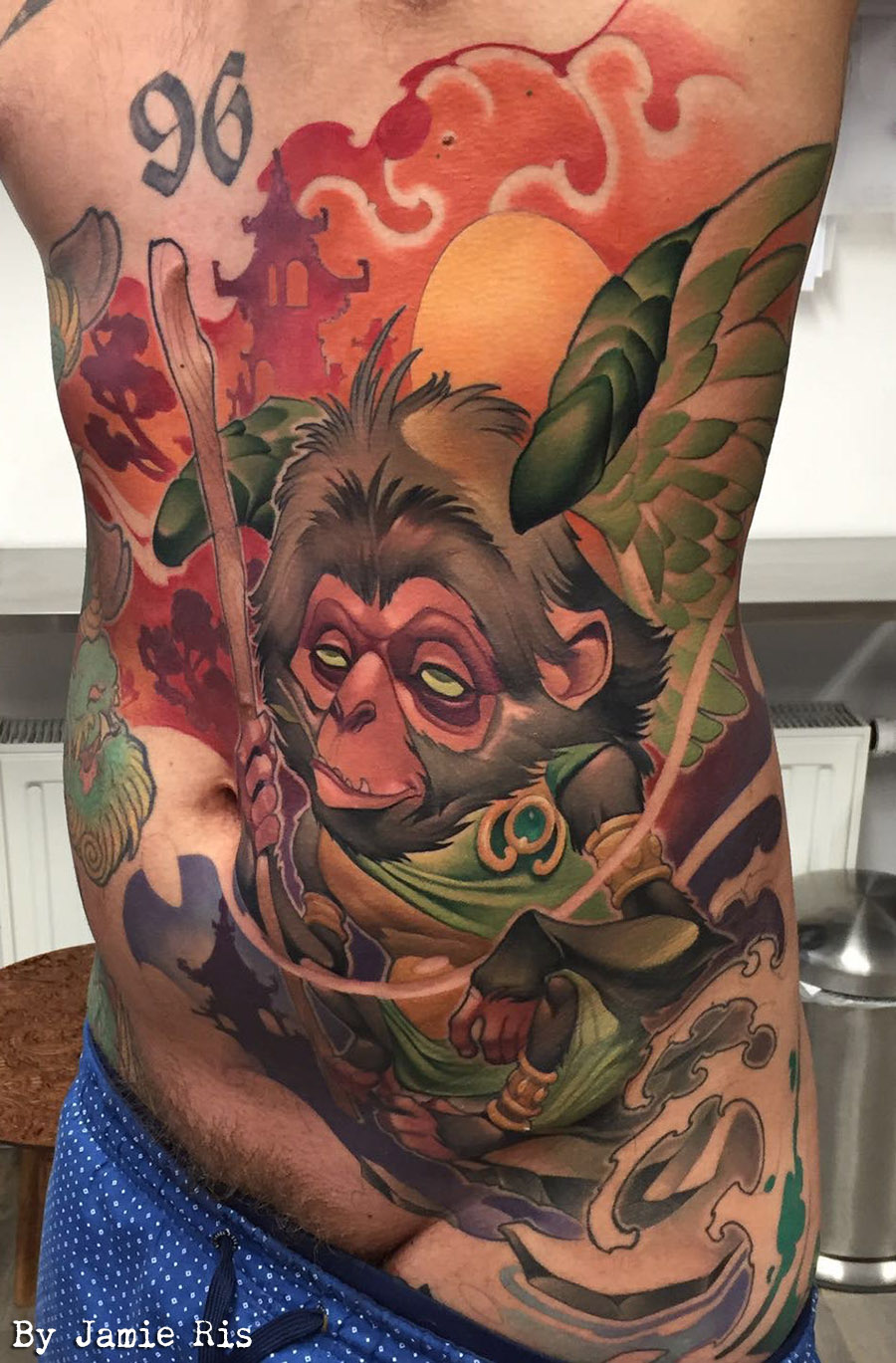
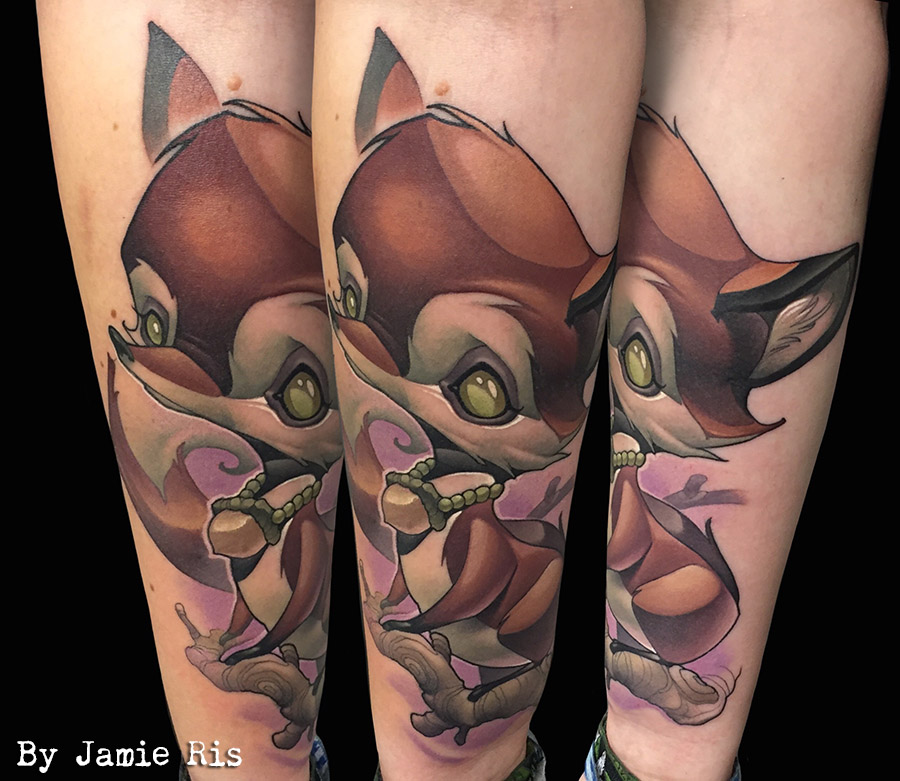
« In the « newschool » world, every artists knows each other. We’re all connected and so inspire each other, but sometimes when you look at something totally different from the tattoo world, you can find new ideas » he reveals to us. Graffiti is one of his influences. He admires the work of Born. K, Daim, Kram, Seak as well as many others. In digital art, he really likes the work of Jorge Sefy and Ryan Woods. Among the tattooists, he follows the creations of Timmy B., Victor Chil, Logan Barracuda, Tanane Whitflied, Kelly Doty, Tony Ciavarro and a ton of others. His style, mainly influenced by his humour and his overflowing imagination is really original.
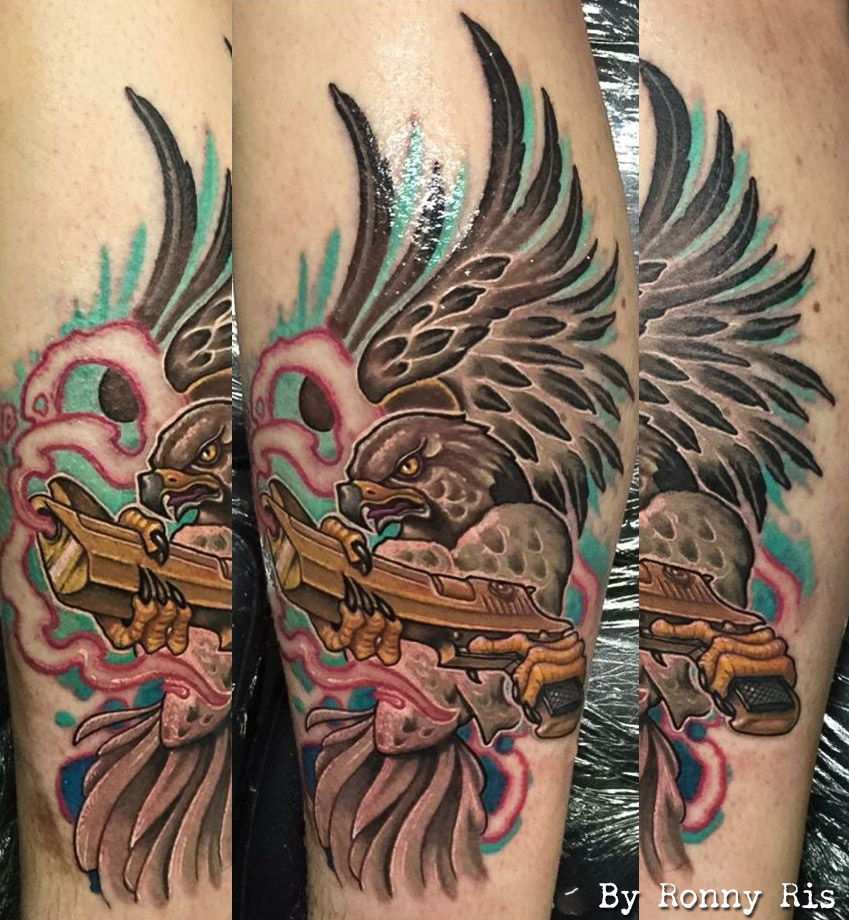
The Ris dynasty doesn’t stop there.
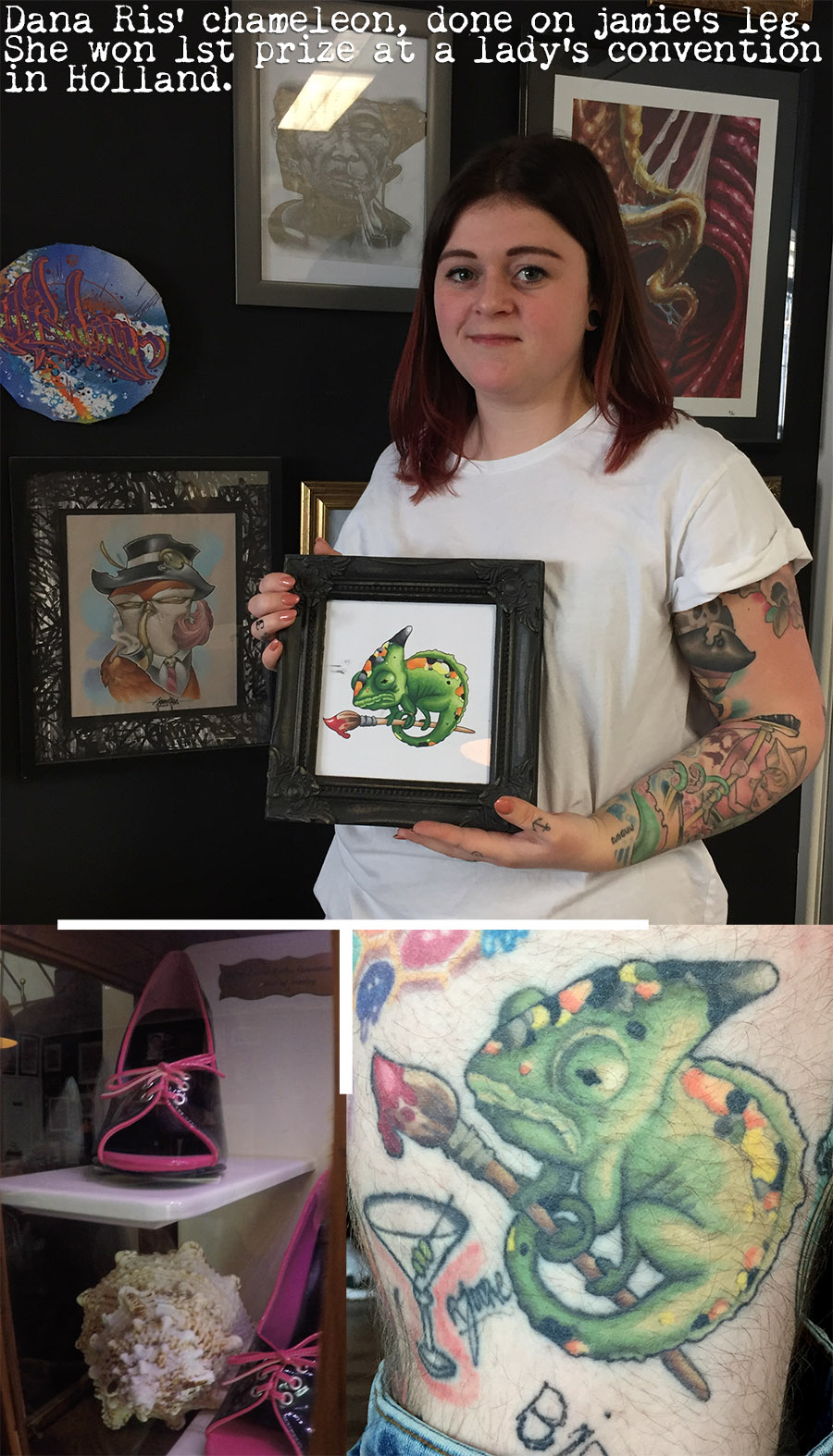
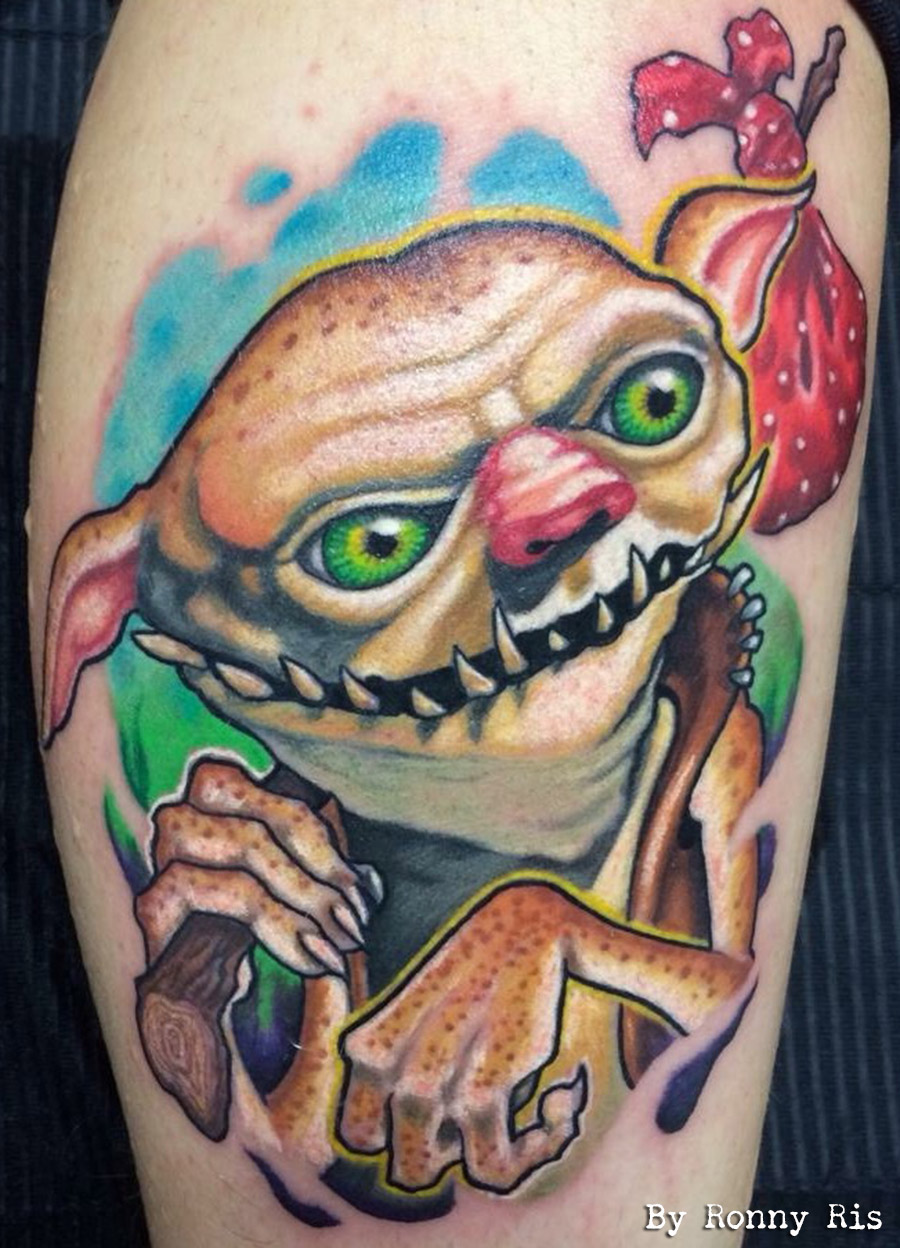
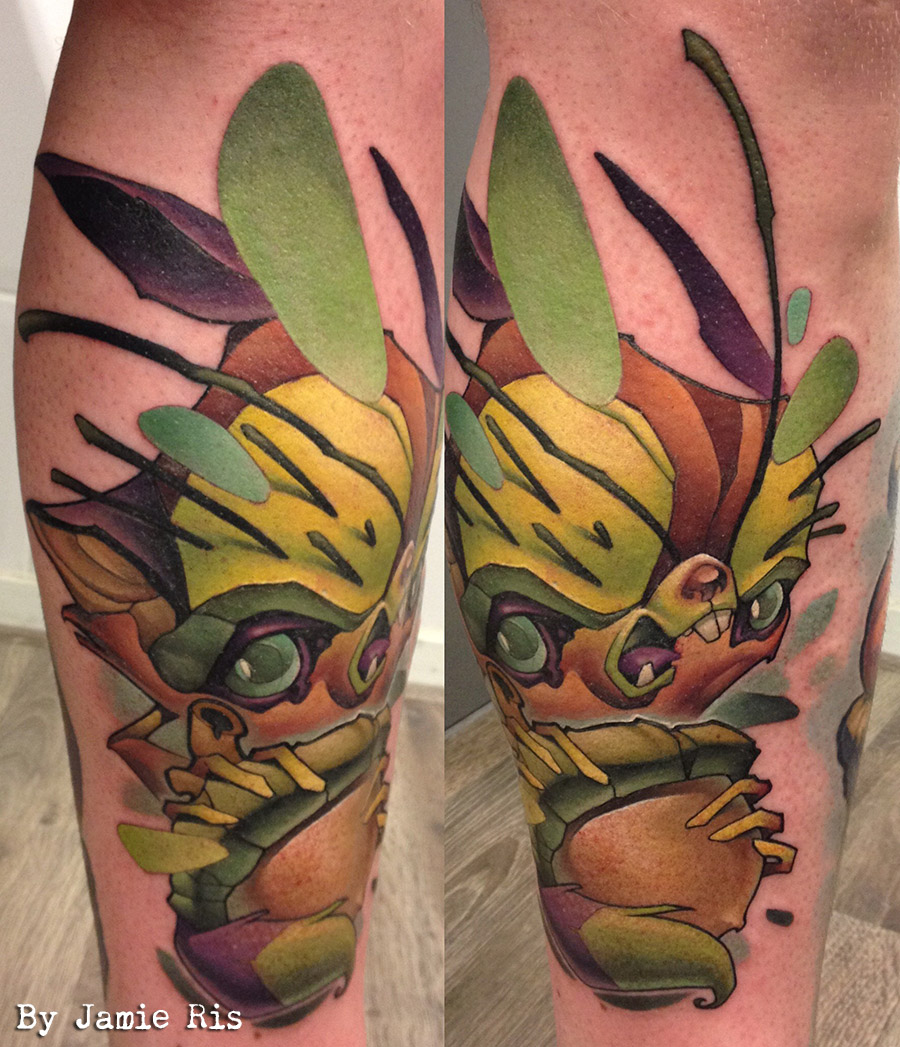
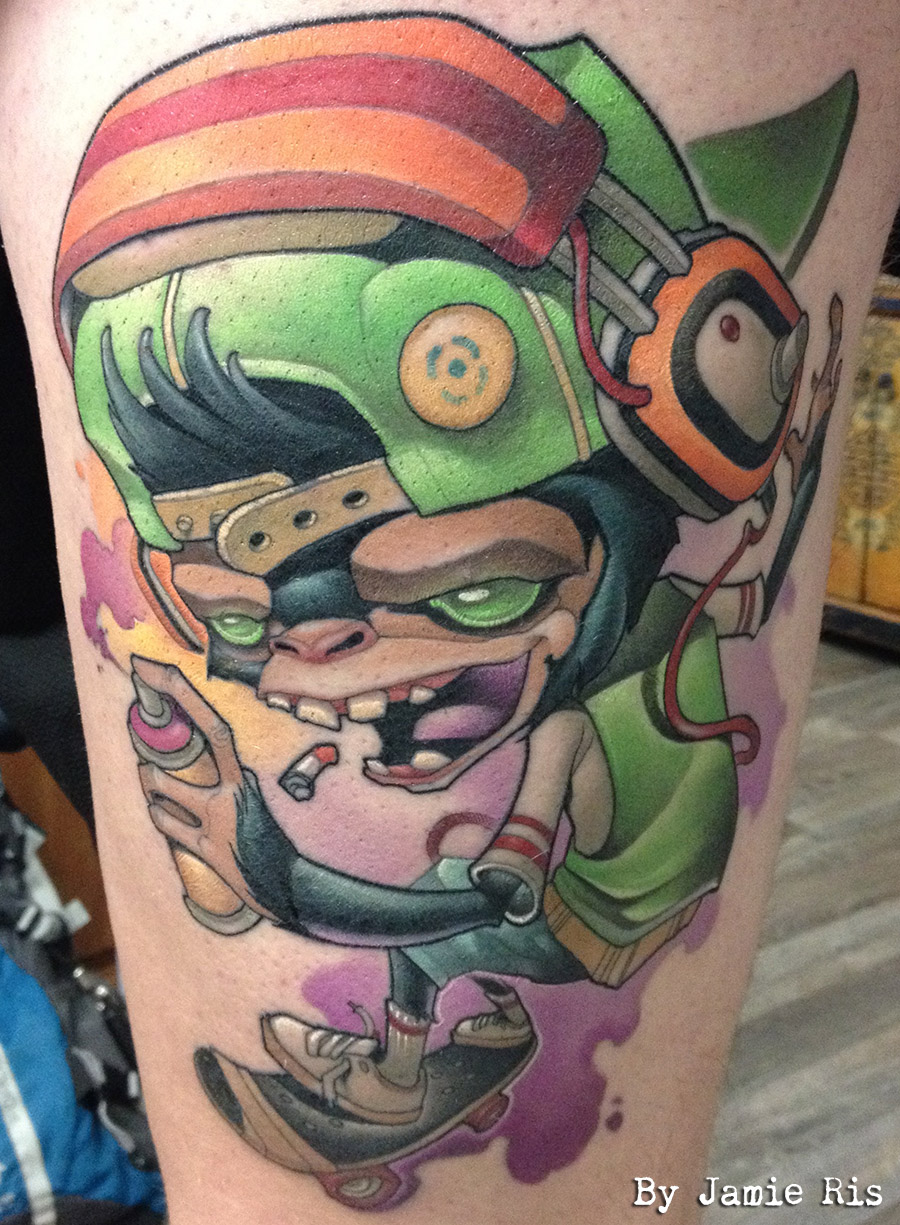
Dana, Manuela and Ronny’s daughter took Jamie’s place at the reception and like the others, she also does some tattoos from time to time. Dana was rewarded for a cartoon chameleon on Jamie’s leg that she did at a convention gathering only female tattoo artists.
The beginning of a promising career.
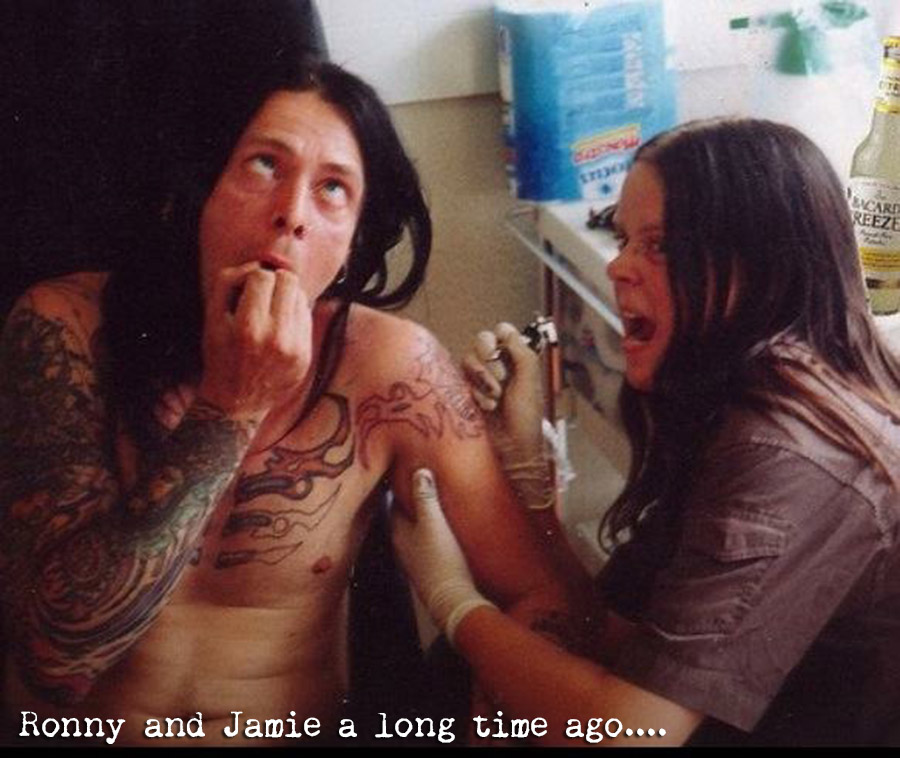
Cody, the youngest, already tattooed his brother Jamie at the age of 5 and his father the following year. The (lineage?) continues.
When we asked Ronny Ris what he thought about the evolution of tattooing these last twenty years, he replied :
« People are more aware of what’s possible, of all the different styles, so now tattooists can specialise in a particular style, they can focus more on what’s coming from the heart as an artist. At the time, you had to practice every style in order to work every day, we didn’t have a choice. What’s more interesting as well is that customers come in with bigger, more elaborated projects. But now, everyone tends to come into a tattoo shop as easily as any other store, there’s no more barriers. Before you had to have the balls to come into a tattoo shop, the atmosphere was dark and mysterious. Now it’s really open. We’ve lost a bit of the magic. »
A high-tech team : every « Dogstar » tattoo artist draws on a digital tablet, we discuss the technological progress which helps tattooing. Ronny explains to us that before, he had a workshop filled with equipment, spray cans, brushes, crayons, paints, easels, etc. He threw everything away and now has his whole workshop in his bag. « I love the digital era, it has brought our creativity to a whole new level, you have to live with your time. It’s so much more practical. » he tells us.
« He who follows progress can evolve faster », he says while trying to translate a dutch saying. Jamie continues : « It’s just as if somebody was asking you to learn how to tattoo with coil machines instead of cheyenne or inkjectas or soldering your needles now. What is the point, we go faster with today’s gear. The tablet is kind of the same thing. The objective is to create what you have in your head, if inkjectas, cartridges or the Ipad can make it easier, then why not use it ?… What’s more important is to advance as an artist, what counts is the final result. People who want a painting or a tattoo don’t really care how you managed to do it, what interests them is the result. »
Ronny also says : « It doesn’t really matter, you have to know how to draw anyway, it’s not a technology that would allow you to vocally give commands like « Draw me a frog with a crown » and the next day the drawing is done. »
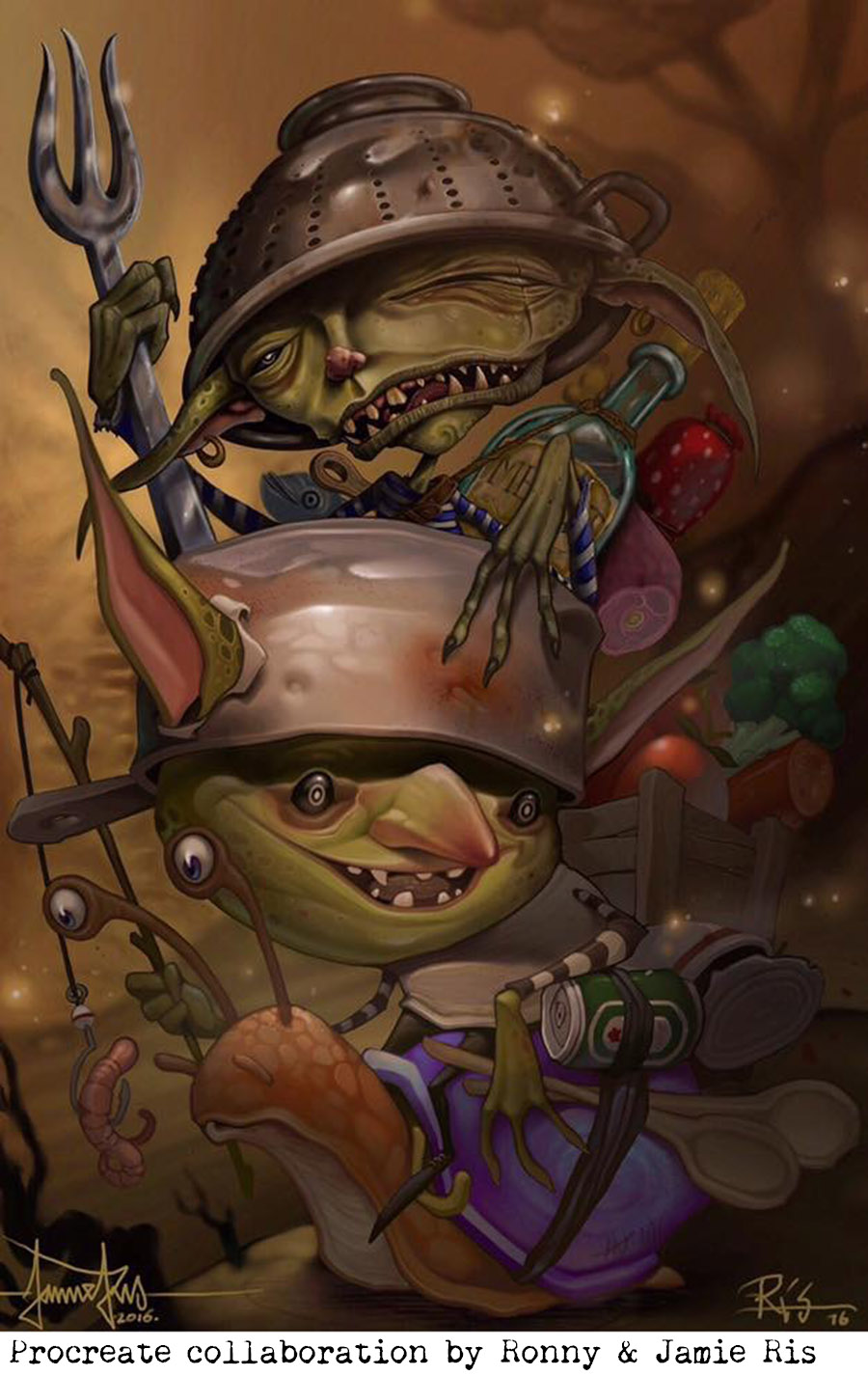
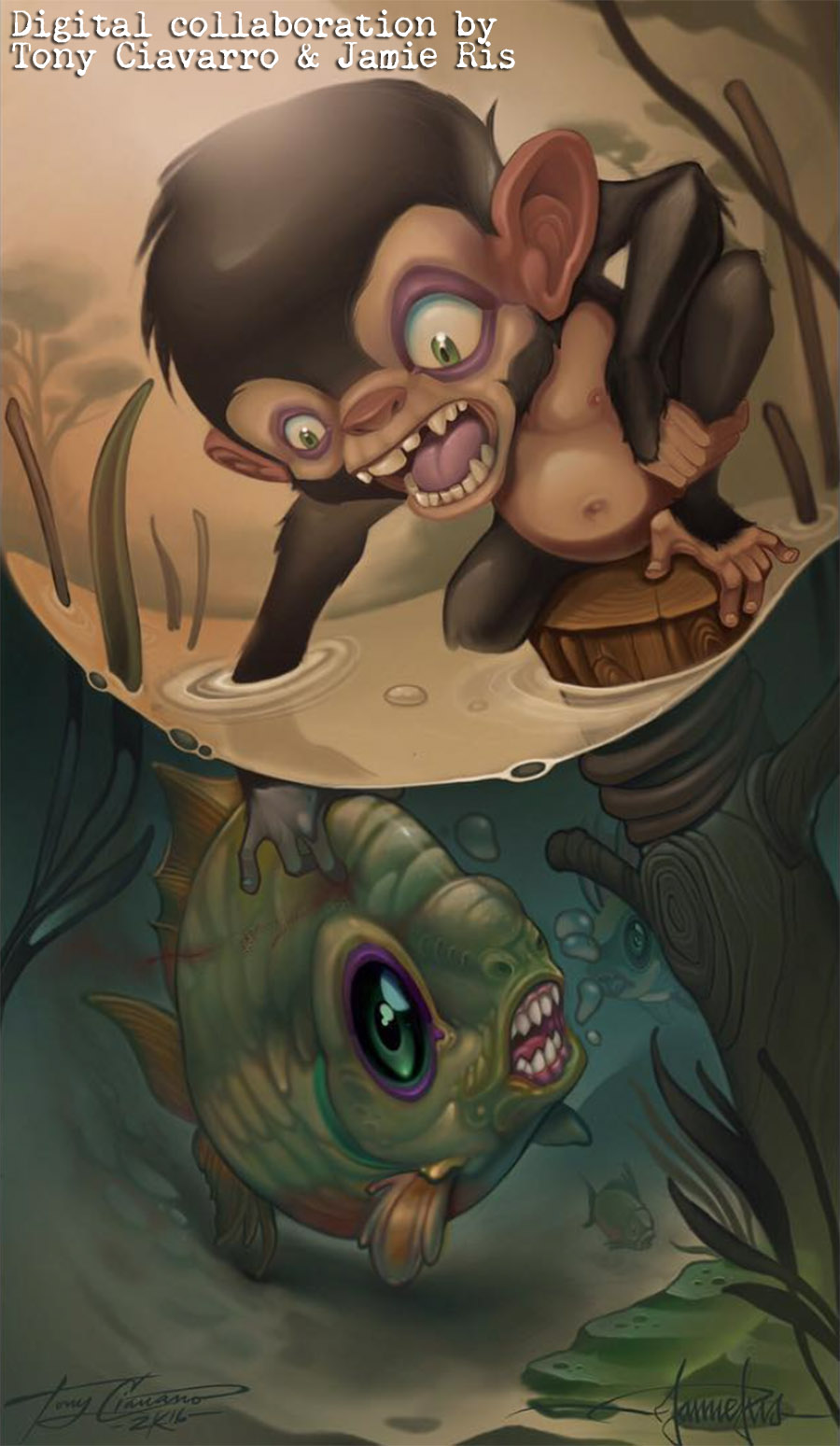
We have to admit that this kind of equipment opens new horizons. Such as the possibility to do collaborations with artists who live on the other side of the planet. For example, Jamie made two illustrations with pro create on the Ipad Pro with his friend Tony Ciavarro, who lives in Kingston in Massachusetts. There's quite a few kilometers between Holland and the USA.
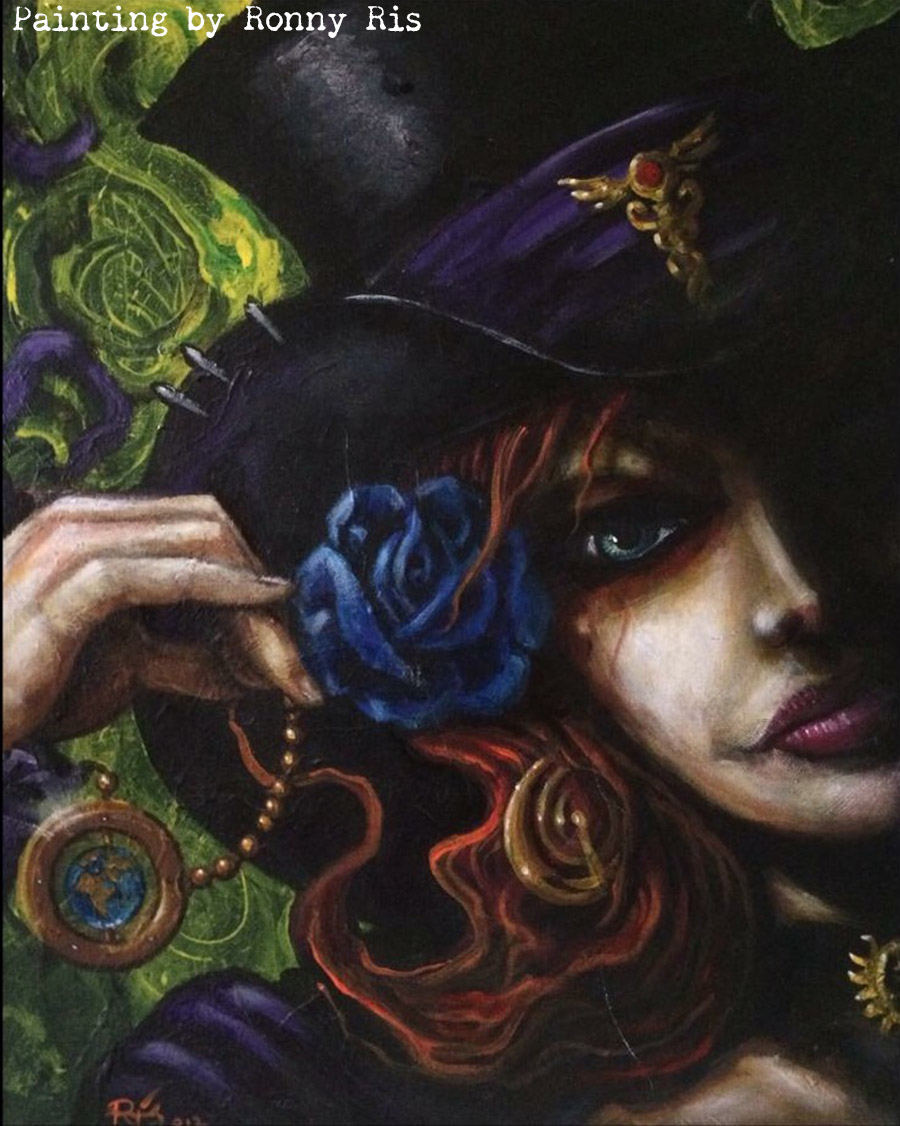
Of course, the arrival of the tablet doesn’t mean that the « Dogstar » artists don’t work with other mediums. If you go on their instagram and facebook pages you’ll be able to admire their numerous illustrations made with acrylic and other ustensils.

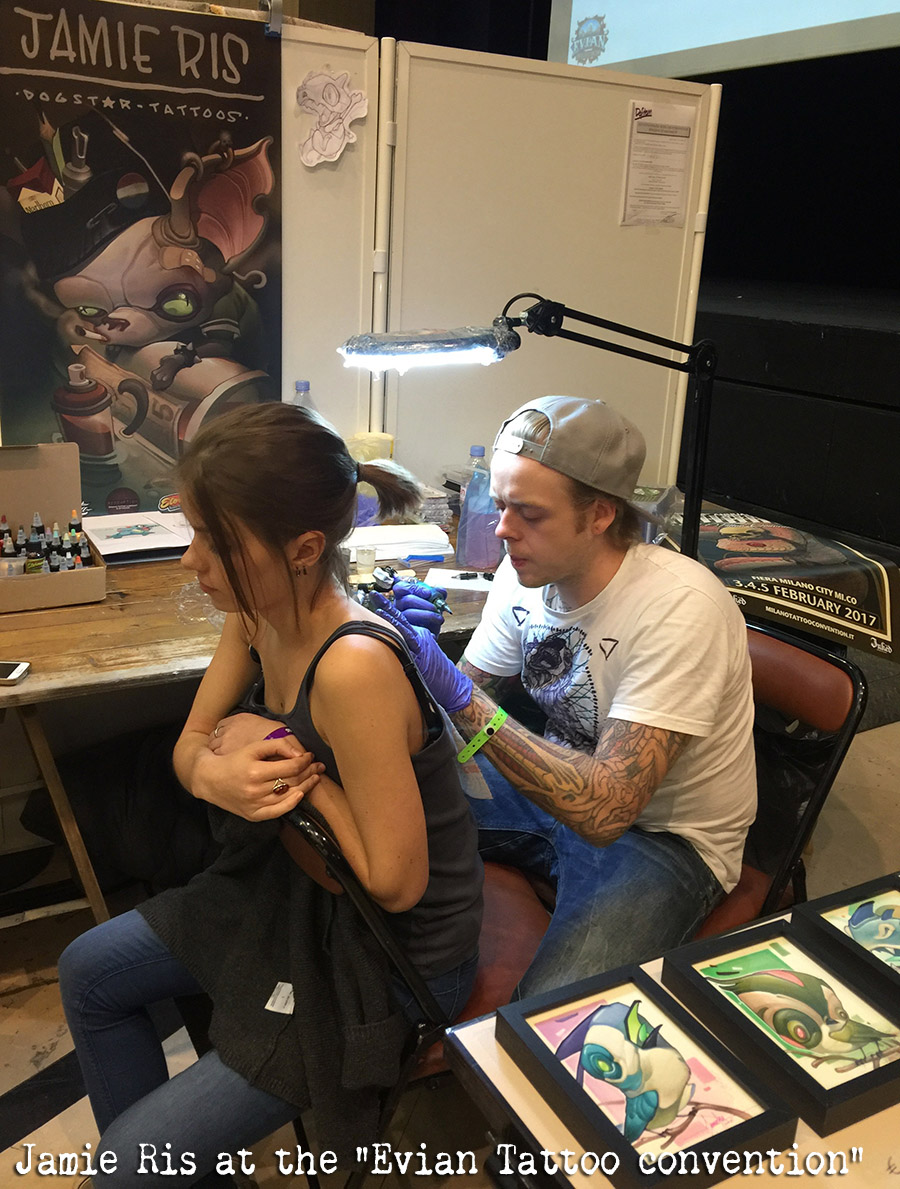
The cartoon style, very colored and the great technical qualities of Jamie Ris allowed him to participate in many tattoo conventions all around the globe. This allowed him to make many encounters and make new friends who sometimes pay him a visit in Aalsmeer.
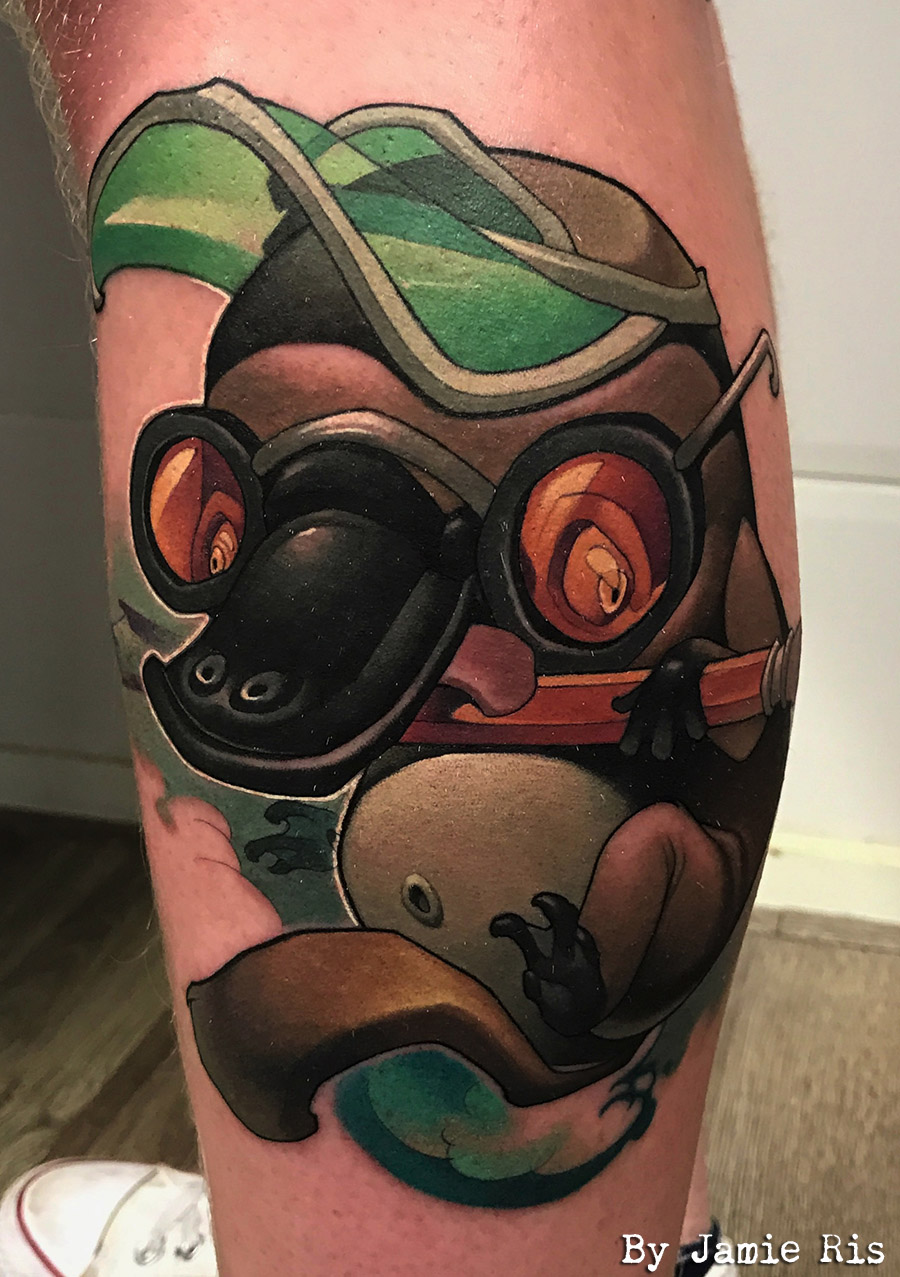
« Dogstar Tattoos » as well as having very good tattoo artists within its walls, also has the luxury of welcoming guest artists of international renown such as Timmy B., Kelly Doty, Teresa Sharpe, Leo Valverde, Nathan Evans, etc etc.
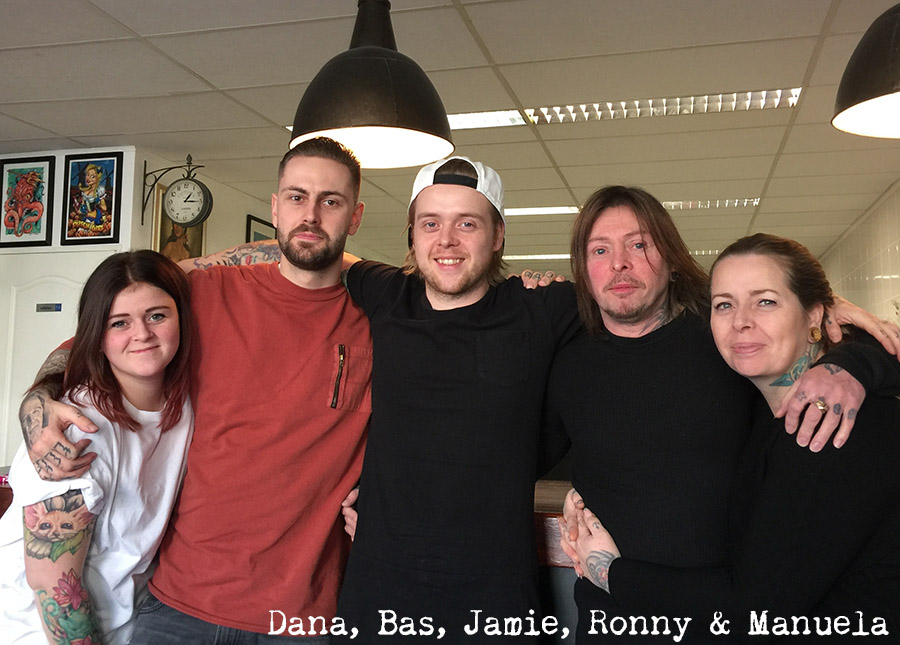
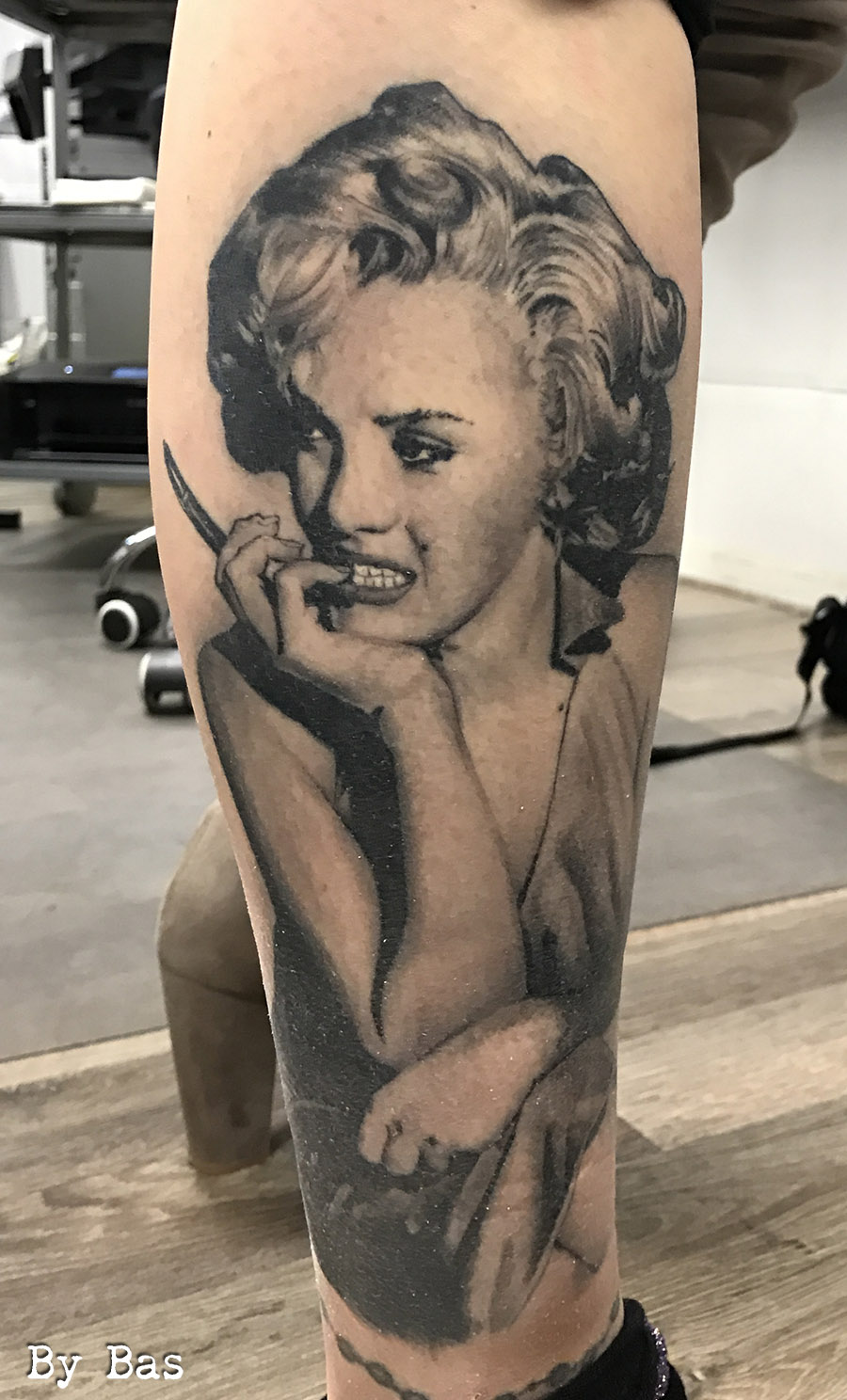
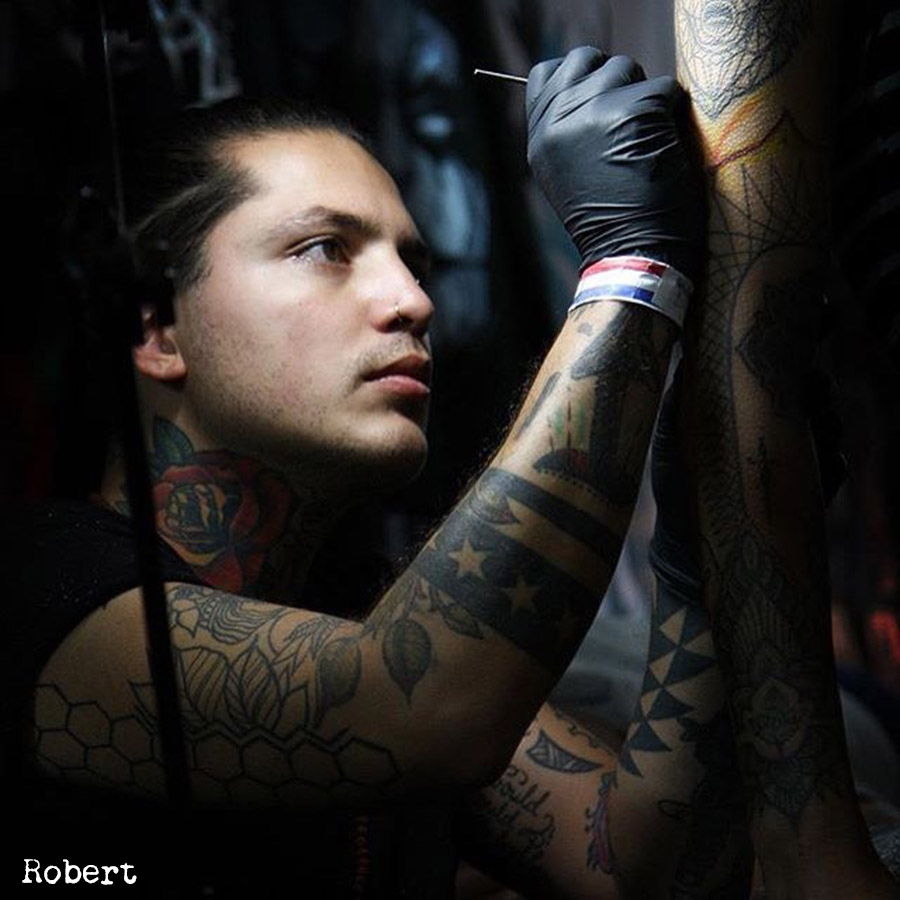
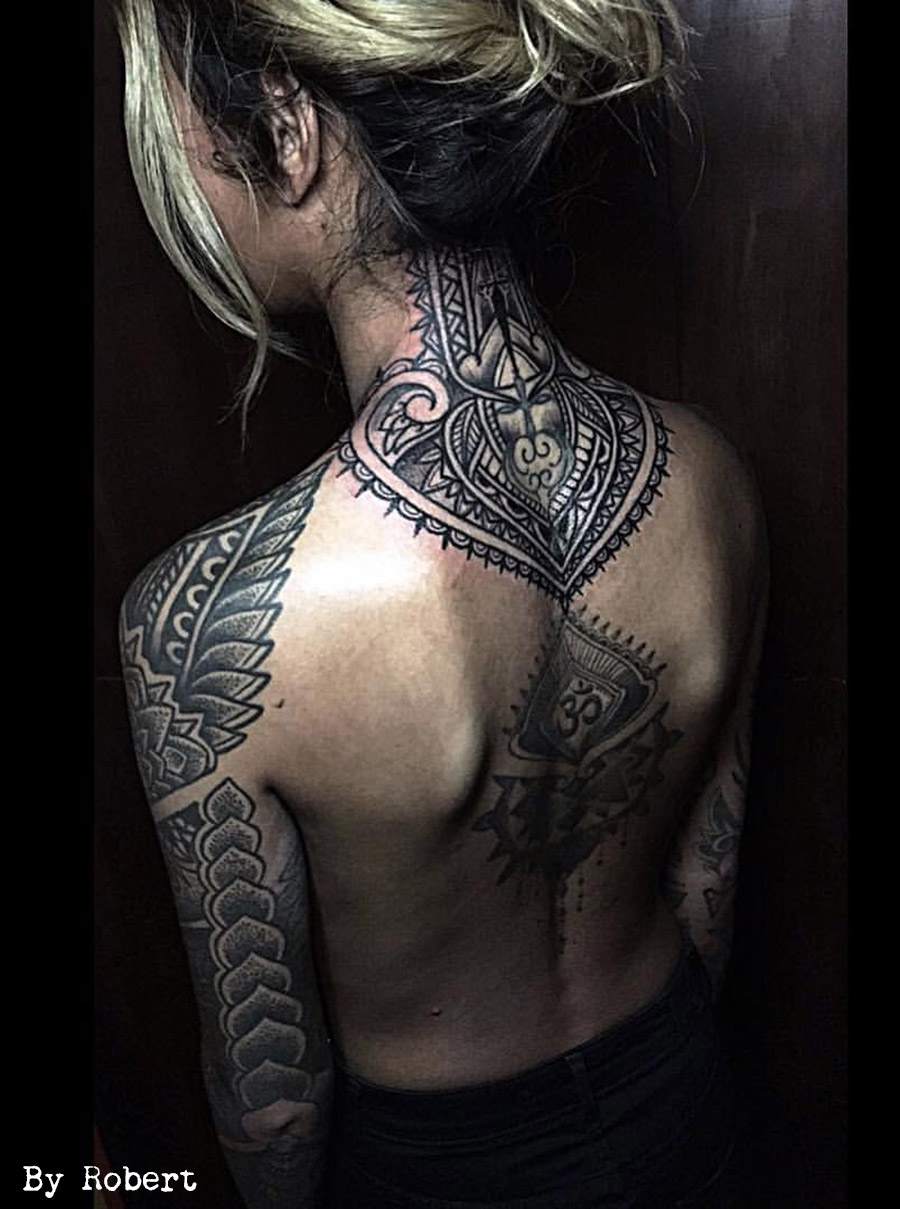
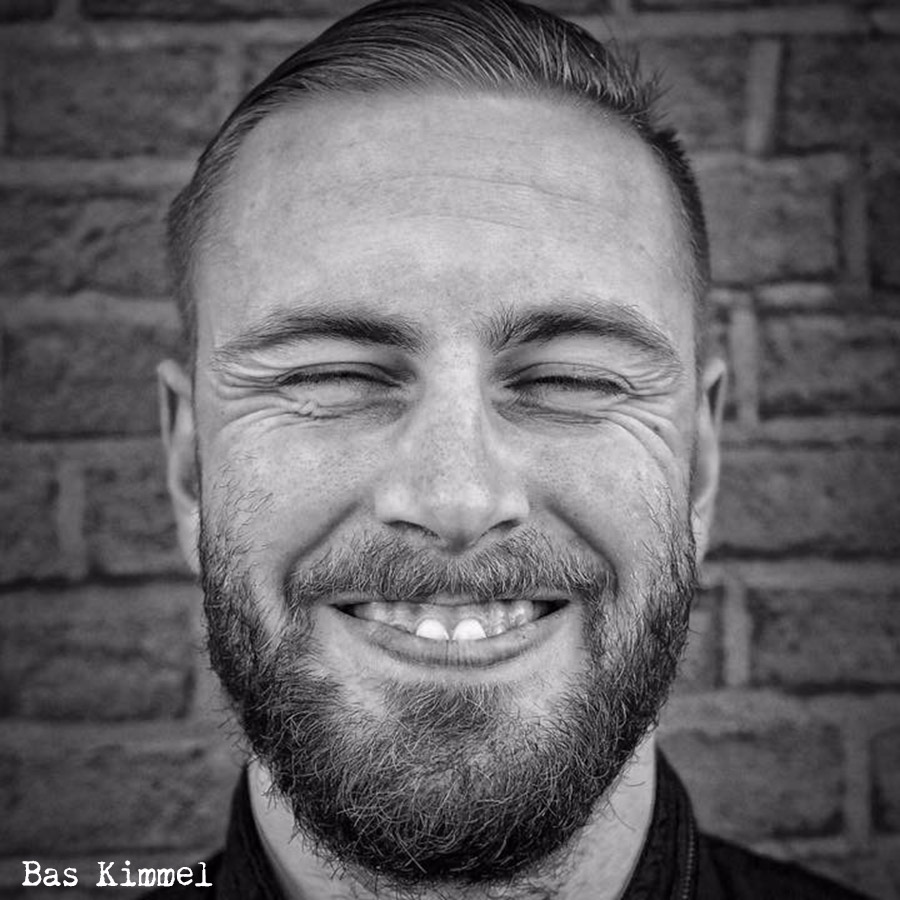
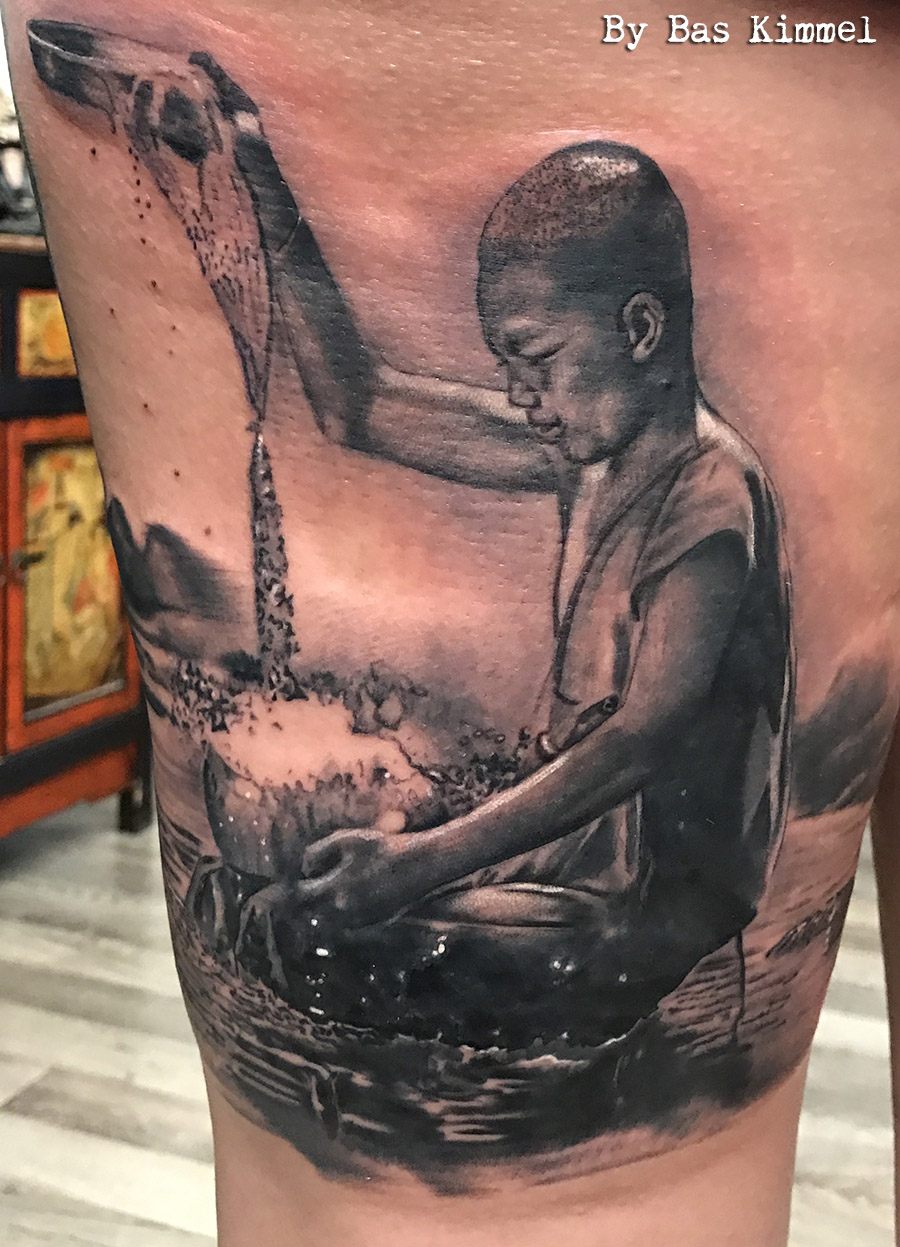
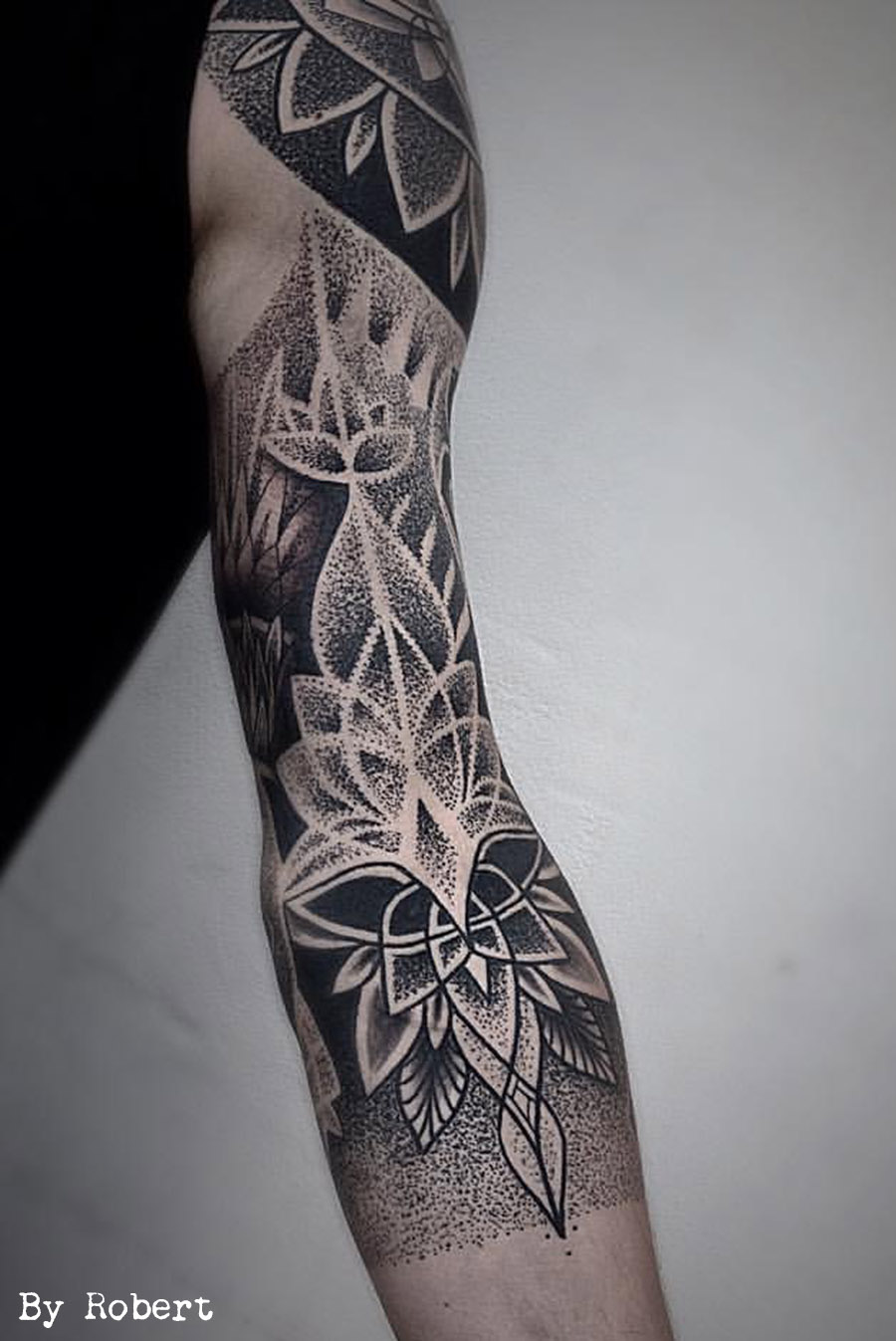
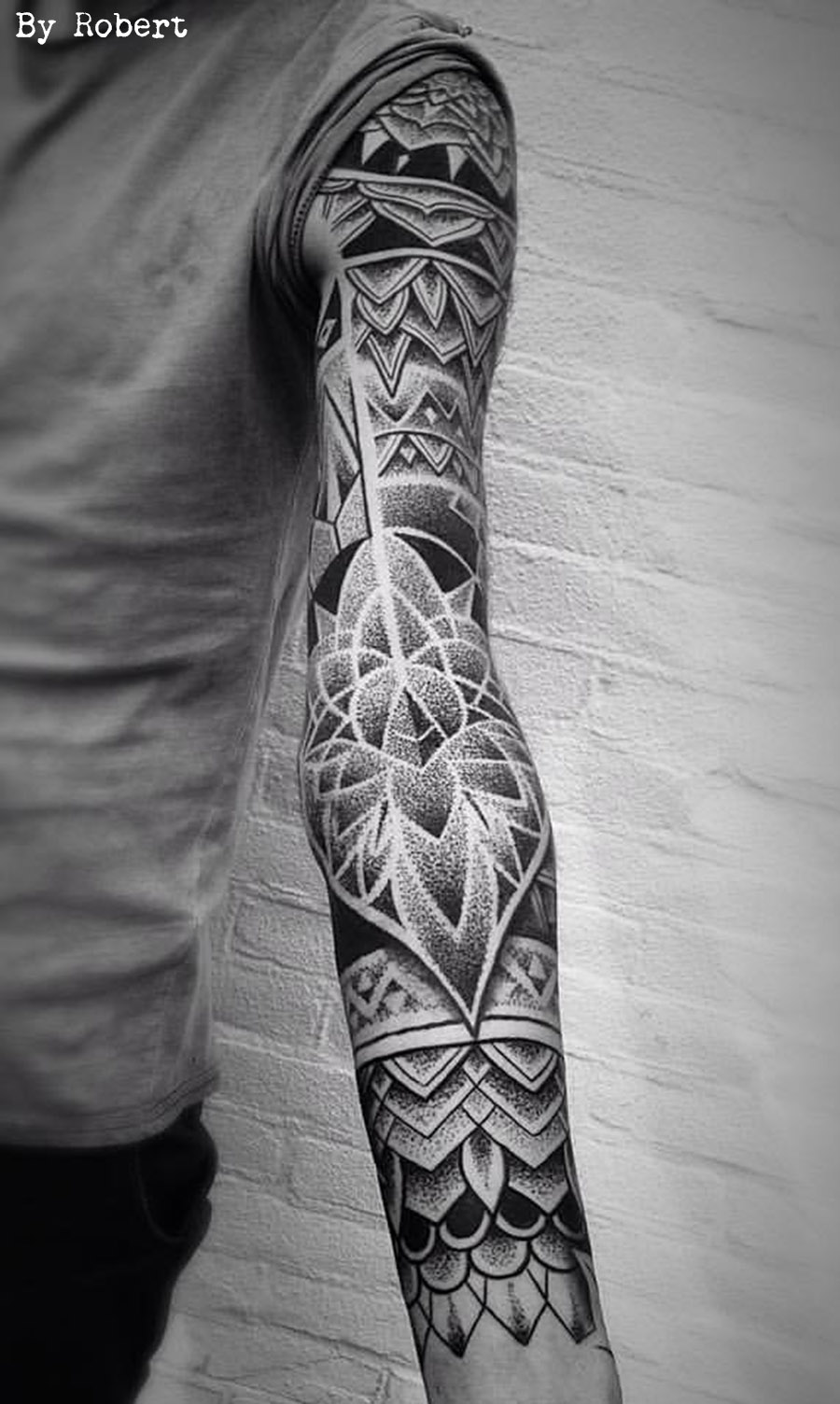
We can also admire at the shop the work of two artists who shares the premises with the Ris family. Bas who joined the team in 2013, specialised for a time in letterings, he now does a lot of realistic pieces. There’s also Robert, present since 2015, who practices ornemental, graphic and dotwork tattoos.

RETROUVER TOUS NOS CONTENUS, PHOTOGRAPHIES , GALERIES TATOUAGE ET OUTILS 3D SUR L'APPLICATION
ATC TATTOO

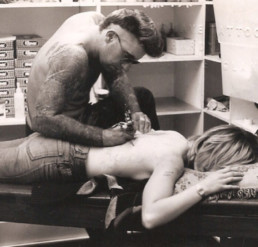
Interview : Lal Hardy
Text : Pascal Bagot
English tattooer Lal Hardy lived the 70s and the 80s as few others did in the tattoo trade. At that time in London, he’s a key actor of the new creative wave coming from the US, initiated by artists like Ed Hardy and which hits the UK. He tells us about this turning point in history which changed the face of modern tattooing in Europe, from his studio in Muswell Hills opened almost 40 years ago : « New Wave Tattoo ».
When you were young, were would you go and get tattoos ?
February 8th, 1976, I was 16 or 17, I went and got my first tattoo : a panther’s head with a dagger done by Dave Cash in Woodgreen- North London. It cost me 4 pounds which is probably 2 euros or whatever. Because there were so few tattoo artists the names were very familiar and very famous. In London there was Jock Tattoo Studio in King’s Cross, Cash Cooper in Soho, Dennis Cockell, George Bone... Each town used to have one tattooist. Like in Plymouth you had Doc Price, in Bristol Les & Danny Skuse, Phill Bond in Torquay… Gradually as the 80s started, because of companies like Ultra that were making equipement available, more people started to get into tattooing. Now, there is so many tattooists in London, it must be over 300 in London easily.
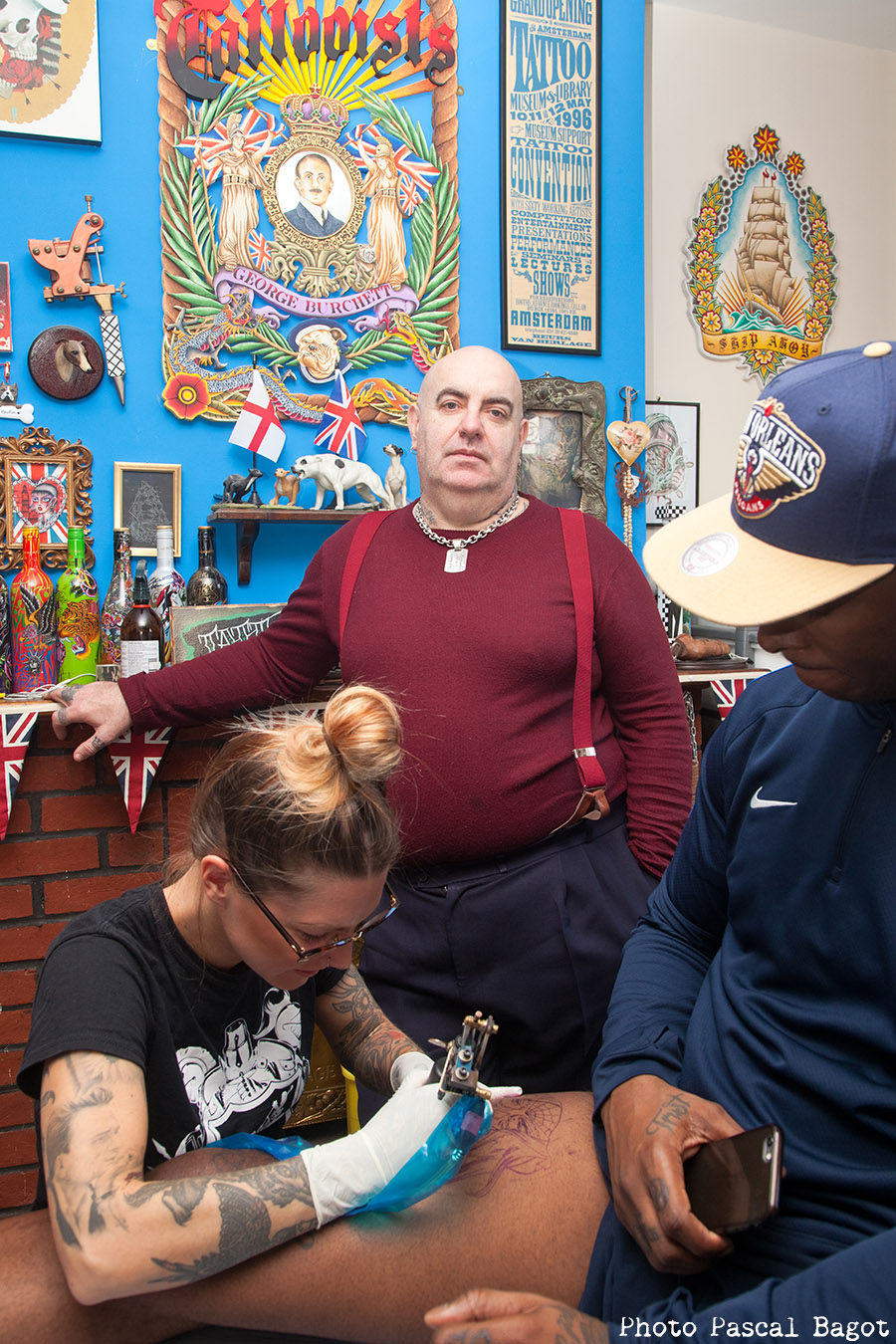
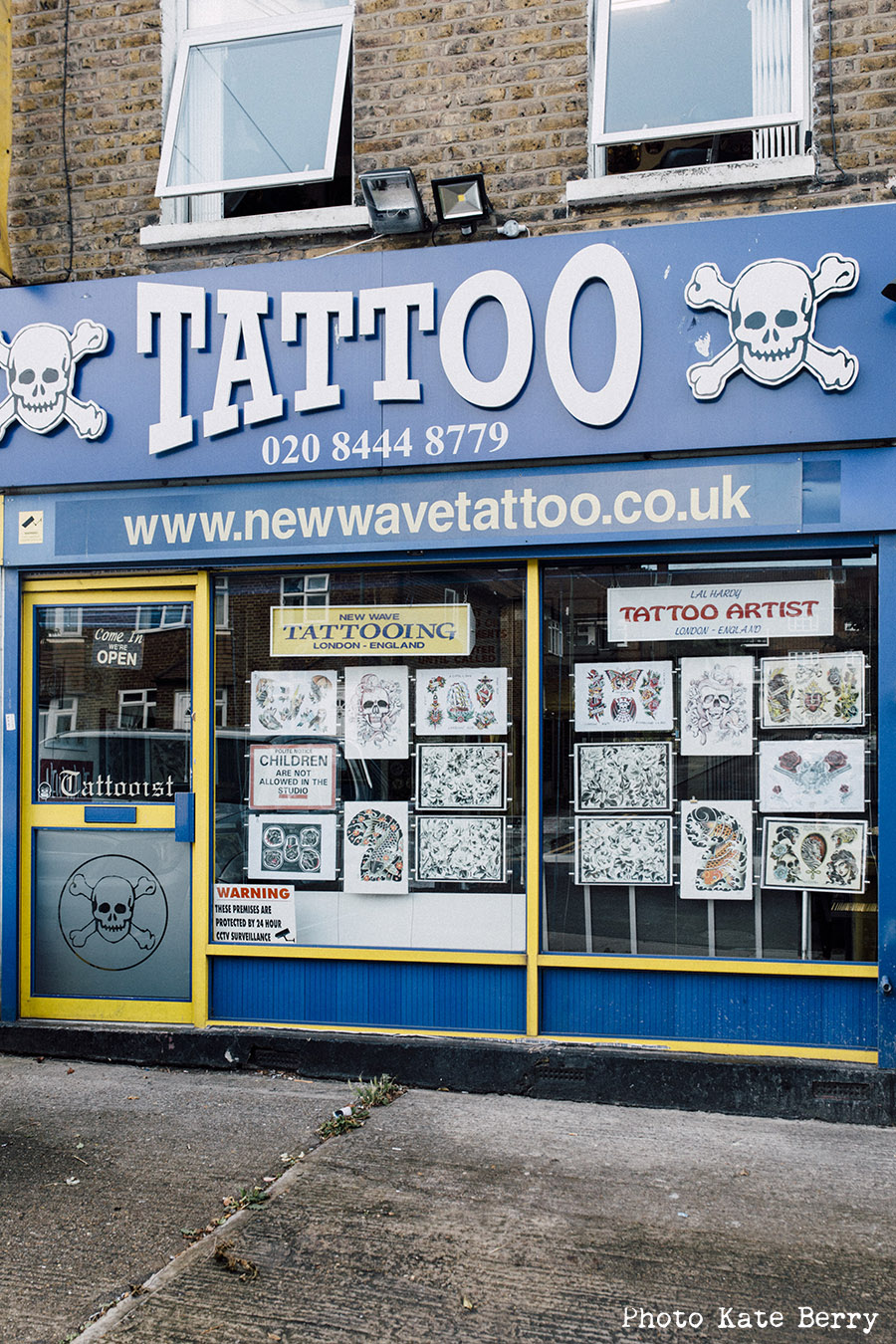
Lal Hardy : Teddy Boys and punks tattoo artist
The 70s and the 80s were very exciting times with the emergence of many subcultures…
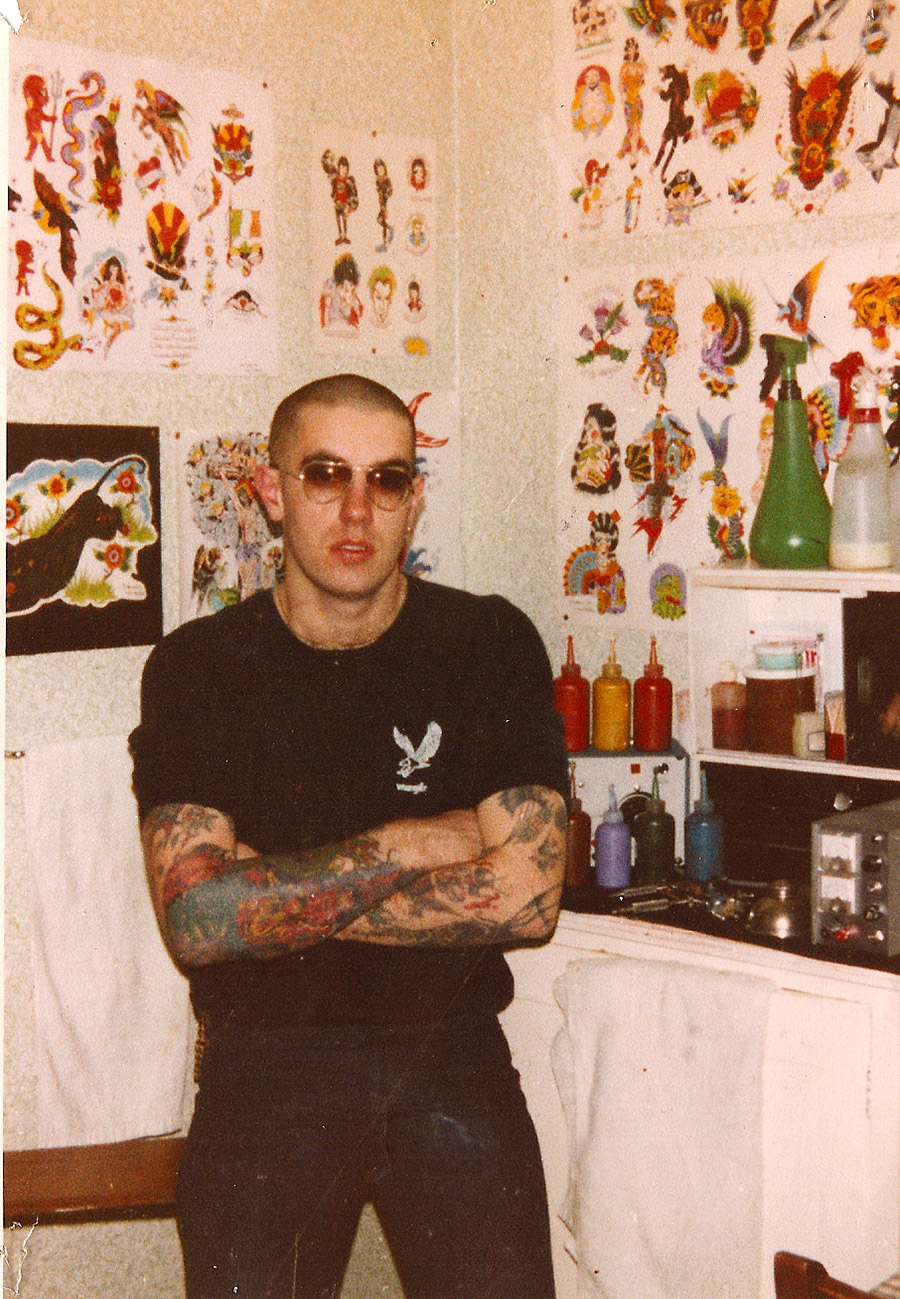
I think the 1980s especially were very interesting time, so much was happening. There was a lot of creativity, of influences. In those days, because there was only two channels, people didn’t have the luxury of staying indoors and being able to watch sport, so the pub became a focal point for the community. And every pub used to have a room where they had music. The revival of the Teddy Boy movement -the original Teddy Boys were from the 1950s- was very exciting : there was like clubs everywhere, everynight of the week was somewhere you could go and watch Teddy Boy bands and rock’n’roll bands. Then it changed to Rockabilly that changed to Psychobilly. At the same time you had communist skinheads, nazi skinheads who just liked two tone music, punks, new romantics…
And subcultures would get tattooed. Which ones in particular ?
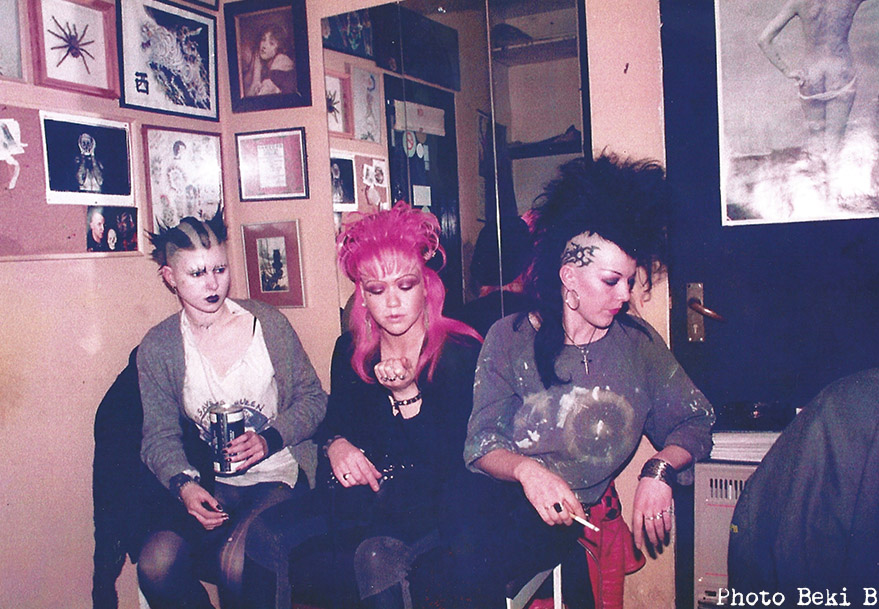
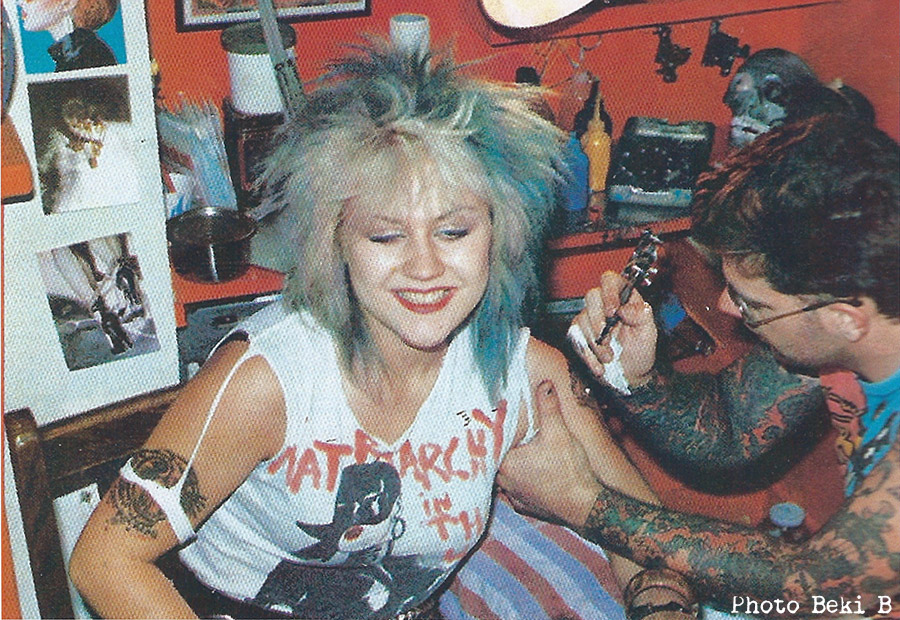
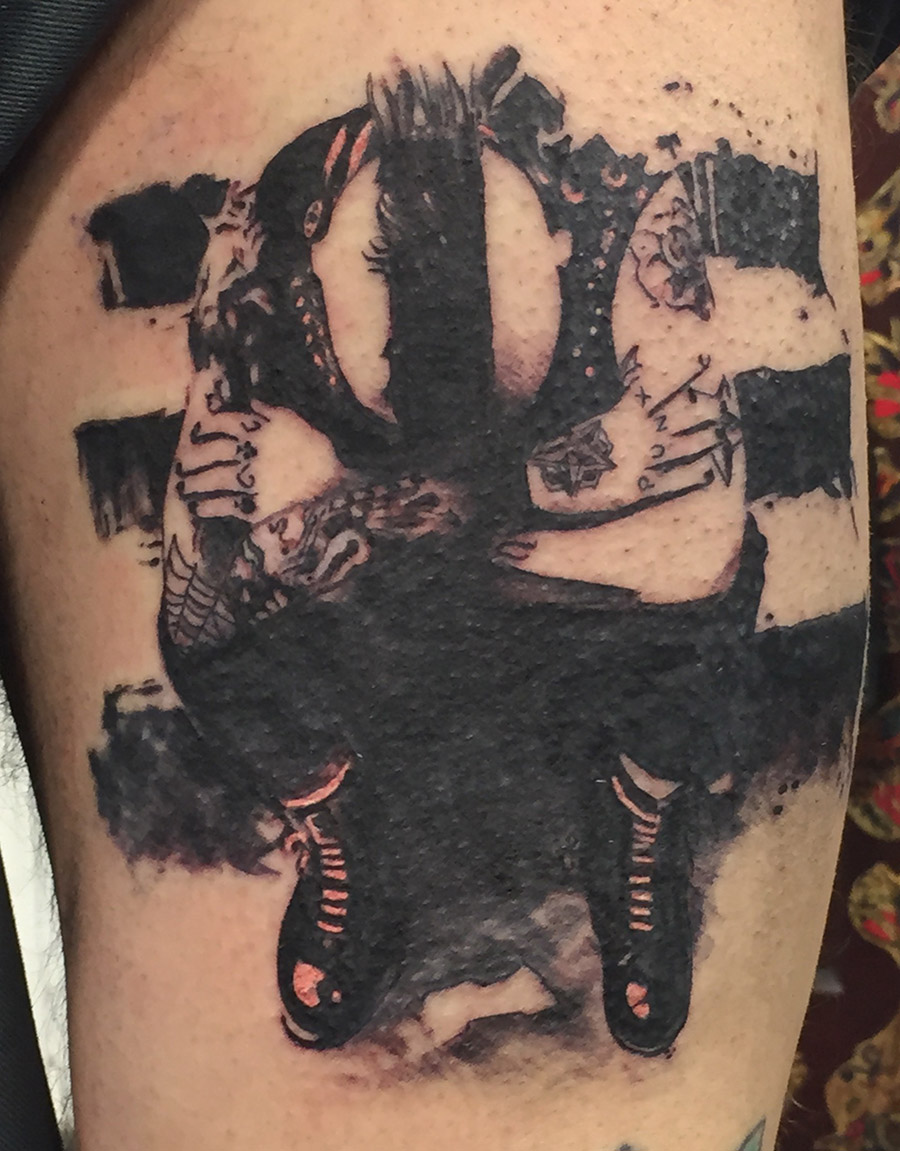
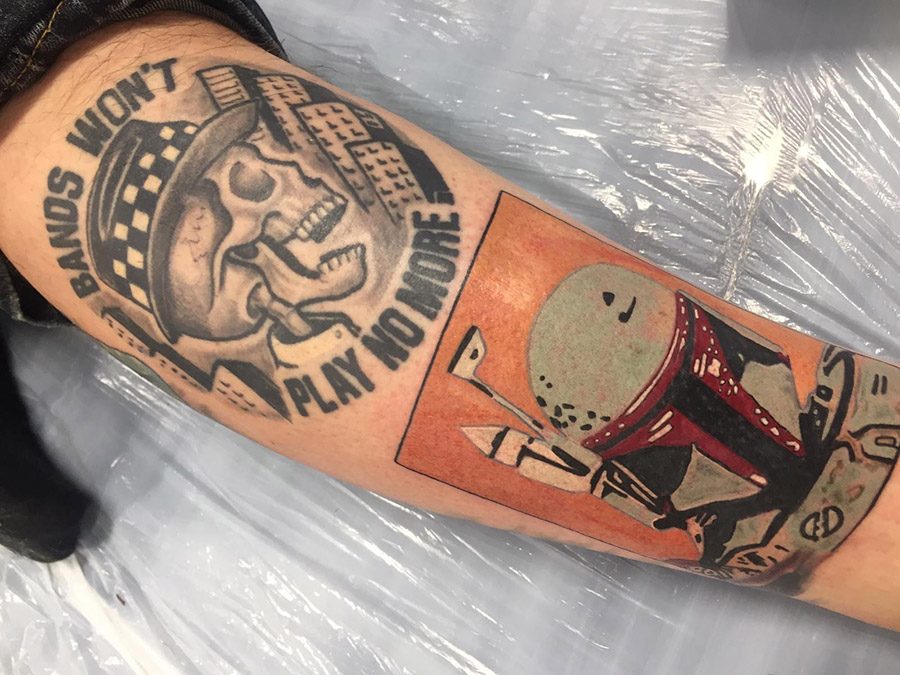
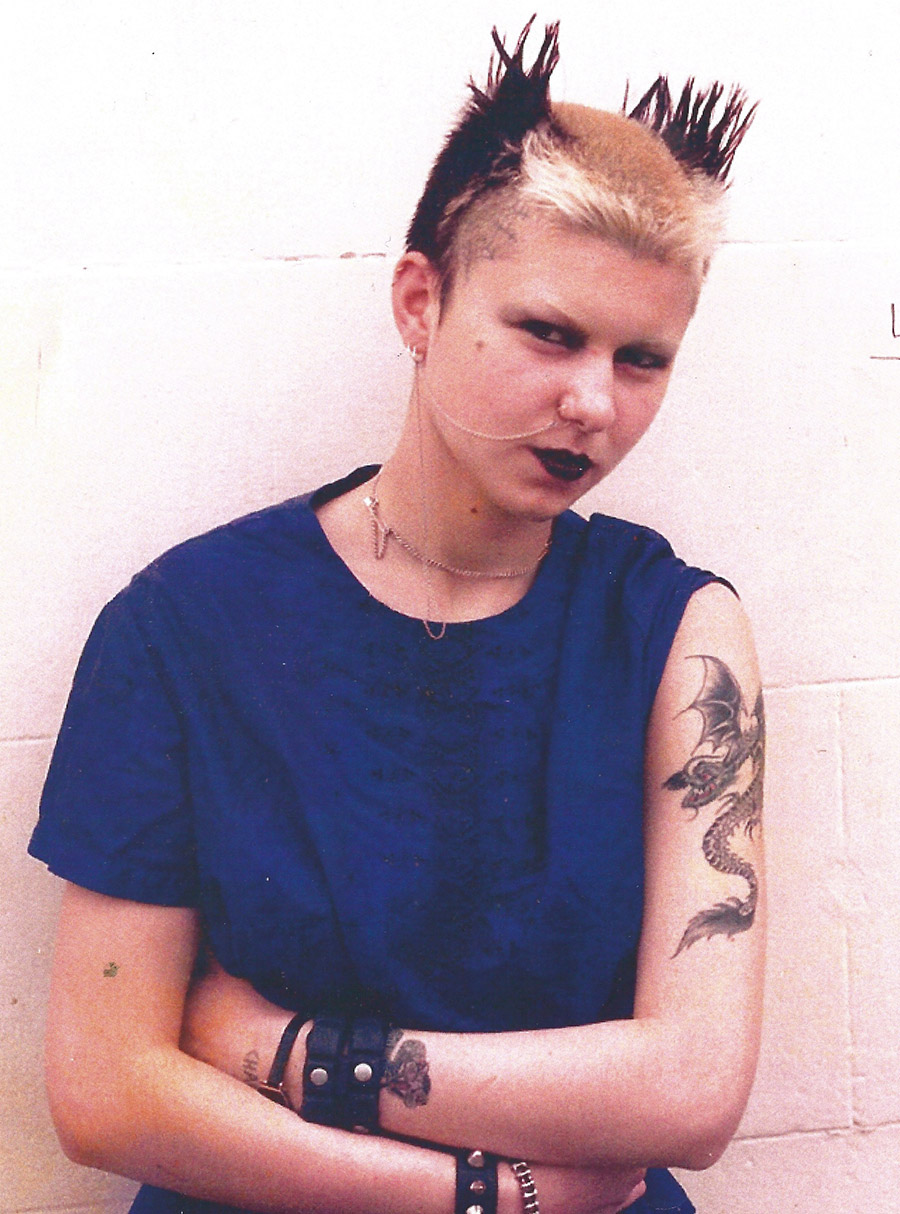
All of them. The ones that tended not to get tattooed too much were the new-romantics. The subcultures picked tattoos that reflected their particular subcultures. But if you look at the very very early punk-rockers, early days of the Sex Pistols and The Clash, not many had punk rock tattoos. It was when the second wave came along, more towards probably from 1977 to 1984, with bands like the Exploited, Anti-Nowhere League. In the punk era, so many people were making fanzines, independantly publishing records, there was a lot of artworks that went out there. One of the thing for example is the Exploited’s mohican skull : you would see it on t-shirts, painted on the back of leather jackets, on band badges, people would get it tattooed too. These images would start to appear in all different formats and mediums.
What kind of designs would these subcultures go for?
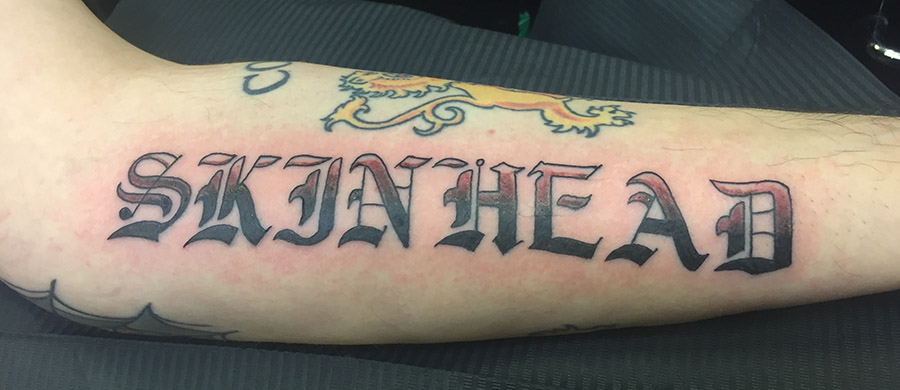
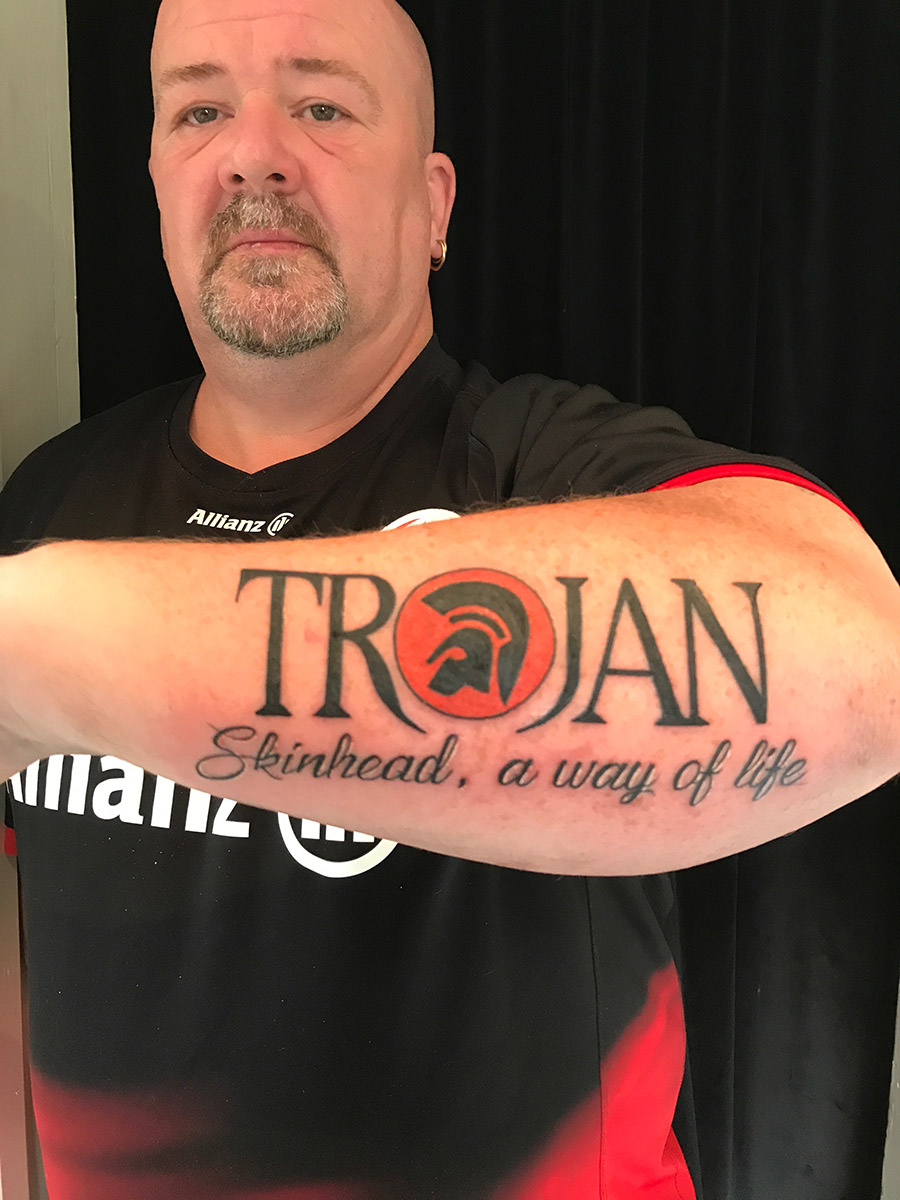
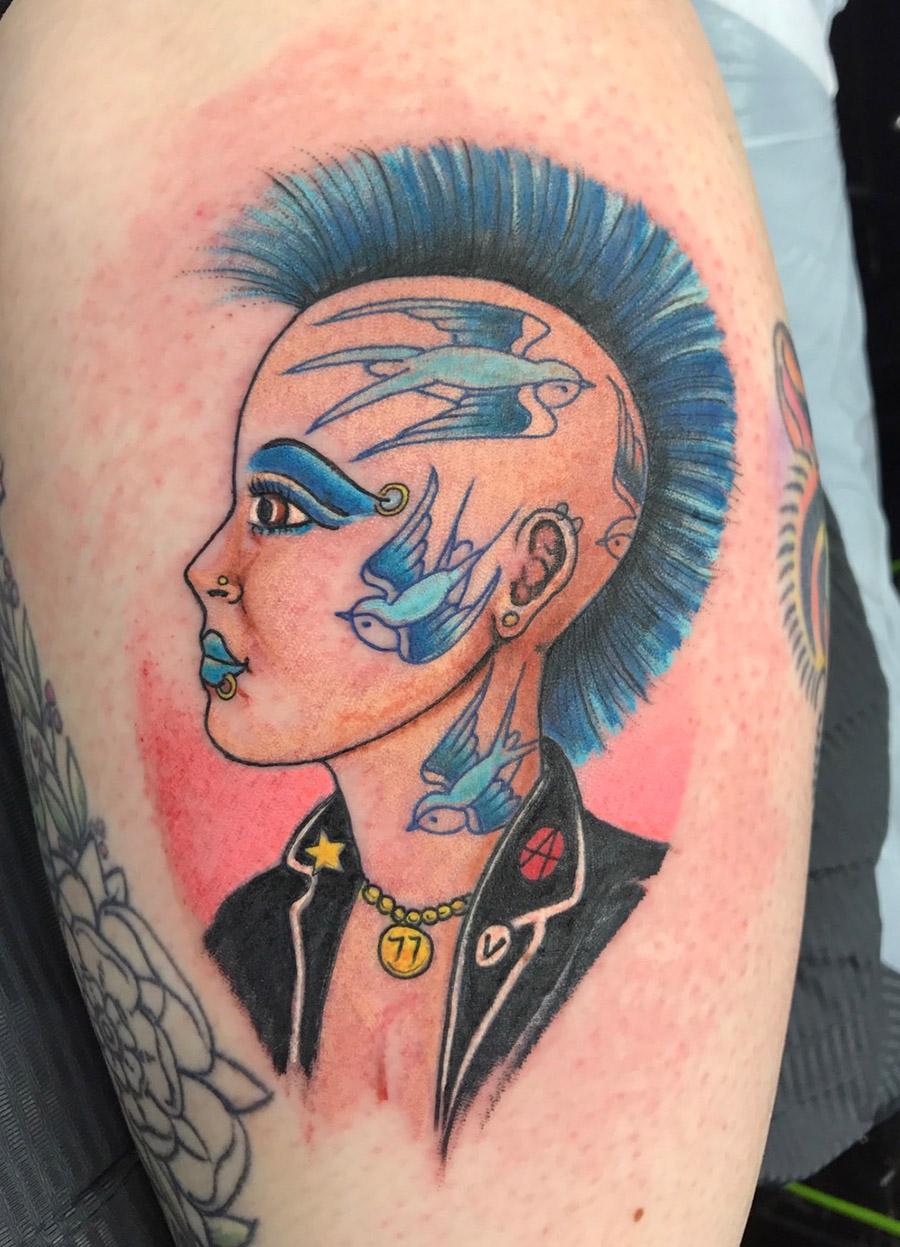
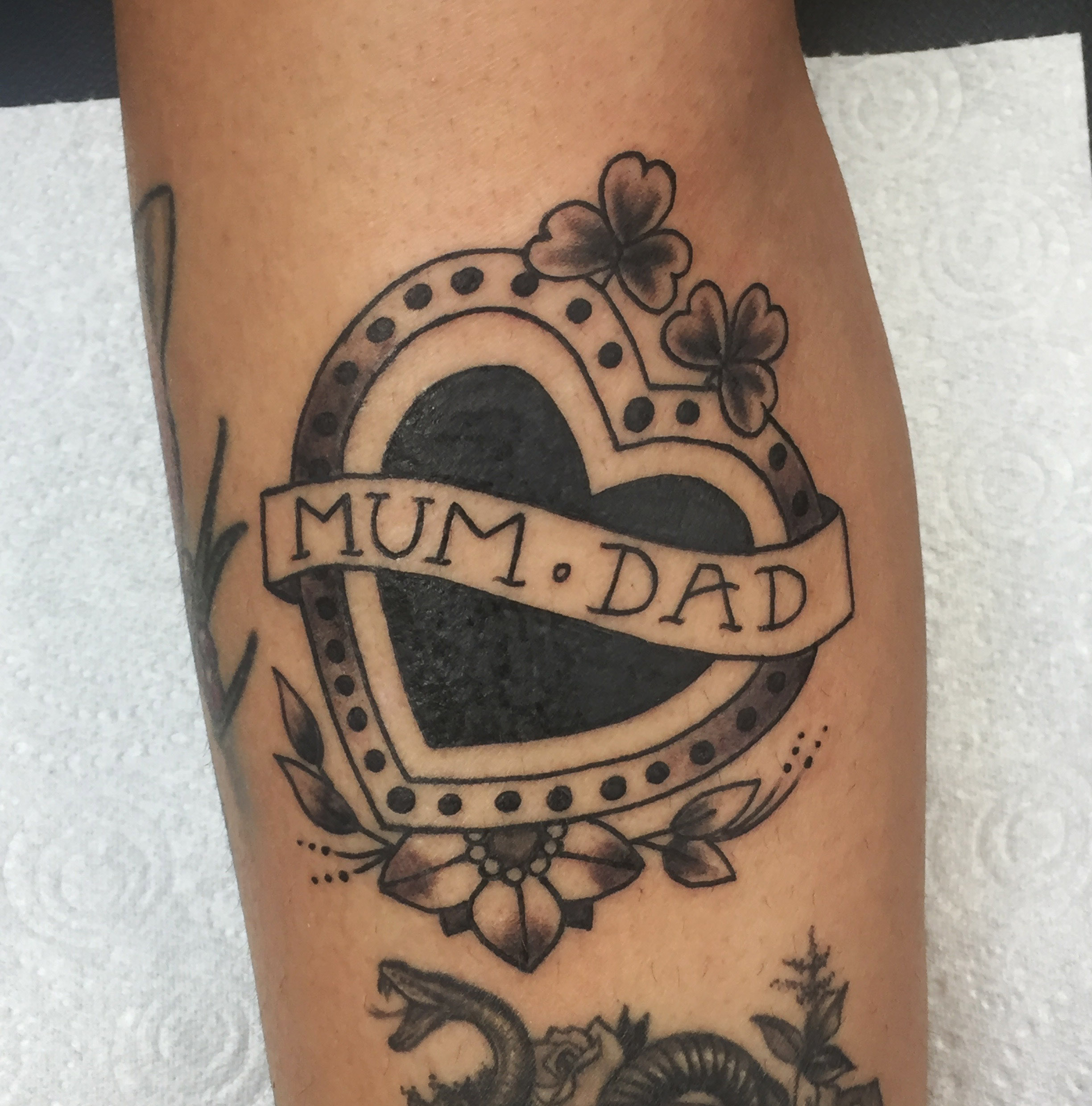
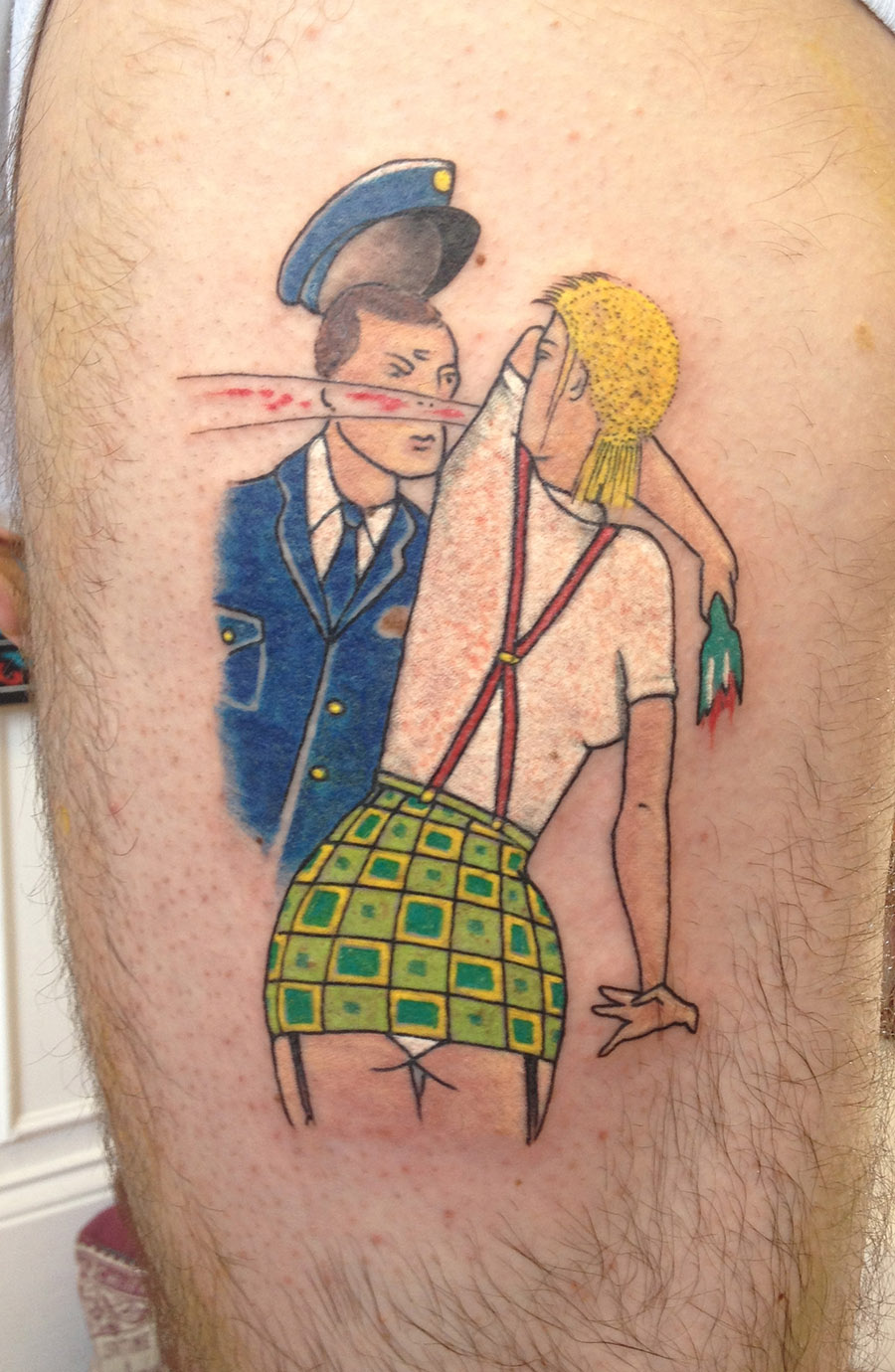
The original Teddy Boys went more for traditionals tattoos : hearts, skulls, swallows, daggers… But the ones of the latter generation got images related to that music scene too : record labels, microphones, tattoos in memory of the stars that died like Buddy Holly, Eddie Cochran, Gene Vincent. If you were a punk, quite often you would have a logo from a band, pictures of punk girls, mohican girls. Because the skinhead movement was fragmented at the time between different political views, there were a lot of patriotic tattooing with images like the Fred Perry logo, « Made in… » and the name of the town they came from, viking iconography was popular, Dr Martens boots ; heavy metal people would go for the Eddie -from Iron Maiden- character and AC/DC logo … It wasn’t like everything was defined then, you were this or you were that. Some of them went from one subcultures to the next. I always think it’s funny when you see a skinhead who is covered in rockabilly tattoos. It was just mad, there were things happening all the time.
The music was a keystone at that time…
The music, the fashion. I copied a lot of album covers. How many people have a Motorhead logo ? The fact that the music the people would listen to and the fact that the people gravitated where the music was being played, linked the fashion of the dress codes. When Sid Vicious died, people wanted to get tattooed this picture of him on which he wears a nazi t-shirt.
Some pictures of the time depict young people with facial tattoos, was it a common thing ?
There was this whole thing about being antisocial. In Britain, in late 1970’s going through the 1980s, you had like Margaret Thatcher, the minor strikes… so many different contributing factors. Young people’s views were molded. A lot of the skinheads would get tattooed on their heads ; some of them would get it on their faces because, when you’re in a group together and you’re in a pub with 500 punks or 500 skinheads… and 50% of them are tattooed, it seems normal within that thing. But when you go out into society and there’s 5000 people on the streets and you’re the one person with your face tattooed, it makes you an outsider. I’ve never done facial tattooing, I found it something to avoid. Now you can go to a tattoo convention and see people with their face tattooed and it seems to be more acceptable. Back then it was basically saying : you’re never gonna get a job.

How would the old-timers tattooists react to the new expectations of this young generation ?
Back then, if you went to Jock and said : « I want to get an Exploited skull » he would go : «What the fuck are you talking about ? ». He just got what he had on his walls, and that was it. Dennis Cockel would probably have because he was pushing the boundaries, he’d come back from America. But the thing is, at the same time as this happen, myself, Ian of Reading –an amazing tattooist-, other people were drawing designs and putting them out. Gradually some of the old-school people realised there was a market within the subcultures.
Being involved in the punk scene, what kind of new designs would you create?
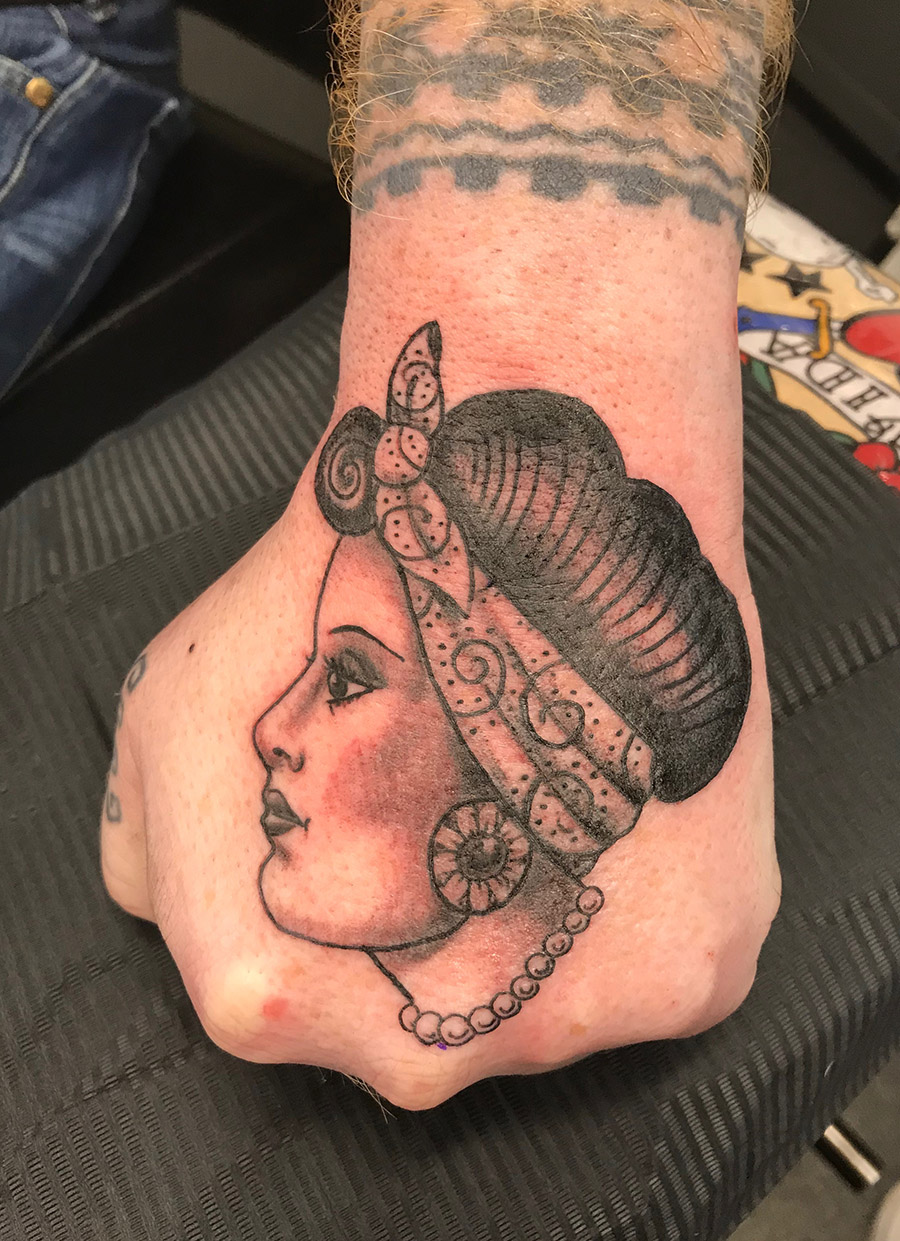
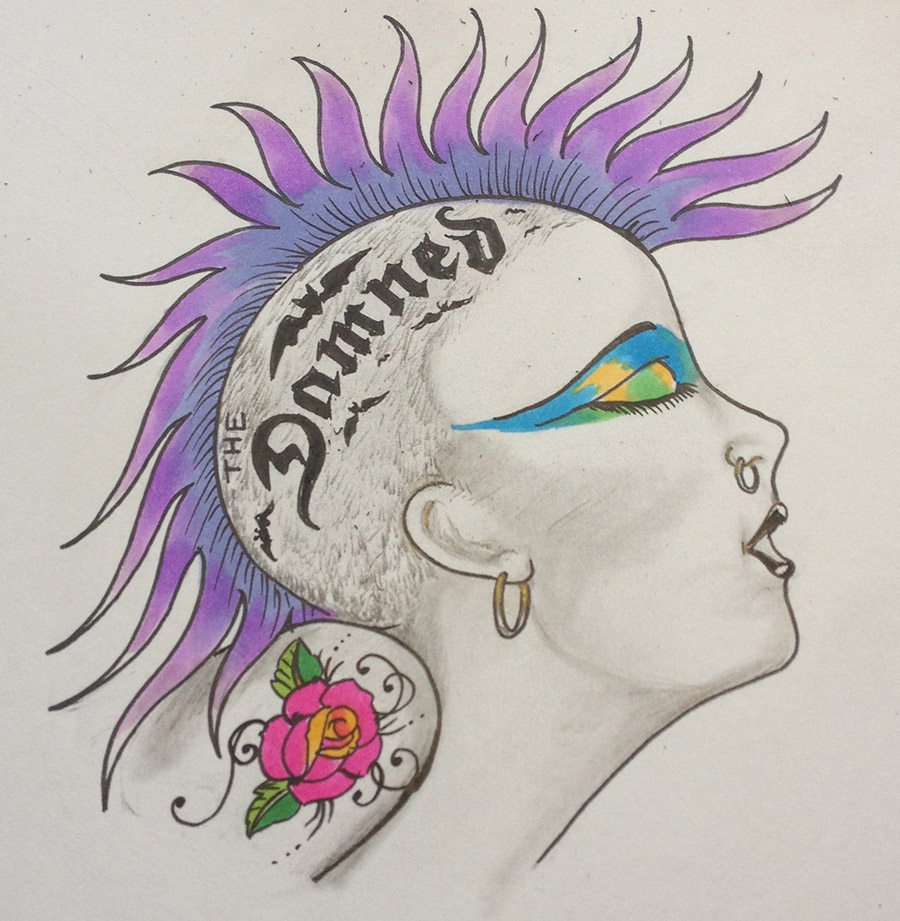
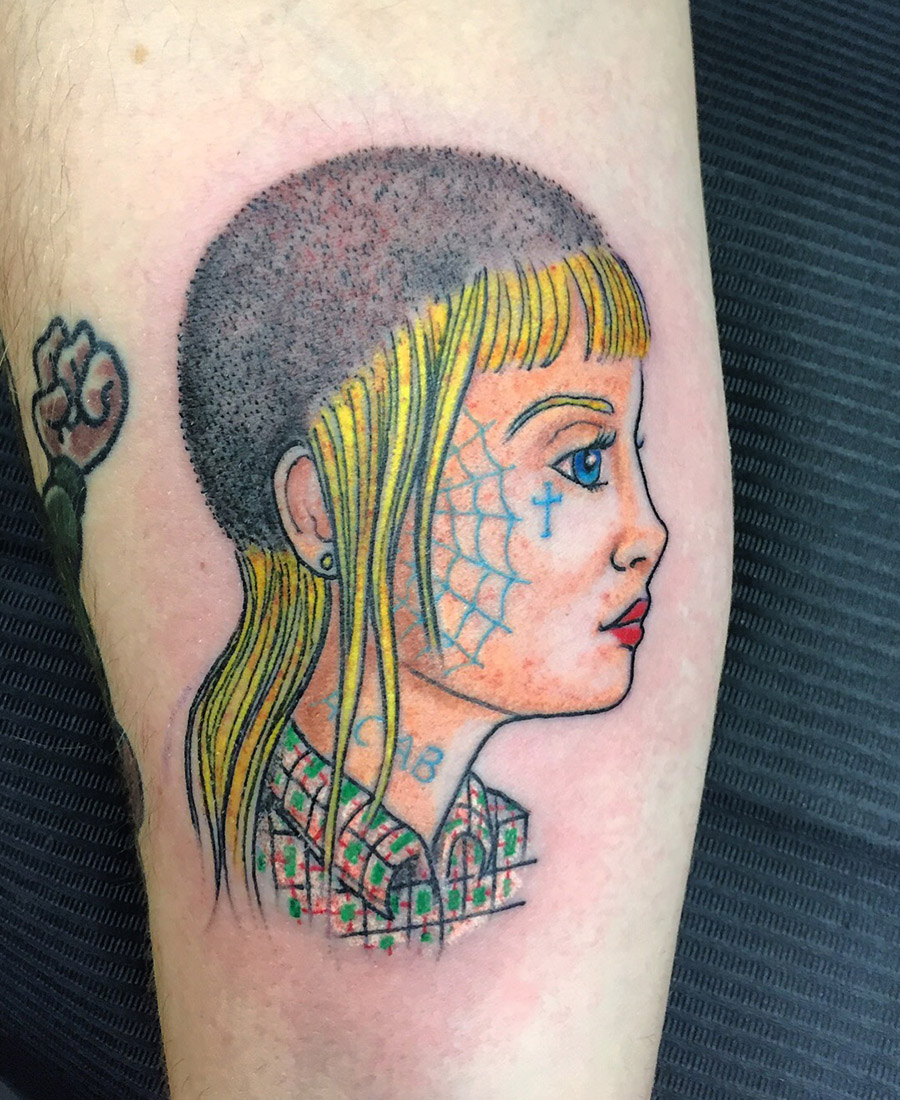
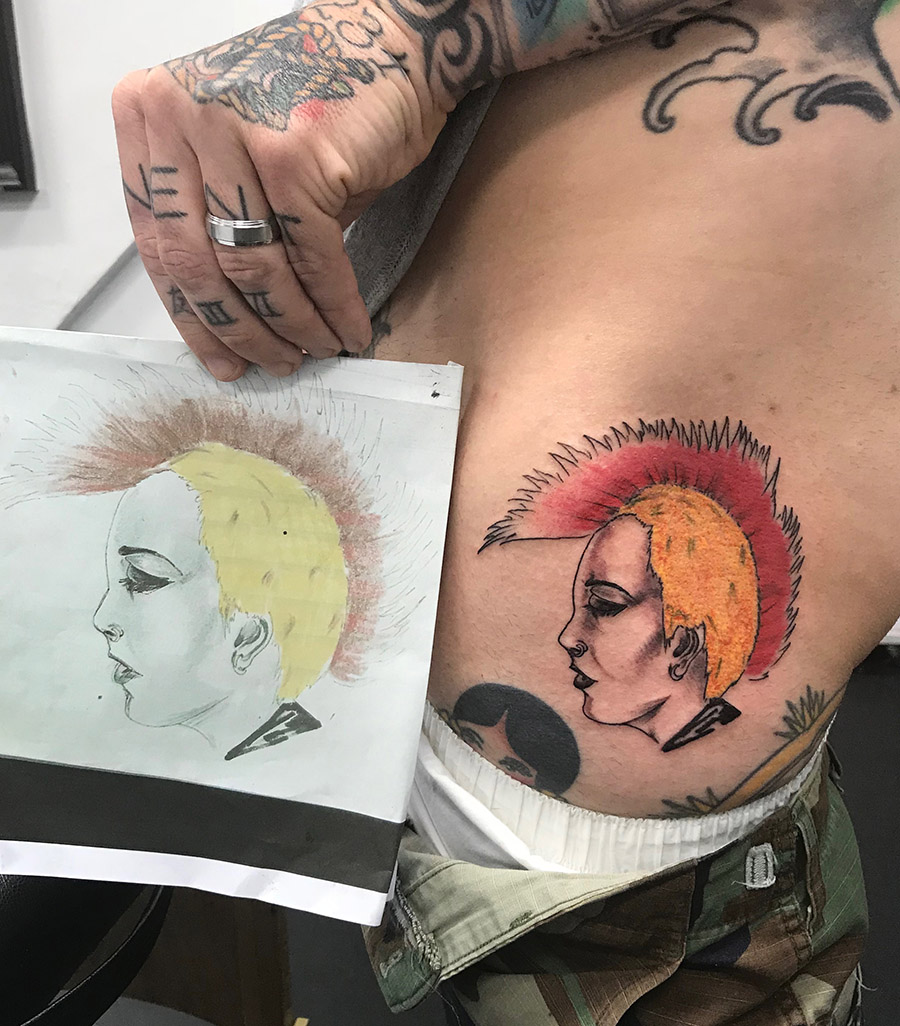
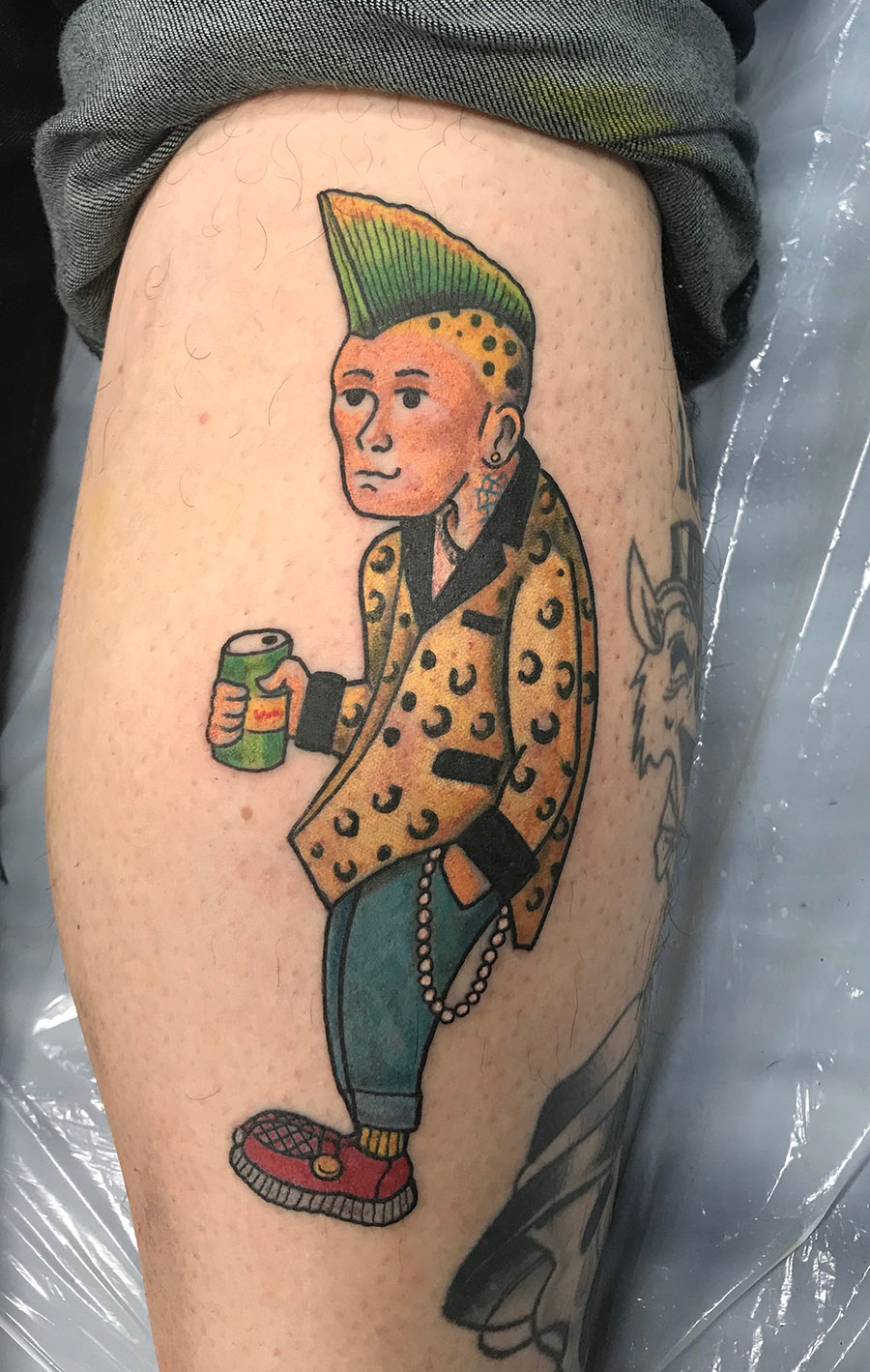
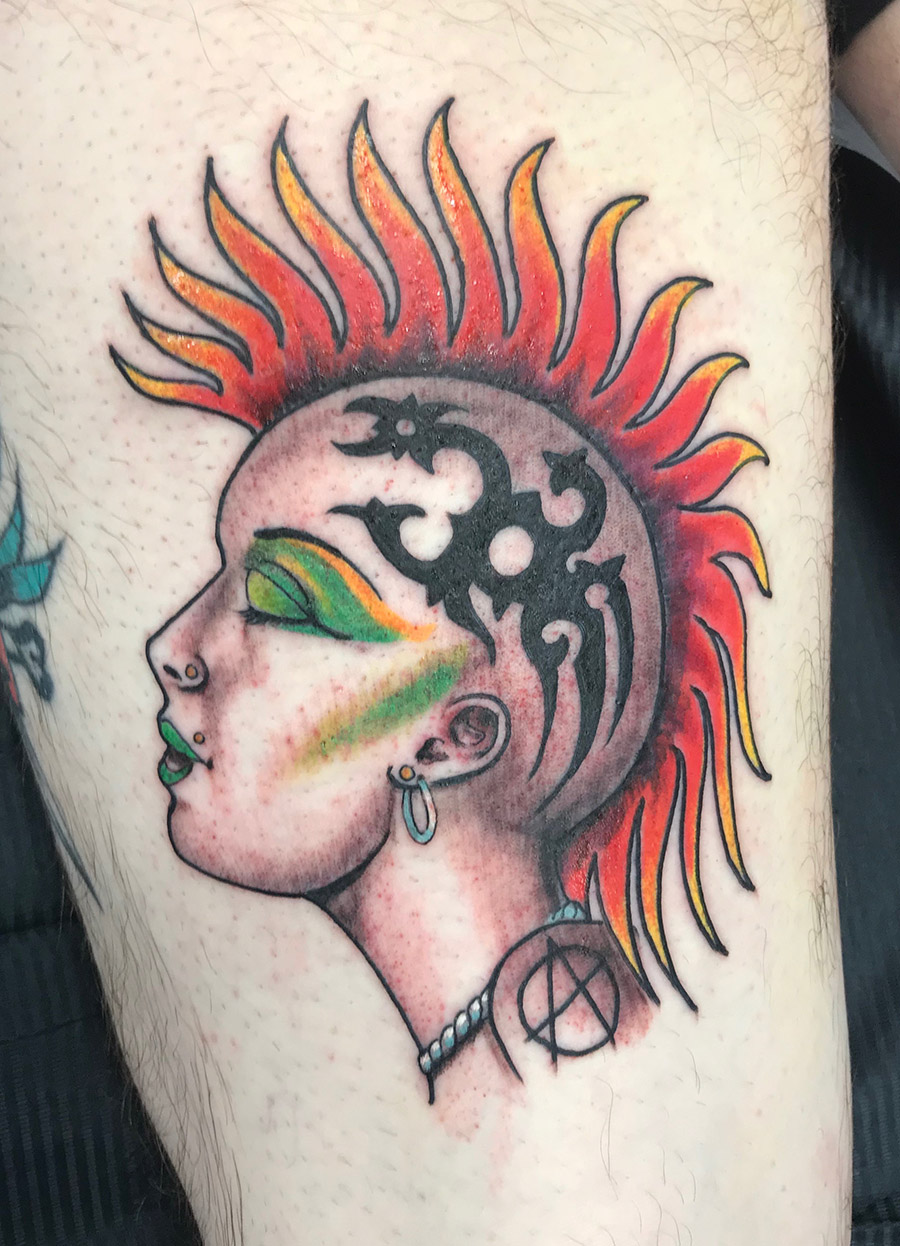
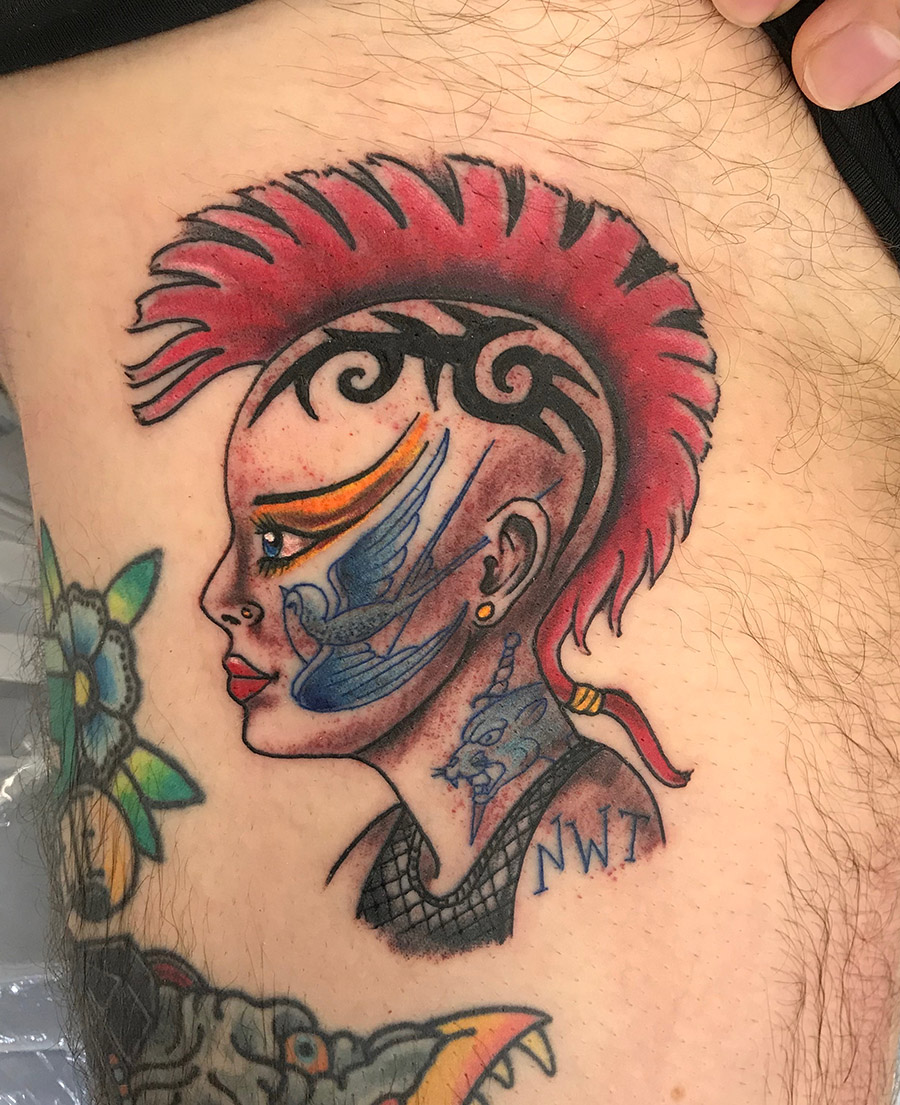
Seeing all that imagery and tattooing on punks, suddenly we started to do punk girl faces, with coloured mohican on it, a ring on her nose, a chain, etc. When you’re young you want to do those things, being enthousiastic. Jock said to me : « Why would you bother putting a earing on a girl? Why ? » The older guys, they just wanted to do tattoos with a minimum of effort and with the minimum of colours. Ed Hardy, after we met, because he loved the punk stuff I was doing, said to me : « What you’re doing is a new wave of tattooing ». I kept it to name my studio.
At the same time Ed Hardy was already moving the lines of tattooing in the US, how did you meet him?
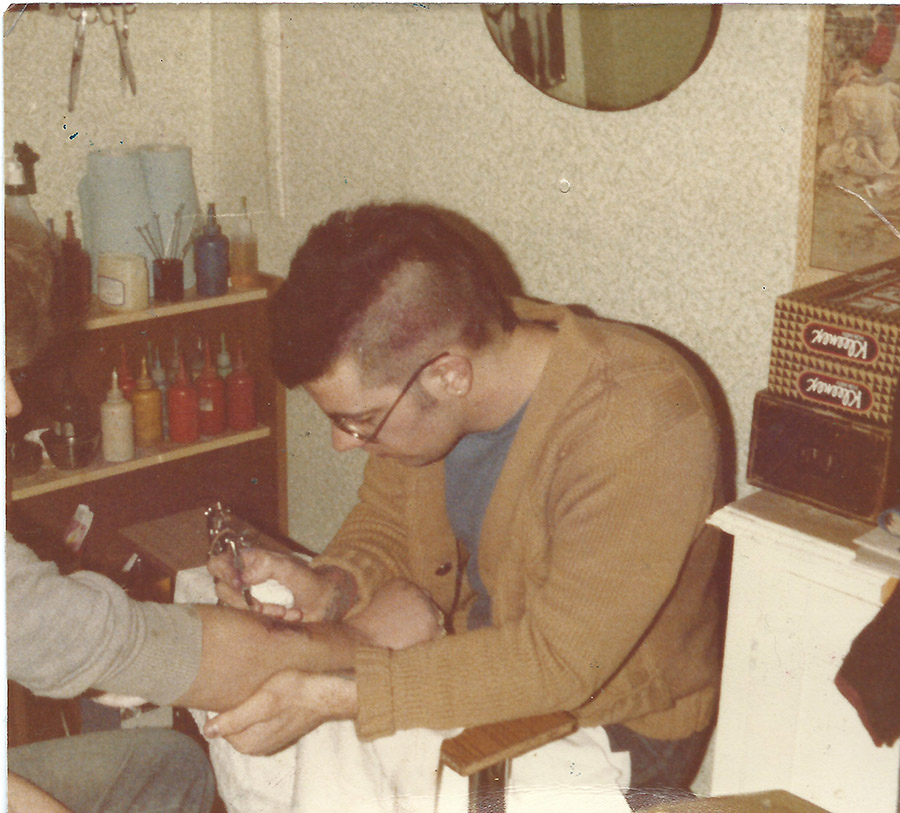
Through Dennis. His shop was in a posh area, with a lot of more upper class, trendy young people going there and where he tattooed the Stray Cats, Steve Jones from the Sex Pistols, to name a few. When pictures of Ed Hardy’s work came out I was getting tattooed by Dennis and hanging around his shop. He told me about Ed and he said : « You really need to see his work ». Then he called me up : « Ed is coming over, come and meet him, if you want to get tattooed by him we’ll make an appointment ». It was 1980. Suddenly seeing the work that he was doing was amazing, unbelieavable. I told him I wanted to get a punk rock girl, he was so enthousiastic to make this design.
What impact did he have on the tattoo scene in England ?
Once it became apparent how visionnary he was, everyone wanted to get tattooed by him, to talk with him and be inspired by him. At the time there was the Tattoo Club of Great Britain, small conventions in hotels, mainly for tattoo artists. Ed came to a couple of them, so the only people he tattooed were tattoo artists. People suddenly realised that you could go out and find inspiration from so many different places. Ed has make people look away from the tattoo flashes that a lot of tattooists were used to copy exactly as they were. He opened doors and opened people’s eyes. Technically too, I never knew what a magnum was until I met Ed. In my eyes, all the fantastic tatooing that goes on now, which is incredible, he really was the starting point for inspiration. For people of my generation, he is like God.

Did you go to America ?
Yes, in 1982, I went to the « Tattoo Expo » convention, on the Queen Mary ship in Long Beach, California. There was Mike Malone, Leo Zulueta, Greg Irons, the Dutchman, Jack Rudy, Mike Brown… all these artists were mind-blowing. Going there and seeing what was going on changed everything. At the same time in England, people like Micky Sharpz, Ian of Reading, Kevin Shercliff, Tony Clifton, these guys started to make a name for themselves, they would trying to push. In Europe you had Claus Fuhrmann, Bernie Luther, Luke Atkinson, Mick in Zürich, Filip Leu… By then that was the beginning of the vortex that started.
What about tattoo conventions?
They were starting to take off a bit, so with that, people would get together. Me and Ian, and some other guys got together and starting to put our own conventions. That was Dunstable Tattoo Expo, the first one was in London 1986 and then they rent of it 12 years after that in a little town called Dunstable. That drew a lot of people together, people like Bernie Luther came in, Claus Forhman, Paul Booth, Horiyoshi III. Suddenly this whole energy was happening. Back then there was one or two in England and Dunstable was the big one in Europe along with Amsterdam.

How do you look at the tattoo scene now ?
In more than 30 years I have been involved in it, it changed so dramatically that I just wonder what’s the next 30 years will have. One of the things now is : how many kids are computer-literate to use photoshop to create designs ? Ultimately with tattooing I guess that, which ever way you create the design and the customer loves it, it doesn’t matter.

 Quel regard portes-tu sur la scène aujourd’hui ?
Depuis plus de 30 ans que j’en fais partie, cela a tellement changé que je me demande à quoi pourront ressembler les 30 prochaines années. Une des questions que l’on peut aujourd’hui se poser c’est de savoir combien de jeunes sont suffisamment formés à photoshop pour l’utiliser dans la création des motifs ? Certaines personnes sont vraiment contre l’utilisation de l’ordinateur, mais en fin de compte, si le client est satisfait, cela n’a pas d’importance.
 CONTACT :
 CONTACT

CONTACT :
New Wave Tattoo
157 Sydney Road, London N10 2NL
England.
instagram : lalhardy
FIND ALL OUR CONTENTS, PHOTOGRAPHS, TATTOO GALLERIES AND 3D TOOLS ON THE APPLICATION
ATC TATTOO

Sacred Faces – The Chin women of northern Burma
Herders of Cows, Mrauk-U, Rakhine State
Text and photos: Tom Vater
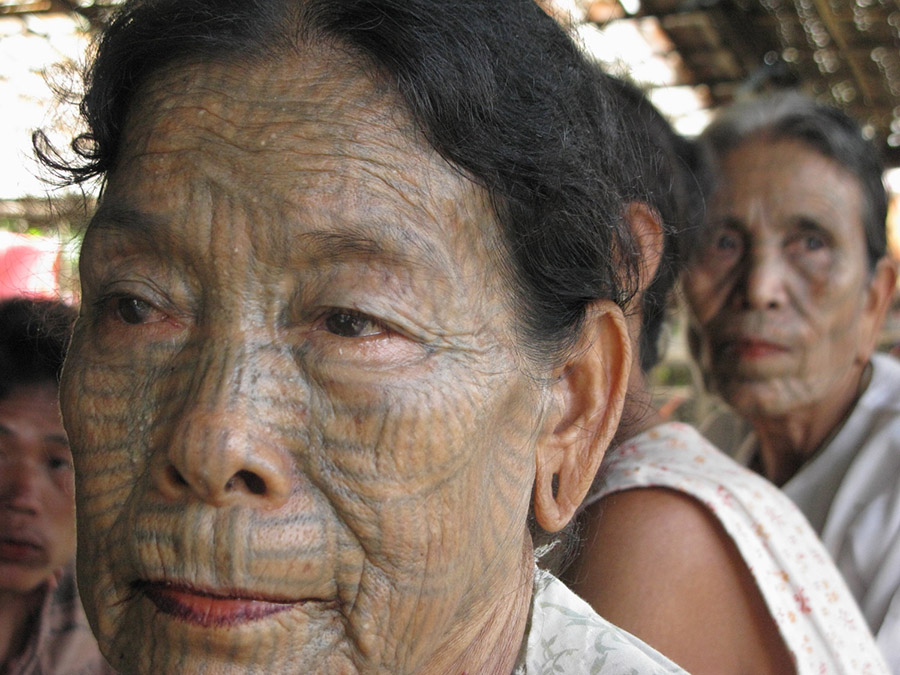
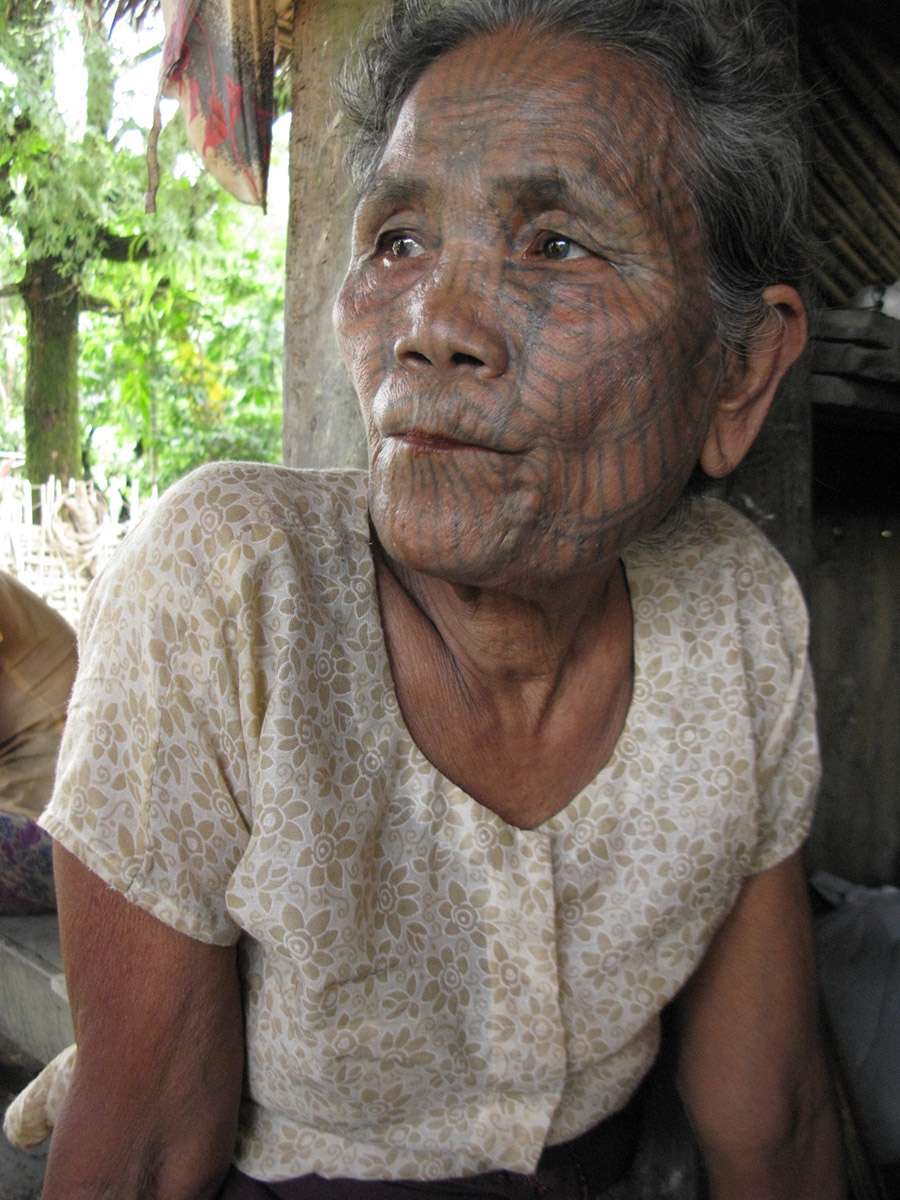
“I got tattooed 60 years ago. In those days, Chin women had their faces tattooed in order to appear ugly to outsiders, to the Burmese and to the Japanese, to avoid getting abducted and raped. But we also considered our tattoos to be beautiful. With independence, the Burmese no longer allowed us to get tattooed. We were punished if we put marks on our faces because they wanted to make us Burmese,” sums up Ma Aung Seim, a seventy-one year old Chin woman.
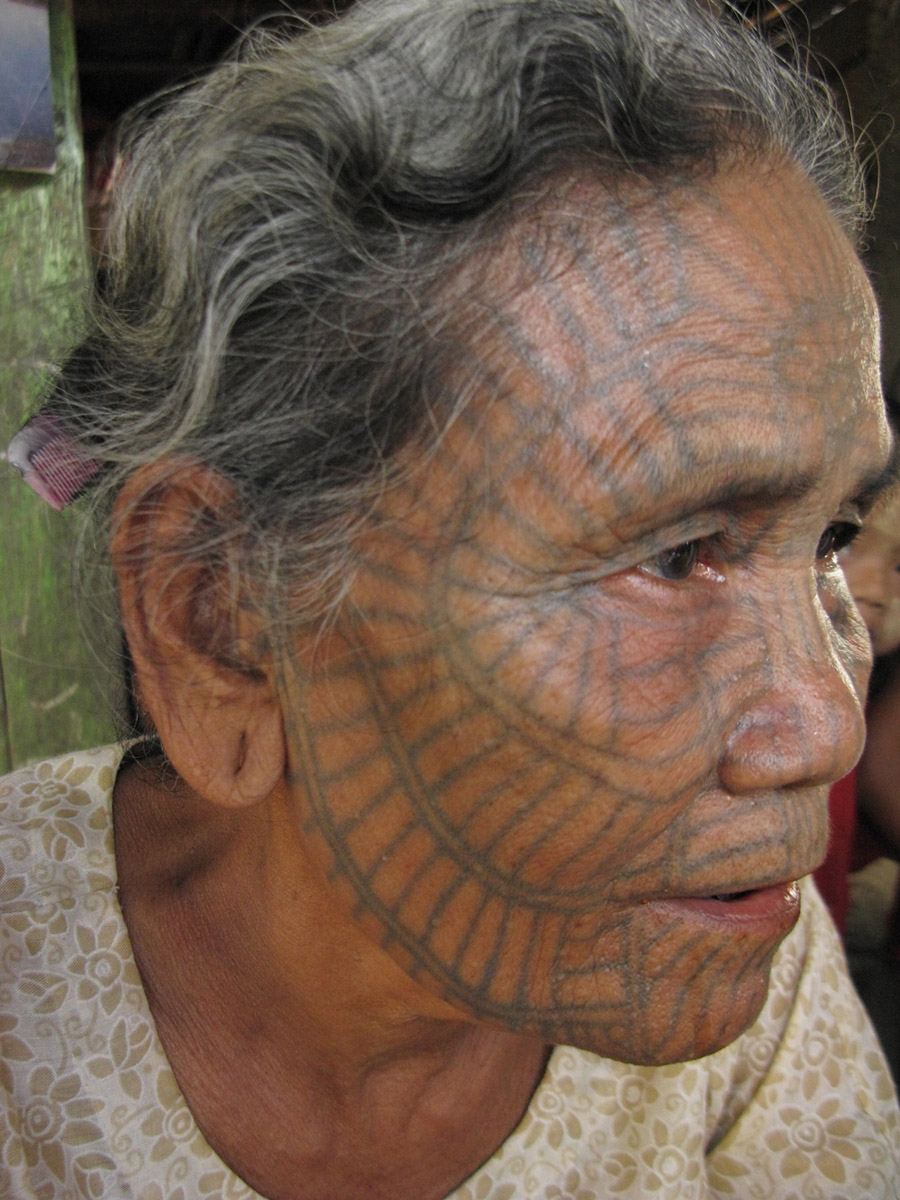
Ma Aung Seim, Chic Chaung Village, Arakan State
Today, few members of Burma’s 130 ethnic minorities still wear tribal tattoos. Following suppression from British colonisers and missionaries until independence in 1948, and the heavy hand of the Burmese military since the 1960s, the tradition is about to fade away into the opaque realms of history. The tattoos of the Chin women of northern Rakhine state are amongst the last visible traditions of a once unique cultural identity.
In 2012, I travelled to northeast Burma, beyond the main tourist spots of Yangon, Bagan, Mandalay and Inle to Rakhine State, on the border with Bangladesh and just south of Chin State. During that humid summer, Sittwe, the state capital of Rakhine, repeatedly exploded in racist pogroms by the Buddhist majority against the Muslim Rohingya minority. Hundreds were killed, raped and tortured, mosques and townships were wiped out and tens of thousands of people were displaced. But this was only the start of Burma slipping back into a heart of darkness of Conradian proportions.
Despite Nobel laureate Aung San Suu Kyi’s election victory in 2015, which raised hopes for a peaceful democratic transition, many ethnic minorities remain at war with the Burmese government and some 800.000 Rohingya fled to Bangladesh in 2017, following a campaign of terror, ethnic cleansing and possibly genocide by the Tatmadaw, the country’s military, supported by much of the population and Aung San Suu Kyi’s ruling party. After a half century of military rule, an angry nationalist people used its newfound freedom of expression against a tiny minority. In many ways, this was nothing new. Violent and ruthless assimilation of some of Burma’s 130 minorities had already been practised by the British and the Burmese military for two centuries.


Burmese Military, Mrauk-U, Rakhine State
Apart from the unfolding catastrophe of the Rohingya, numerous other conflicts along the country’s fringes, between the dominant Bamar who make up some 69% of the population, and ethnic factions, continue. The reasons for these conflicts, also known as the world’s longest running civil war, are complex and go beyond racism by the dominant ethnic group – access to natural resources and their exploitation also play important roles.
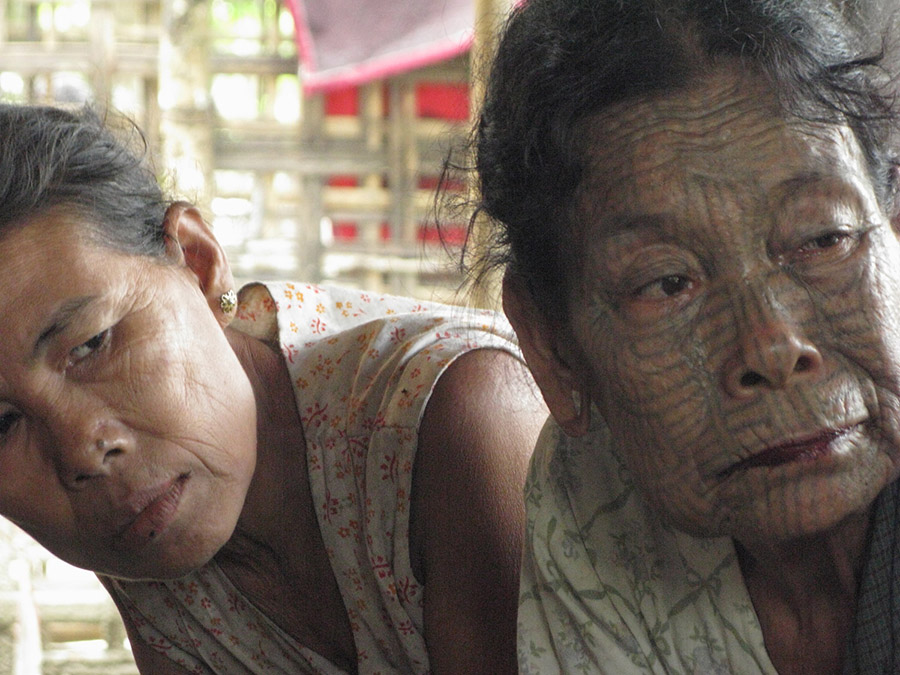
Chin Woman, Chic Chaung Village, Rakhine State
So what, you may ask, has all this to do with tattoos?
At the very heart of the Burmese conundrum lies ethnic identity. And ethnic identity has defined the history of tattooing in Burma.
Chinese records from the Qin dynasty (221-206 BC) mention the tattoos of the Lue and Yue minorities in the Mekong region. These communities tattooed themselves to ward off evil spirits. They adorned their legs with demons and snakes, perhaps the Naga of Sanskrit origin, which is a potent symbol not just amongst Hindus, but Jains, Sikhs and Buddhists as well.
In the 6th century, Brahmin priests, fearful that Buddhism might wipe out Hinduism on the Indian subcontinent, sent emissaries to Southeast Asia who brought Yant with them - magic diagrams used for meditation, usually drawn or carved onto wood, metal or cloth. At some point, these Yant made the transition to the human skin. Neighboring Thailand has experienced a huge resurgence in this tattoo tradition, called Sak Yant, in recent years.
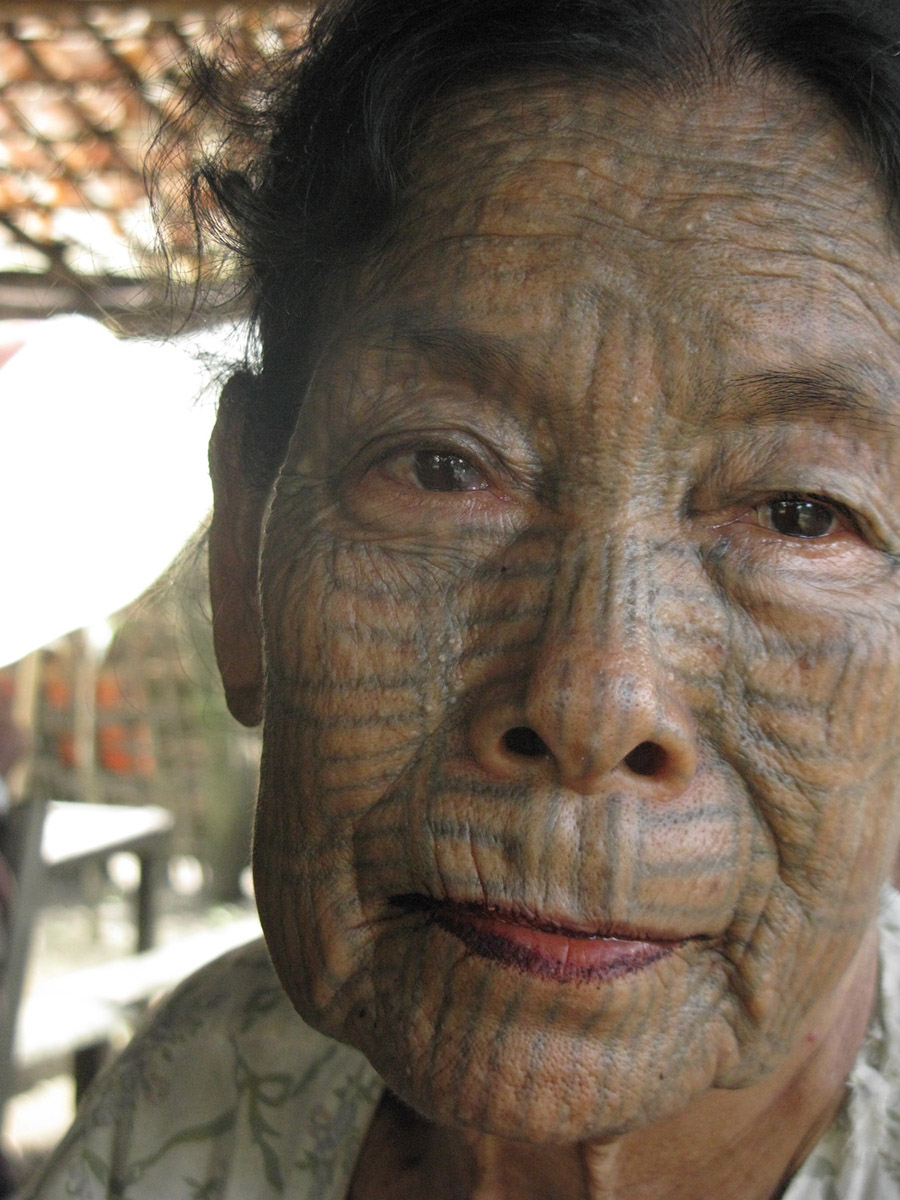
Chin Woman, Chic Chaung Village, Rakhine State
In Burma, the Shan minority appear to be the first community who took up tattooing, likely thanks to influences from both southern China and the Indian subcontinent.
Like the Lue and Yue, the Shan tattooed themselves predominantly below the waist. The local shaman would also be the resident tattooist, who applied the sacred patterns using a long needle made from wood, along with natural inks. Often the adherents would zone out on opium to reduce the pain of the ritual which could involve many sessions over a long period of time.
Buddhism has been around Burma since at least the third century and Theravada Buddhism has been the dominant religion since the 11th century, having gradually replaced various animist beliefs.
According to Buddhist belief, the human body is divided into twelve parts and specific sacred tattoos were applied to specific areas of the body. Hindu gods, Buddhist figures, mantras and diagrams belonged on the back, the arms and the head. Mythological creatures and animals at home in the Himavanta, the forest at the foot of Mount Meru in Hindu mythology, graced shoulders, throats and ears. Peacocks and geckos in the waist area afforded sexual strength, while ankle tattoos protected its wearers from snake bites.

Ma Aung Seim, Chic Chaung Village, Arakan State
Between the 14th and 17th century, the Shan passed tattooing on to the Bamar. Different tattoo traditions flourished among Myanmar’s other ethnic groups. But the British, keen to create a national colonial identity, suppressed tattooing. George Orwell, who served in colonial Burma as a policeman was himself tattooed, apparently in defiance of what he perceived as an exploitative regime.
Following independence, the dominant Bamar brutally suppressed other ethnicities to bring them in line with their idea of common national identity. By now weaned off tattooing, they made minority tattoos illegal.

After an eight hour rain-drenched boat journey up the Kaladan River, I reached Mrauk-U, a place almost too wondrous and beautiful for words. The remnants of the ancient Arakan capital, which ruled the region between the 15th and 18th century, stood amongst the village homes and in paddy fields.
But was not as peaceful as it first looked. In the hills around Mrauk-U, the military had set up patrols. Around the ancient moss-covered chedis that poked out of the dense vegetation, men with heavy weapons cowered in the grass, on the look-out for ‘terrorists’, a euphemism for the unpopular local minority – the Muslims. The military was popular here, despite having suppressed the people of Rakhine for decades. Their divide and conquer strategy was paying off in the new, free Burma, where people were frustrated and were looking for scapegoats.
“They are keeping the town safe, in case of a Rohingya attack,’ I am told by local tour guide Michael,

Child in a house in Chic Chaung village, Rakhine State
The Chin State
Chin State was only a few hours travel away and I escaped the heavy atmosphere to head north with a couple of Americans. The Chin people are of Tibeto-Burman ancestry. To this day, some people here are animists, despite British missionary efforts and the heavy hand of the Burmese which has caused many locals to flee to neighbouring Bangladesh and India.
We jumped on a rickety boat and headed up the Lemro River. Dilapidated villages lined the eroding riverbanks where naked kids stood and stared at us in wonder and horror while women washed themselves and the rags they wore in the muddy water.
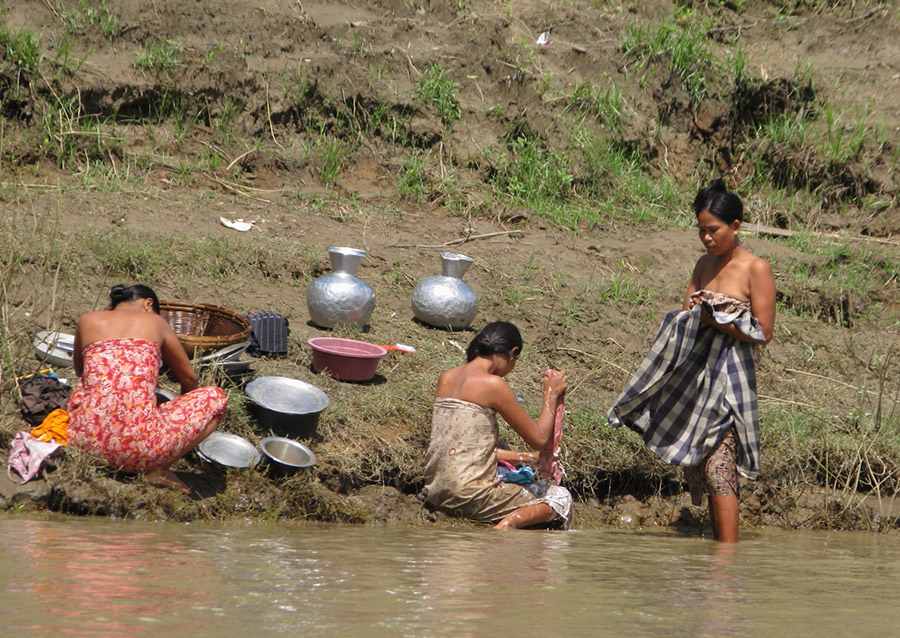
Women's Toilet along the Lemro River, Rakhine State
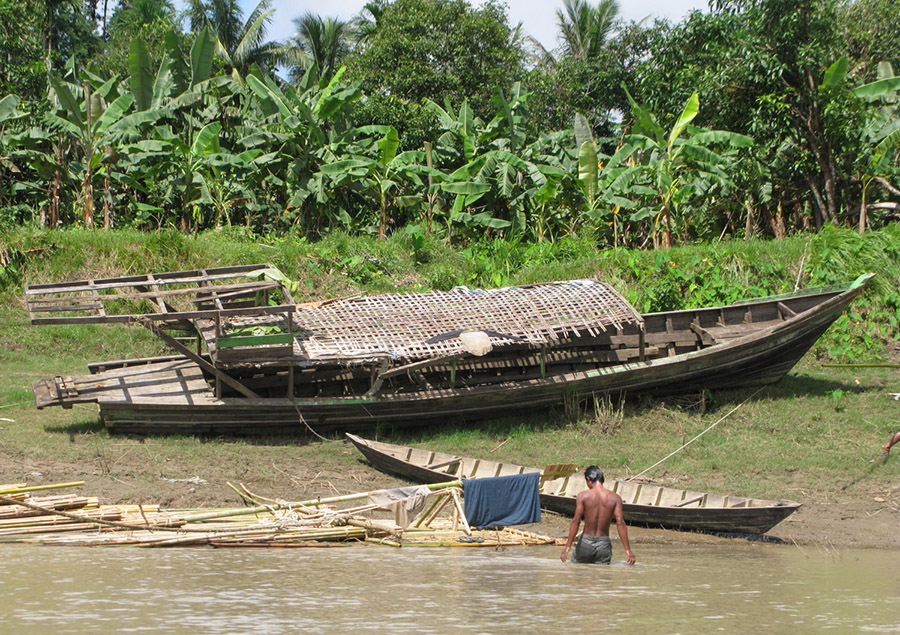
Construction of boats along the Lemro River, Rakhine State
A few hours up river, we reached two Chin villages. These communities were not happy places. While the Burmese successfully assimilated the locals to become Buddhists, they did not introduce health care or electricity. Nor has the government bothered in the seventy years since independence. The first young woman I met had an ovarian infection and no money to journey south to see a doctor. One of the Americans I traveled with was a doctor and operated the girl there and then with barely any equipment or pain killers. Clearly I had reached some kind of frontier.
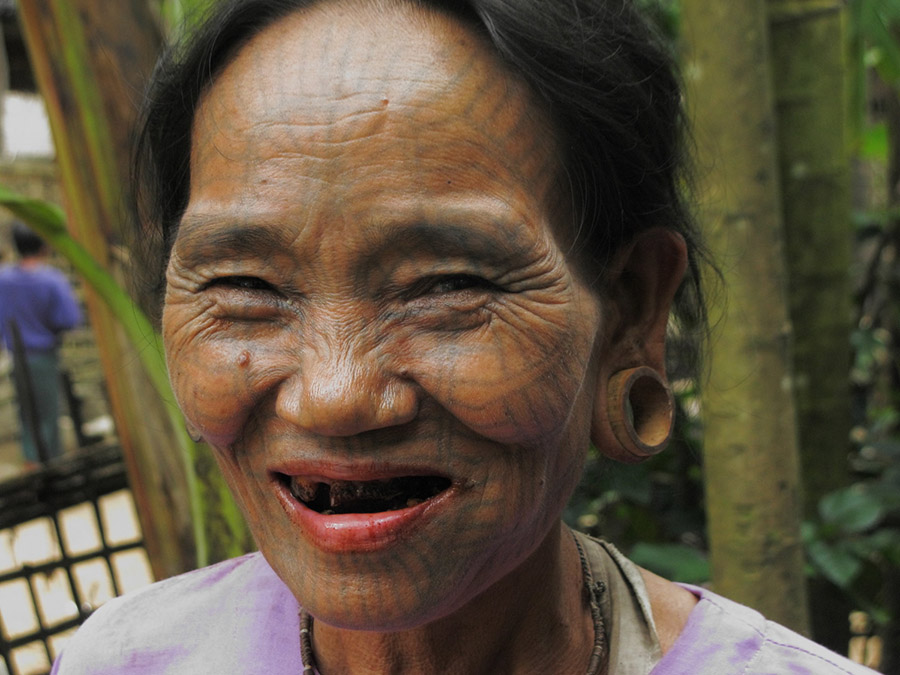
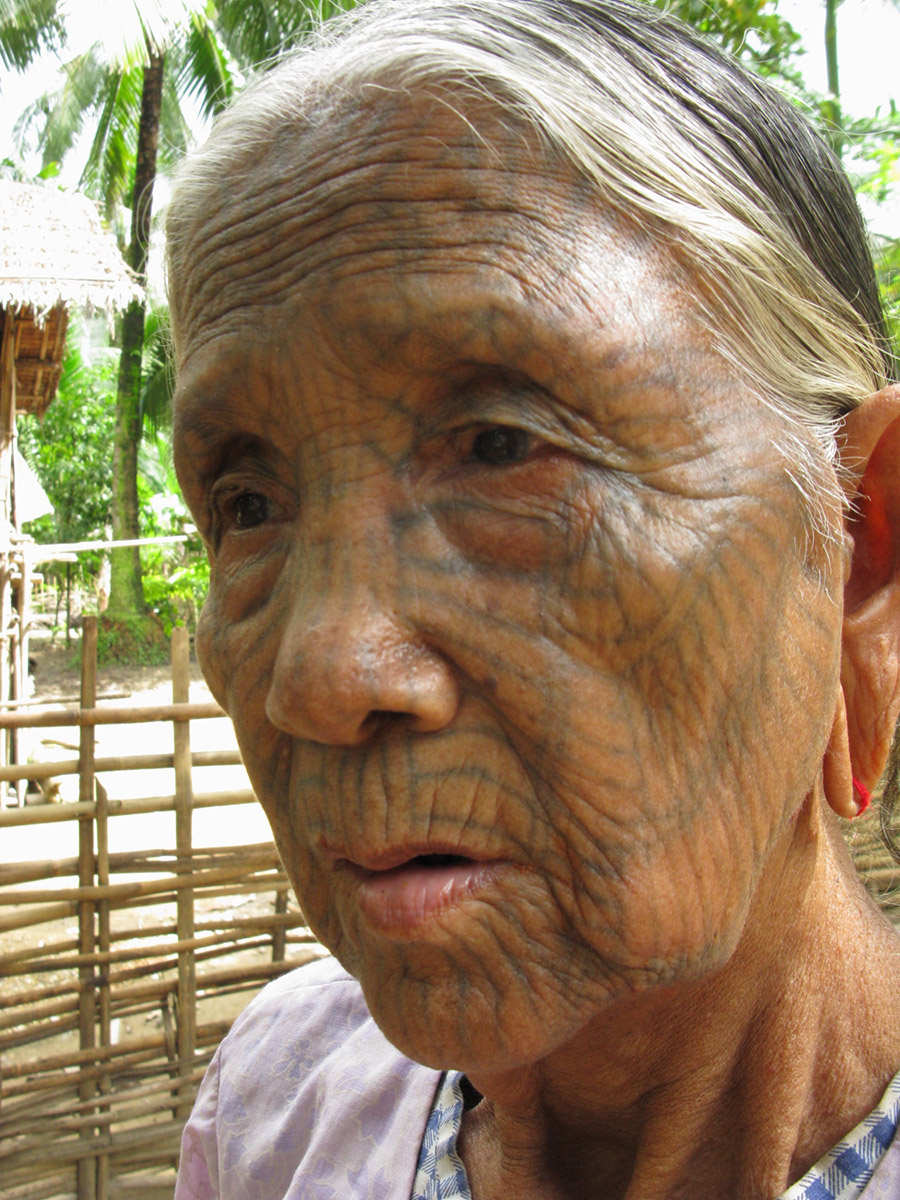
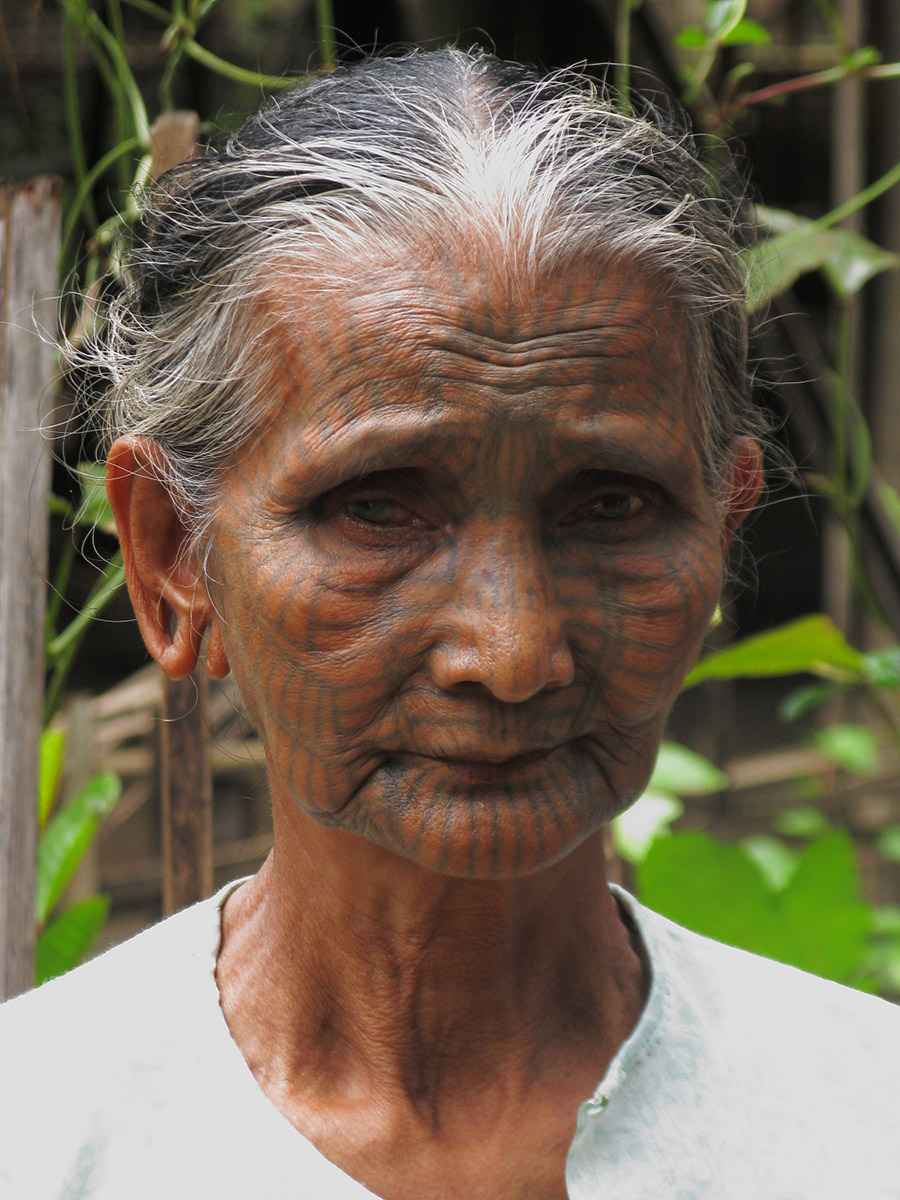
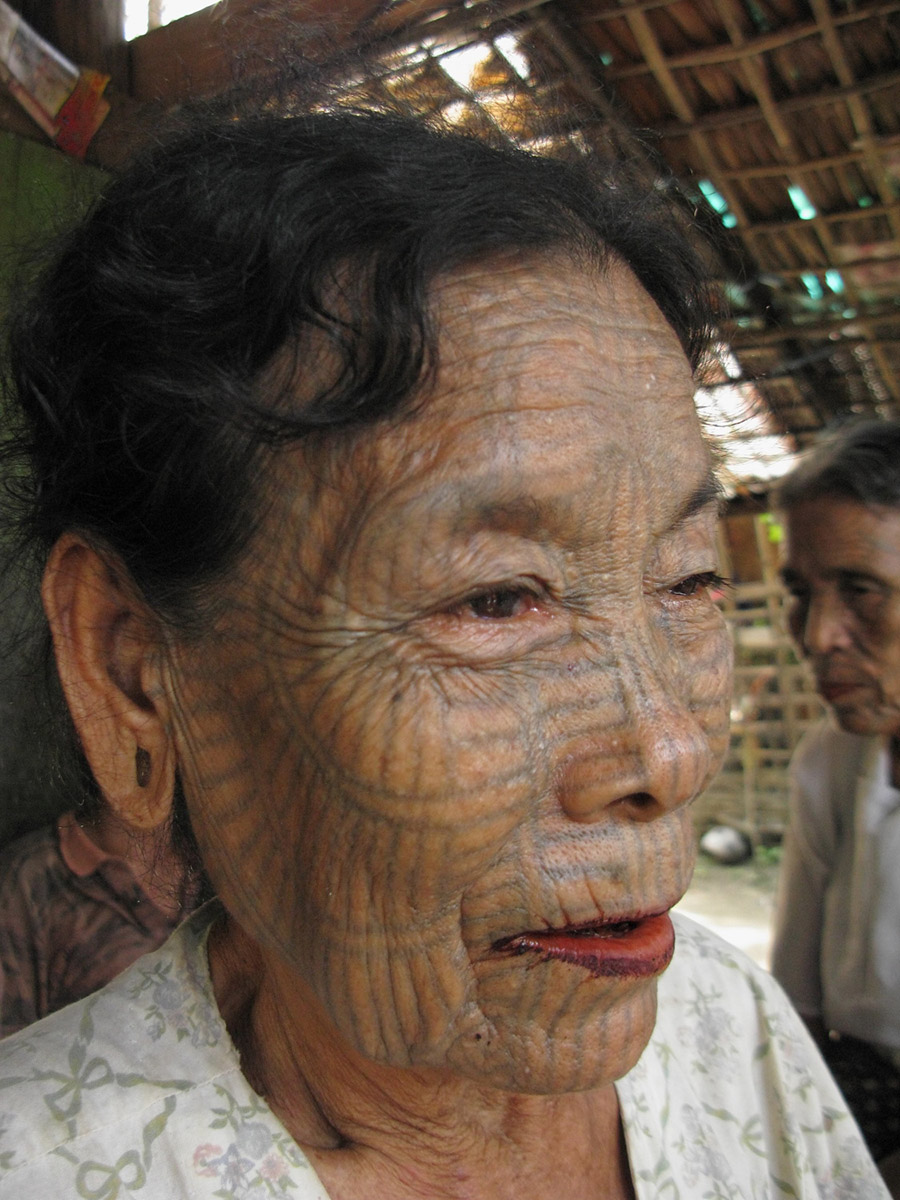
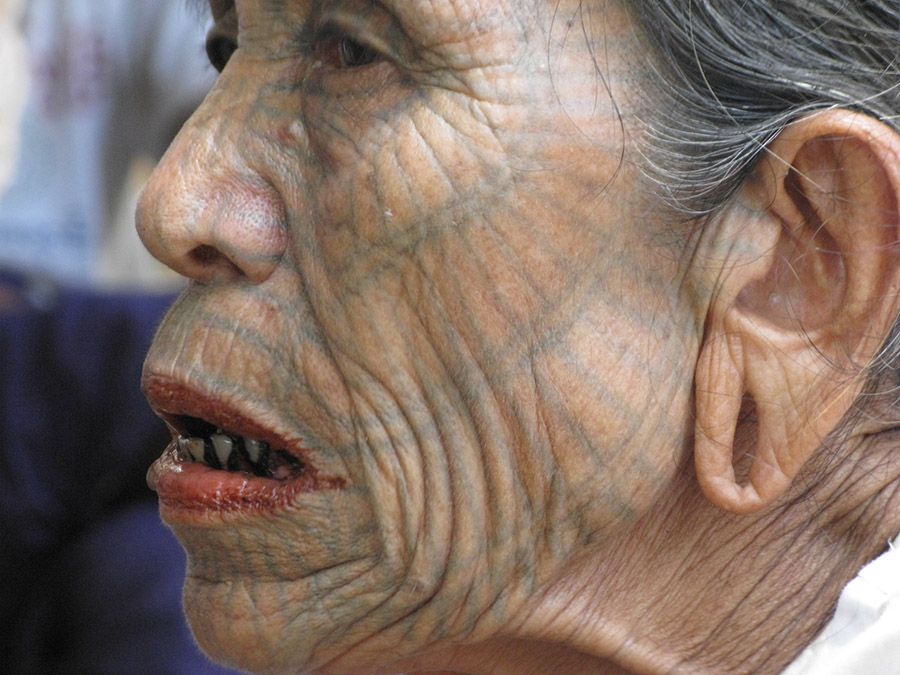
Many of the older women had face tattoos which brought a modest flow of tourist dollars. Ma Aung Seim told me, ‘I feel ashamed to have tattoos. I want to be Burmese. I was tattooed when I was ten years old. All I remember is the pain.” The fading geometric patterns have almost melted into the deep lines of her face.
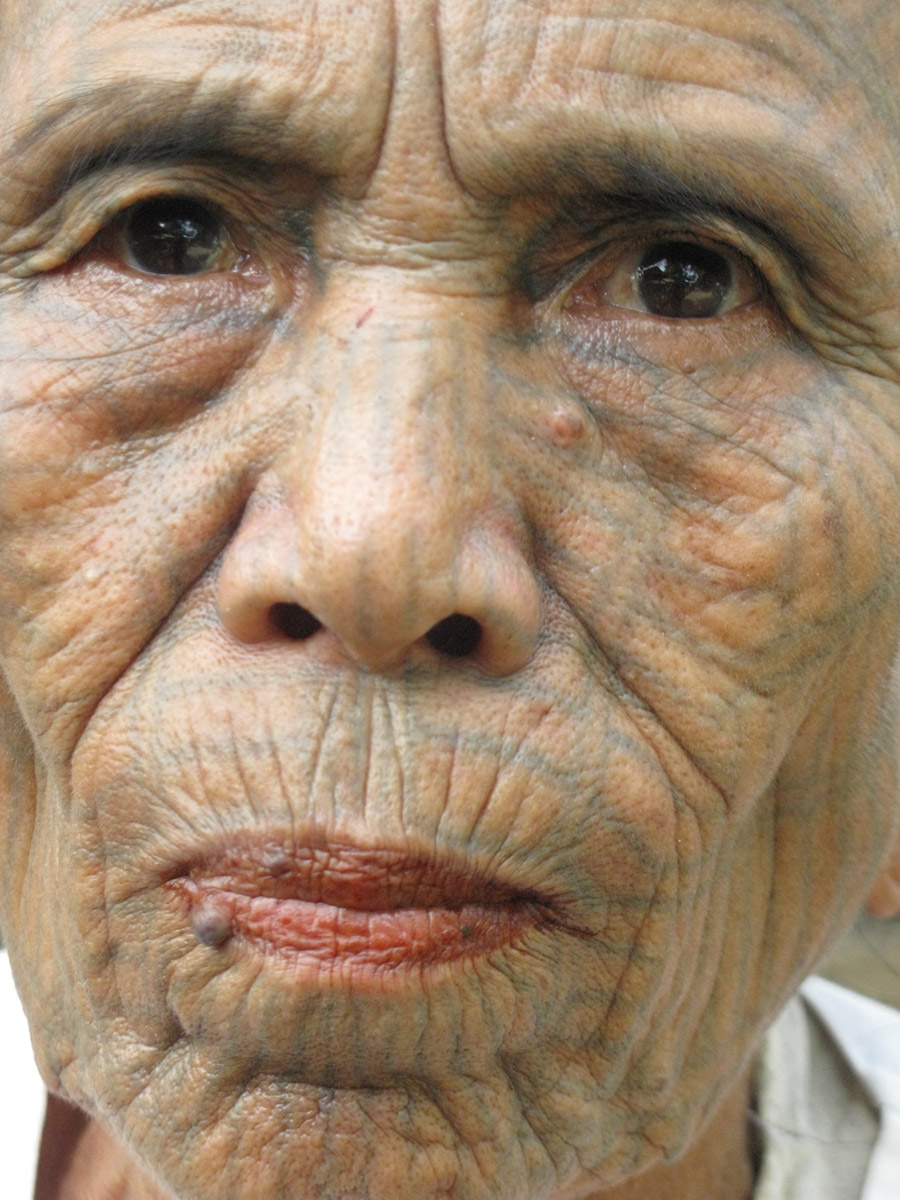
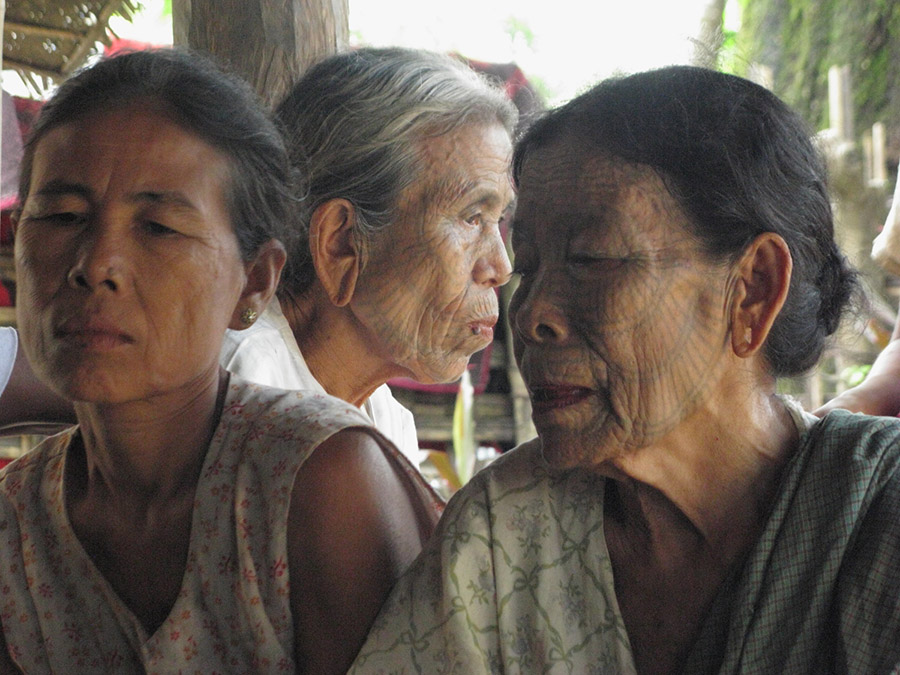
Michael told me that the tattoos have no religious significance. “These women were all tattooed to make them uglier so the chance of kidnapping by the former elite of the Arakan kings and by the Japanese during WWII was smaller. The Japanese wanted to use these ladies as comfort women, but the tattoos put them off.”
This story has been kicked around Burma in one form or another for eons: A Burmese king married a beautiful Chin lady and took her home to his palace. But his bride was unhappy with her new life and escaped. To foil her pursuers she carved lines into her face with a knife. This allegedly led to the traditions whose demise I was witnessing now.
But there is more to it than this. In the past the women of each community would wear distinct tattoo designs. Pa Mae covered the whole face including the ears and eyelids. Pa Pyouk covered the face with black spots. Pa Khyaung involved the carving of eight lines across each cheek. Pa Kyar was identifiable by four lines and four dots on the cheeks while Pa Wine mixed circles and lines.

Children of Chic Chaung Village, Arakan State
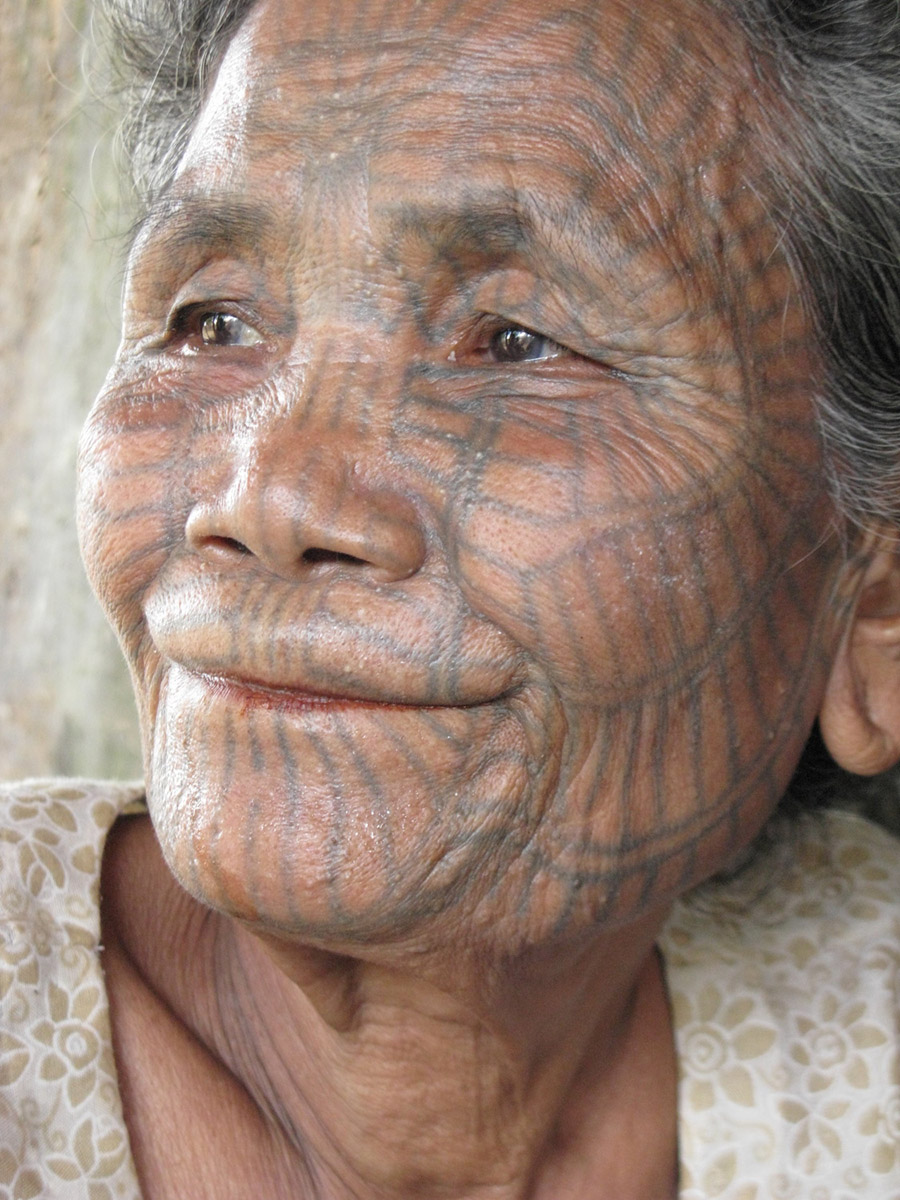
Ma Aung Seim, Village of Chic Chaung Village, State of Arakan
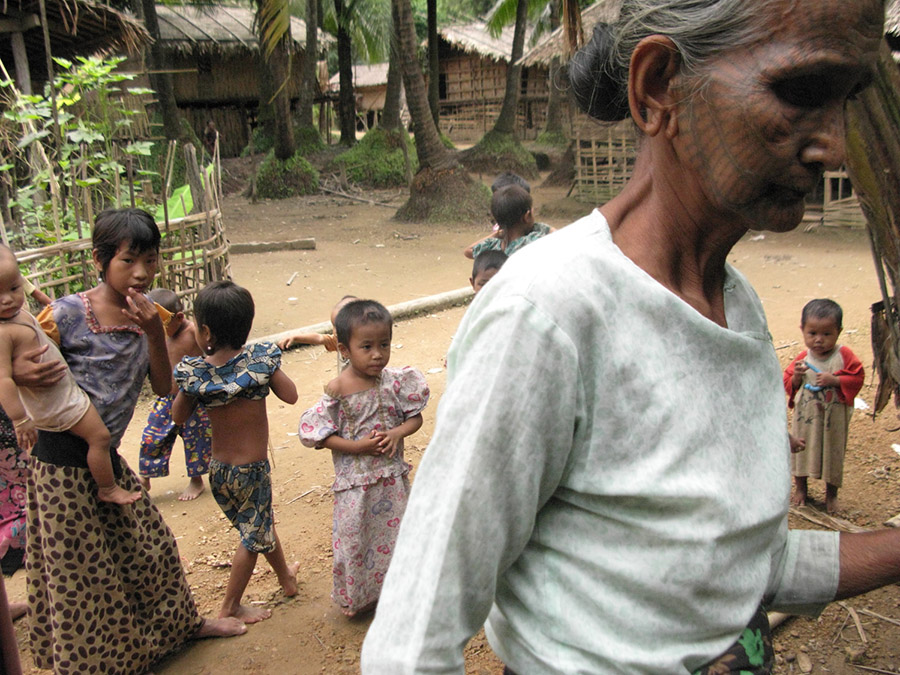
Chin women : what tattoos means?
Sadly, the old ways have been forgotten. The Chin women barely remembered anything about the significance of the incredible markings on their faces. Ma Aung Seim commented, “The tattooists are long dead. Our children and grand children think it’s silly. They want to be modern. We are the last. When we die, the tradition will die with us.” But clearly, despite her vocal misgivings, she and her friends were quietly proud of their tattoos.
“In the past, girls with face tattoos were considered beautiful.”
The contradiction the chin women experienced between once seeing themselves beautiful and now defining their markings as ugly stemmed from government repression – punishment for getting tattooed tattoos included losing livestock to the state, and this law remains in place to this day – which goes some way to explain the public denial of their culture.

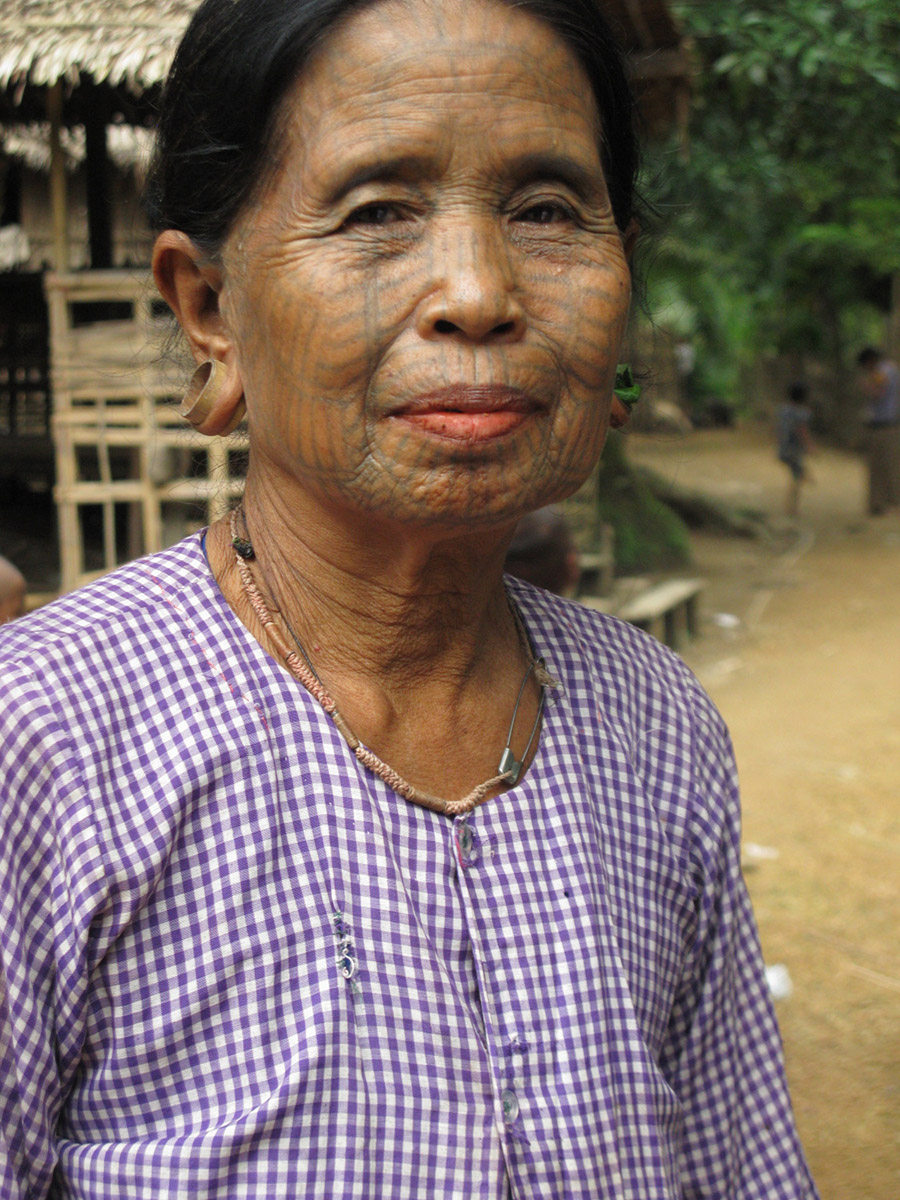

In each village a handful of families lived in simple bamboo and rattan huts on stilts, the undersides populated by chicken and pigs and sick looking, undernourished children. The school was a ramshackle barn with holes in the floor large enough to swallow a child. The teacher was a teenager who had failed his teaching test twice. He shouted at the children, aged between five and ten, and all of them Chin, in Burmese. They shouted right back at him. By the time they grow up, there will be little left of their culture. Asked about the changes modernity was bringing, Ma Aung Seim told us that further up river thousands of Chinese workers were building a dam.
I felt like I was too late, the moment for these people had passed, they were being assimilated without opportunity. Their tattoos speak to us of a past almost forgotten, and certainly suppressed.
Back in Yangon I met Jerry, tattooist and owner of Jerry Ink, a local tattoo studio. He was half Chin and was planning to visit Chin State to research his ancestors’ tattoo traditions. “Tattooing is incredibly popular amongst young Burmese. I hope I will find some traces of old traditions in my home state. I want to reintroduce the Burmese to our common past.”
He will have to hurry.

RETROUVER TOUS NOS CONTENUS, PHOTOGRAPHIES , GALERIES TATOUAGE ET OUTILS 3D SUR L'APPLICATION
ATC TATTOO
Indian Ink : Chapitre 5 - Bombay Boys Sameer & Eric
Texte : Laure Siegel / Photos : Tom Vater
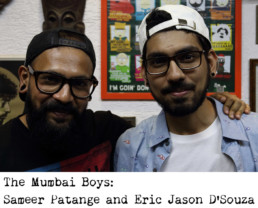
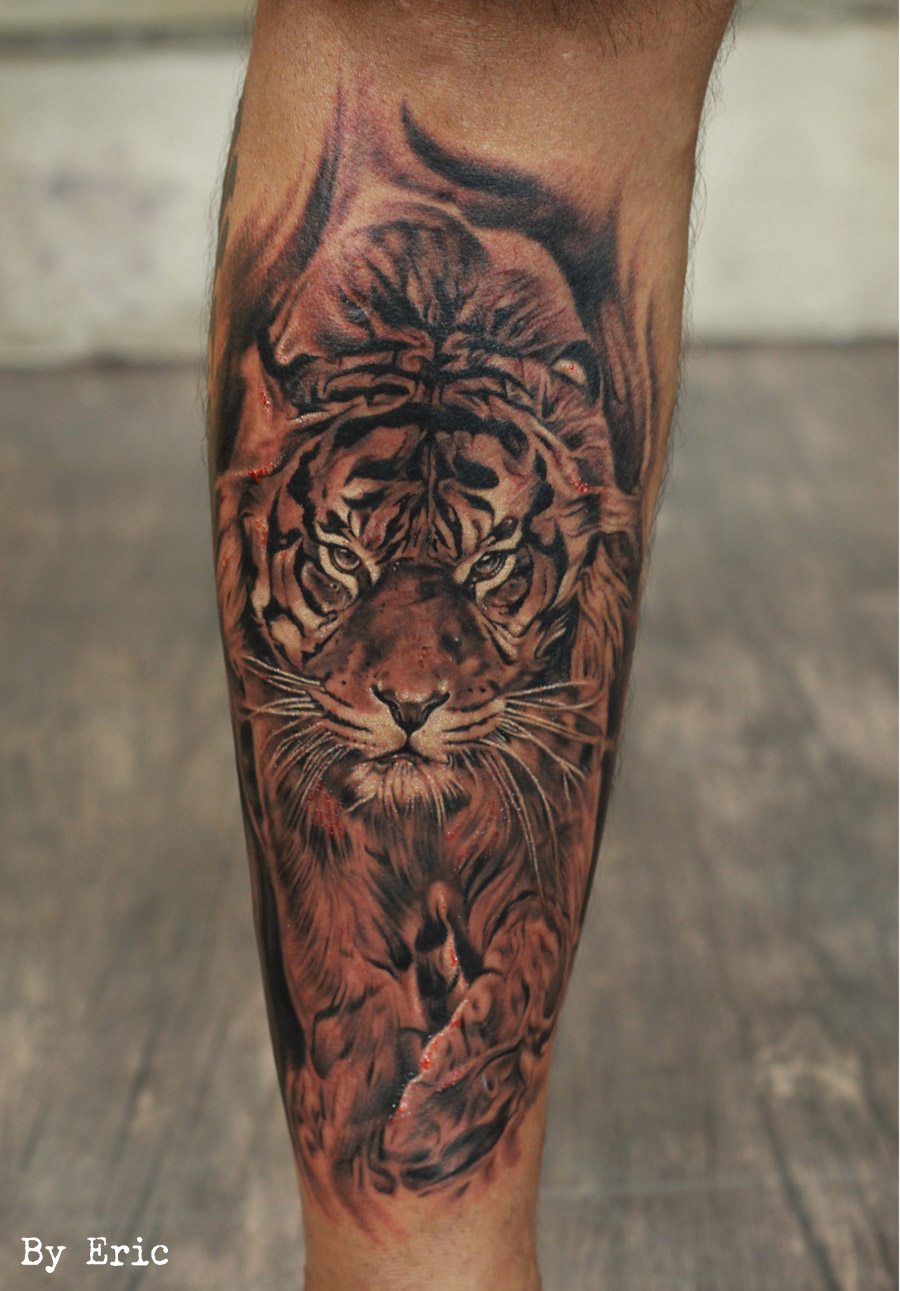
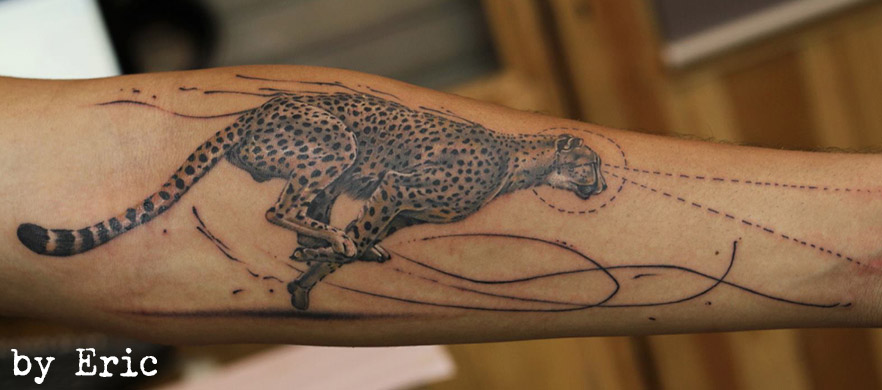
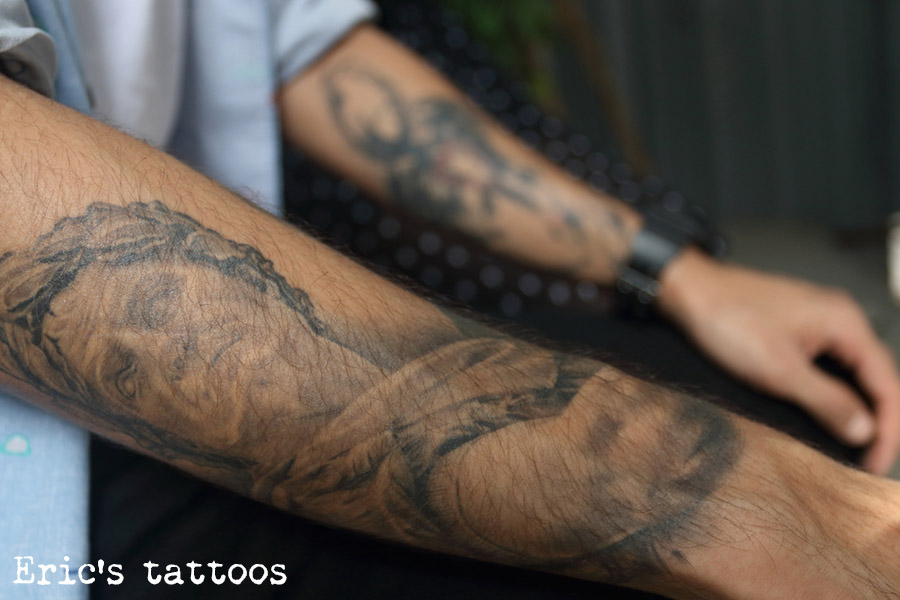
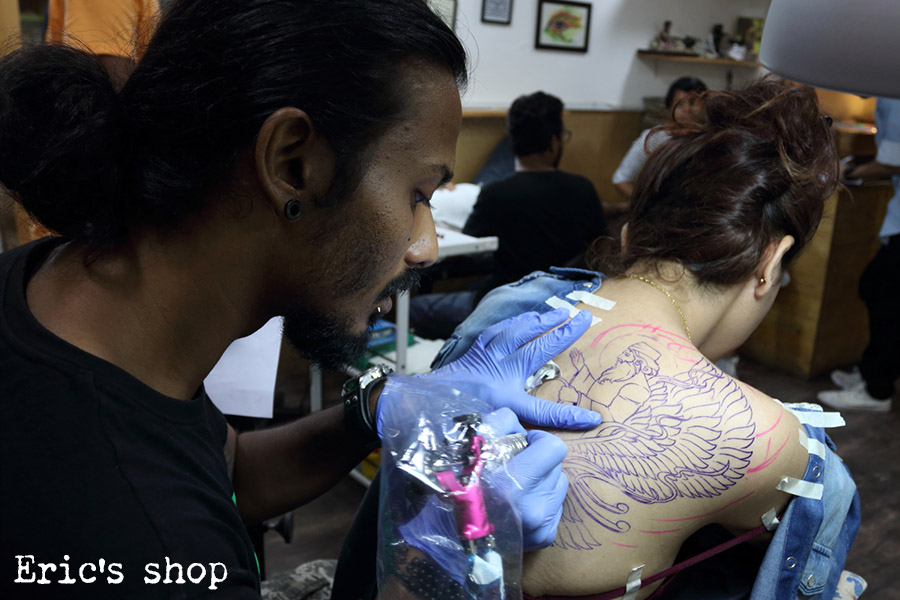
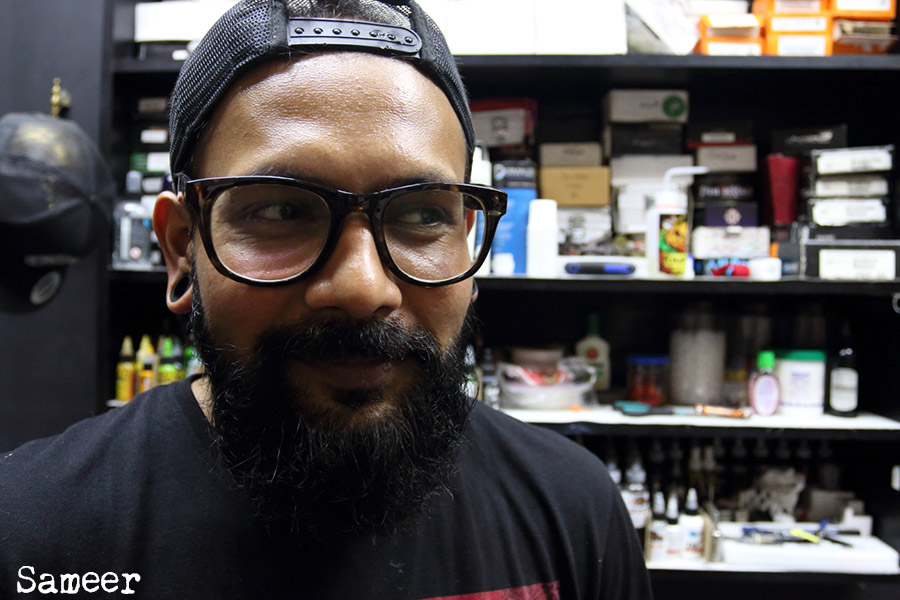
We met tattoo artists Sameer Patange and Eric Jason D'Souza over steaming bowls of goat brain soup in Bhendi Bazaar, the Muslim district of Mumbai on the first night of Ramadan. Both accomplished and renowned artists, Sameer and Eric sketch the contours of the future of the tattoo in India, beyond clichés.
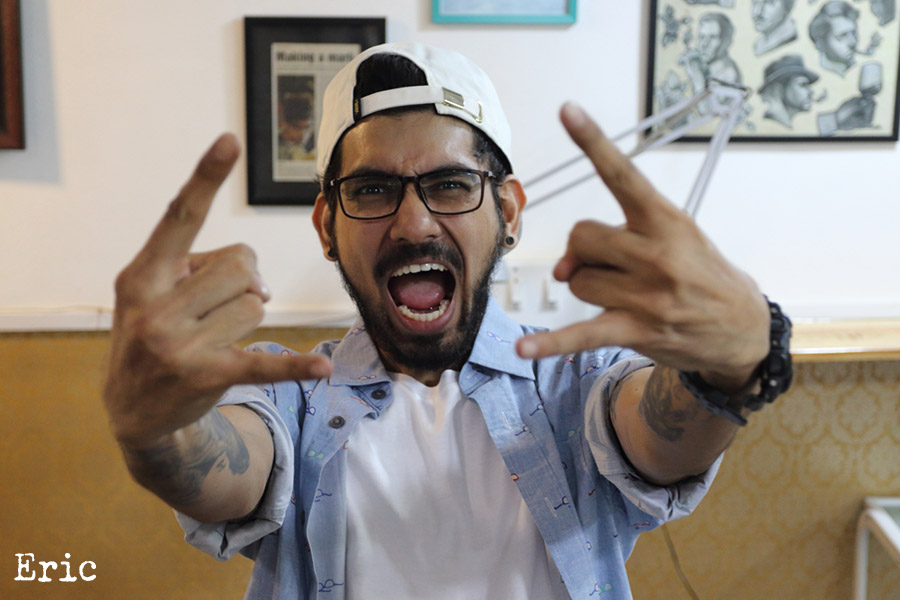

India tattooing futur
Every year in September, the wealthy neighborhood of Bandra turns into a huge week-long fair in honor of the Virgin Mary. Eric first experienced the event at age twelve, a cross on his hand. "My parents are Roman Catholics from Karnataka, I am not an active follower, but I still consider myself to be part of the Christian culture." For most Indians, the first tattoo is usually religious, Lord Shiva for Hindus, Jesus for Christians.
At fourteen, Sameer was more of a black metal dude and had the same design as Phil Anselmo, the singer of Pantera, inked onto his arm. "When I got home looking like that, my parents threw me out. I wandered the streets for three days and eventually came across my father who had been looking for me. He told me to go home and not take everything he’d said to me so literally... "
Sameer, now thrirty-six, recalled the context: "There was a big divide between rural India and urban India. In the cities, until the late 1980s, only gangsters, junkies and street people who got tattooed. No one wanted to be associated with that."

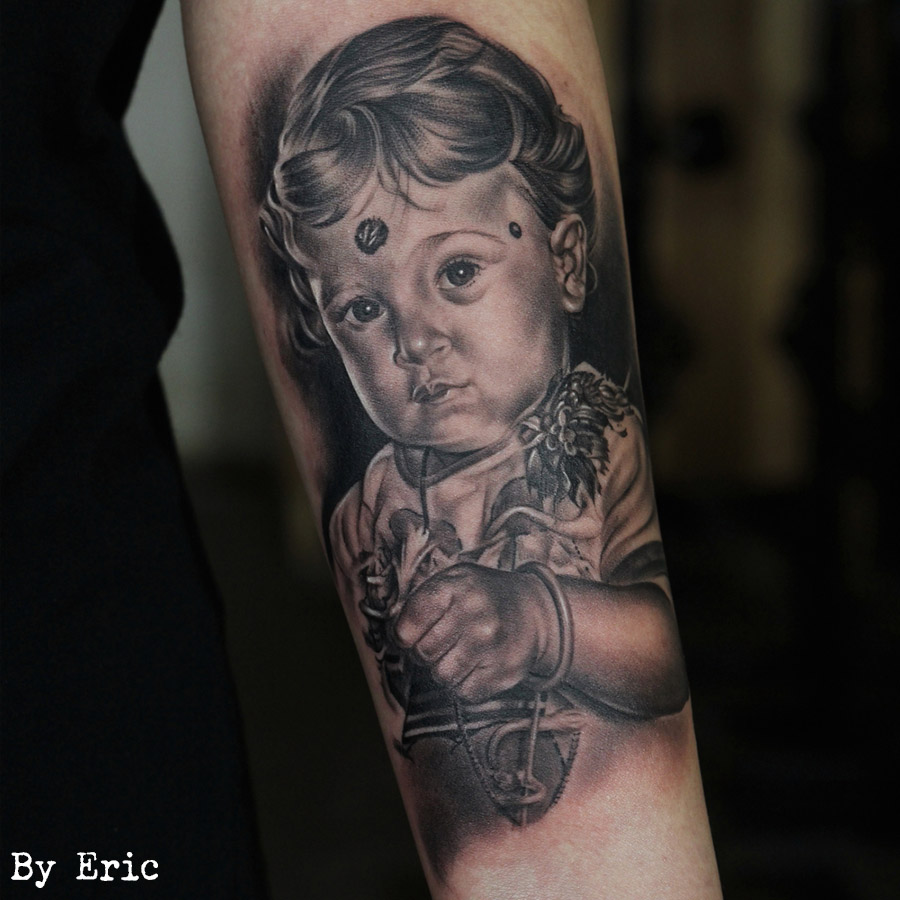
But Sameer and Eric got into tattooing as soon as they managed to push social and financial pressures aside, seeing the craft as a blessed opportunity to live off their passion. "I was a professional soccer player and worked in a call center but I left this horrible job and got serious about art. Ten years ago, no family would have let their child go quietly in this way, because it was not a real career. Today there are even opportunities to study graphic design," says twenty-eight year old Eric.
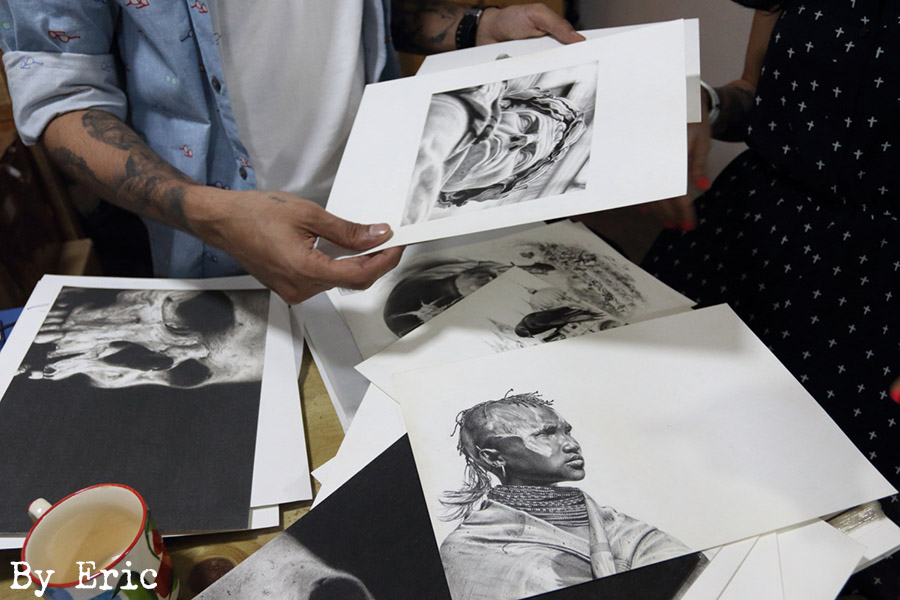

Sameer Patange and Eric Jason D'Souza à Bhendi Bazar : tatooers
Sameer was trained the old fashioned way, by India’s tattoo pioneer. "I was sixteen, my buddies were fans of Axl Rose and BonJovi, the glam rock style was really big in India in the 80s. They wanted the same tattoos as their heroes and asked me to draw the patterns for them." They decided to go see Dr. J.A. Kohiyar, a psychiatrist who had learned to tattoo in London during his studies.
"When Kohiyar returned to Mumbai in 1973, he started tattooing old school flashes at home. He is considered the first "modern" tattoo artist in India.The Doctor was impressed by my drawings, so he hired me as assistant. He also trained Anil Gupta, who later became a super star in New York. »

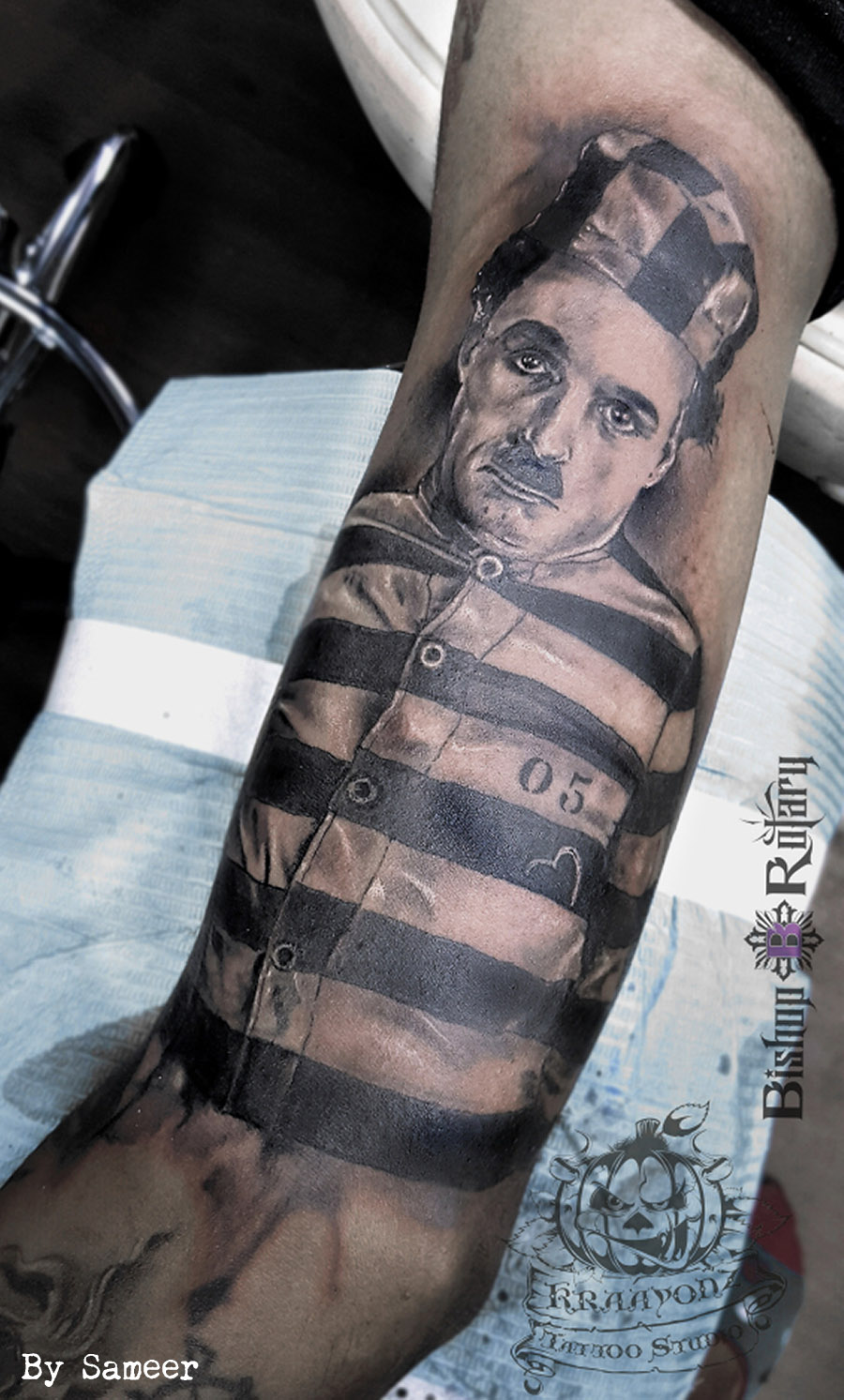
Eric adds, "Kohiyar is a legend, a big part of the history of India. I refuse to do copies of his tattoos even though people come to see me asking for them. It would be disrespectful".
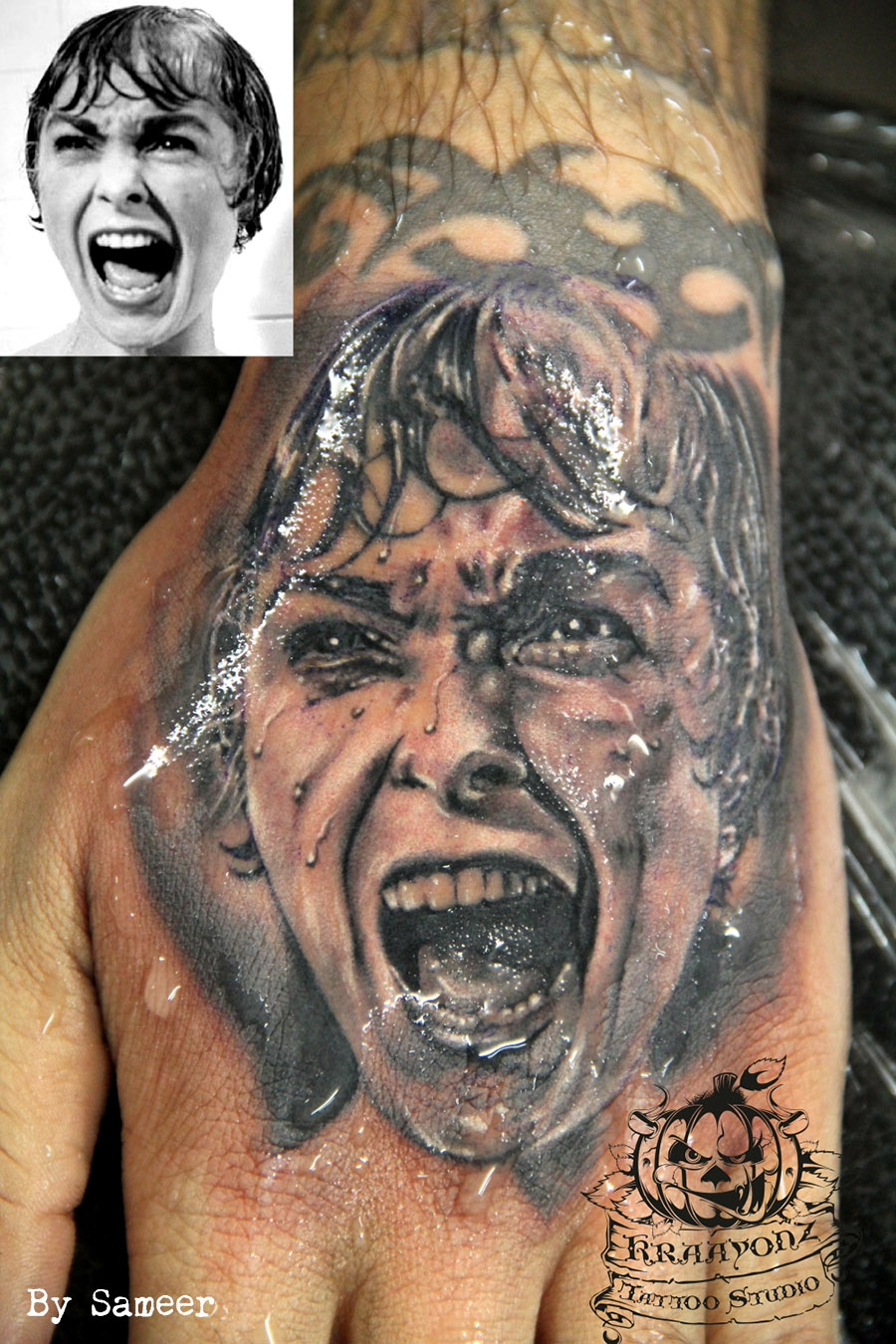
Sameer nurtured his artistic culture, admiring Dave Mc Kean’s collages and Jim Lee's superhero sketches, while spending his weekends at the doctor’s, who finally let him tattoo after two years. "I learned everything with my master. I am open to all styles but I love realism, technical challenges and the emotion of tattooing portraits. In the evening when people go home with their new tattoo, they talk about you and they are happy.”

When he felt Sameer to be ready, Kohiyar let him go and find his way. "I had a lot of media exposure after being inducted as the youngest modern tattoo artist in India at the age of twenty, but I really integrated the tattoo world in 2004. Tattooing was radical at that time."
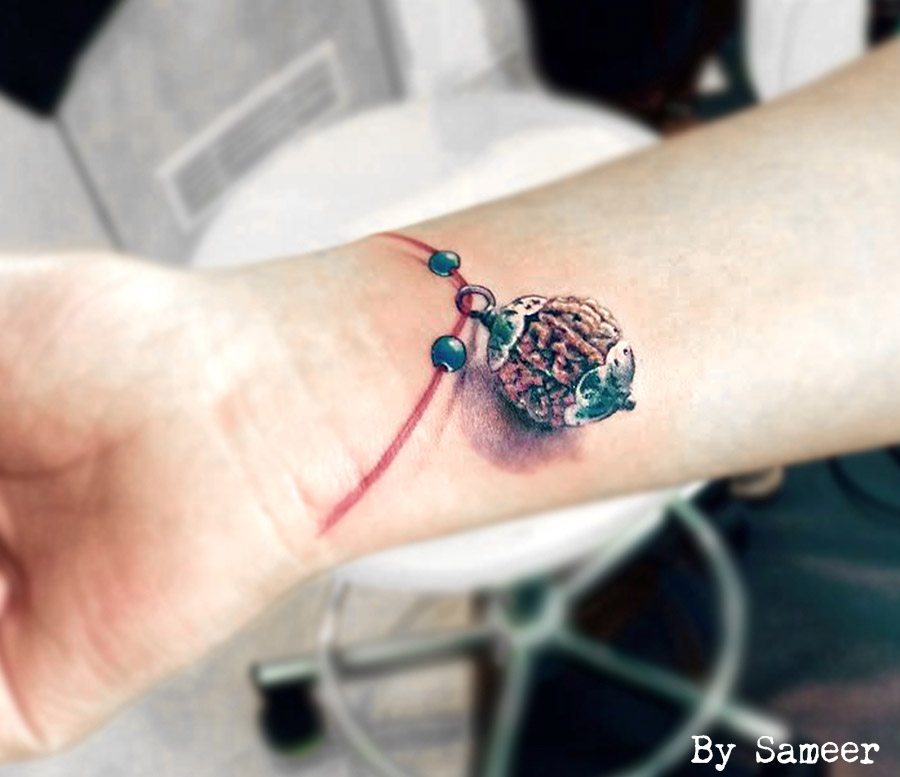
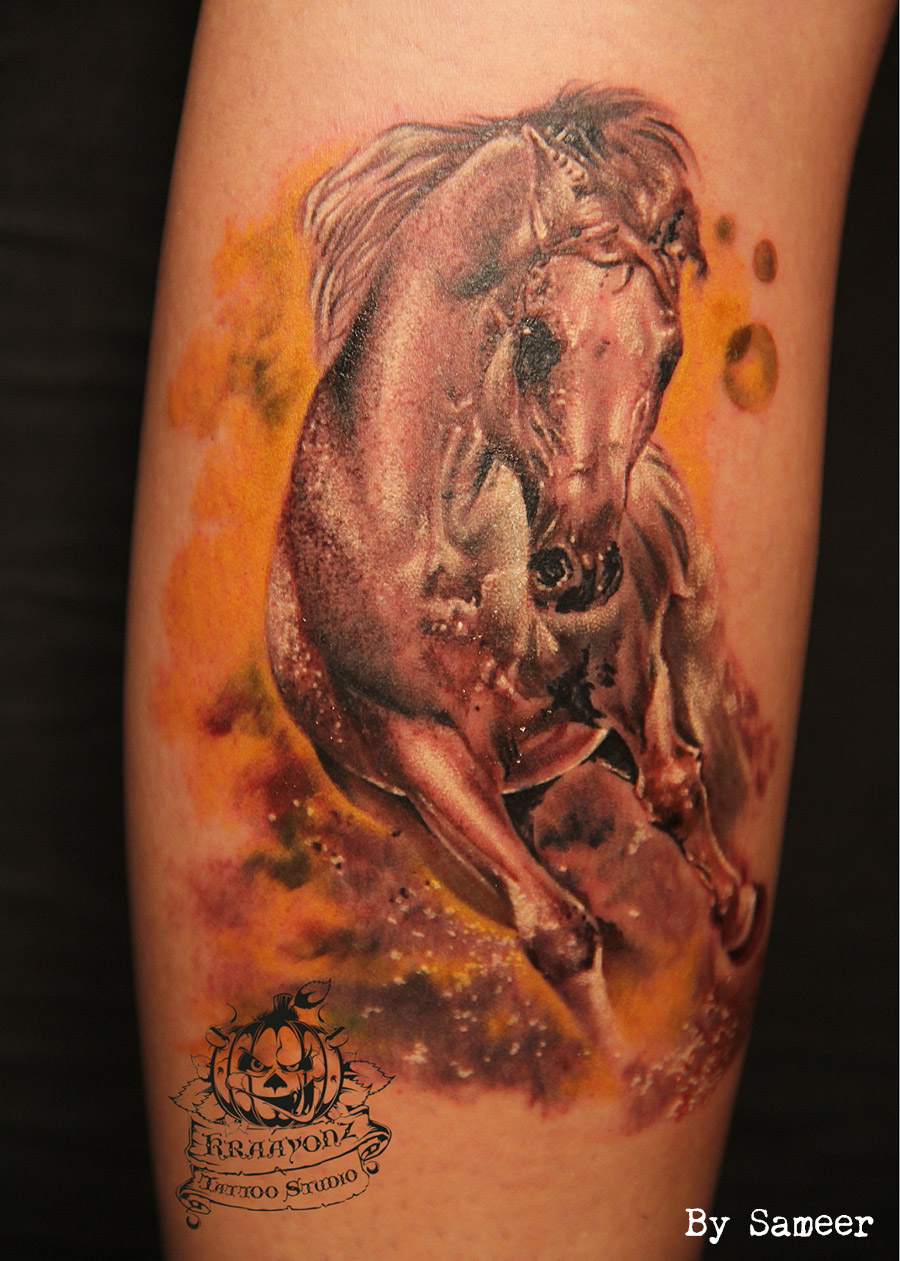
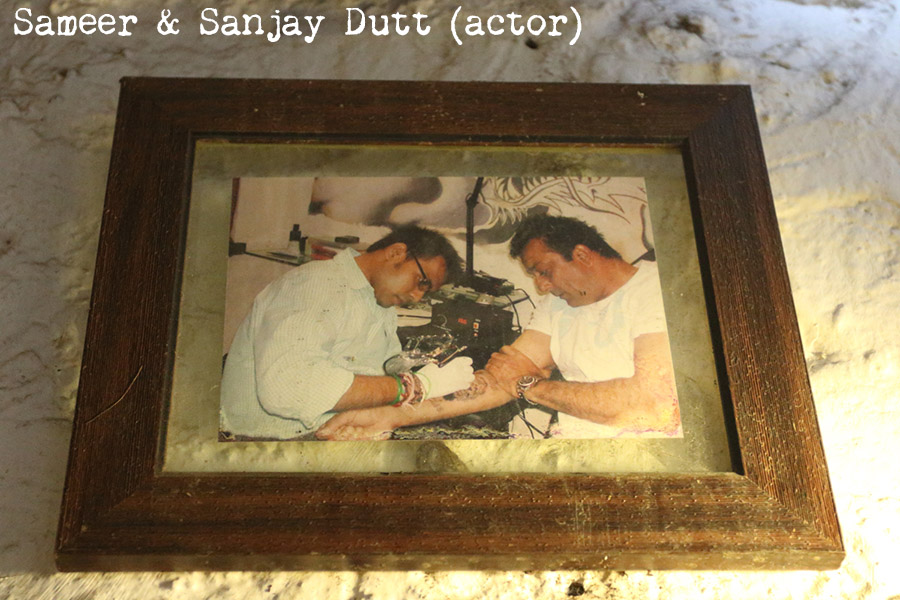
In 2008, Sameer opened his own studio, Kraayonz Tattoo Studio. Since then, he has opened three more shops in Bangalore, Pune and Goa. The latter, a trance temple and hippie paradise, is the other bastion of the tattoo in India,. He employs fifteen to twenty people, manages the apprenticeships of several tattoo artists, and undertakes about three tattoo sessions per month. All this while being one of the favorite tattoo artists of the Bollywood stars.

Sameer's first shop was in front of a courthouse. One day, Salman Khan, one of India’s best known and most controversial actors, emerged from the building. He’d been on trial for crashing his car and killing several homeless people.
"To calm down, he came into my shop and asked for a tattoo," Sameer recalls. Since then, dozens of stars have visited his studio. Sameer refuses to tattoo outside of his shop and does no special favors for his famous clients though he does leave his studio to draw temporary tattoos on film shoots. "I always take my whole team to the studios. I like my guys to see the same thing as me and discover different universes. »

Mumbai beginnings
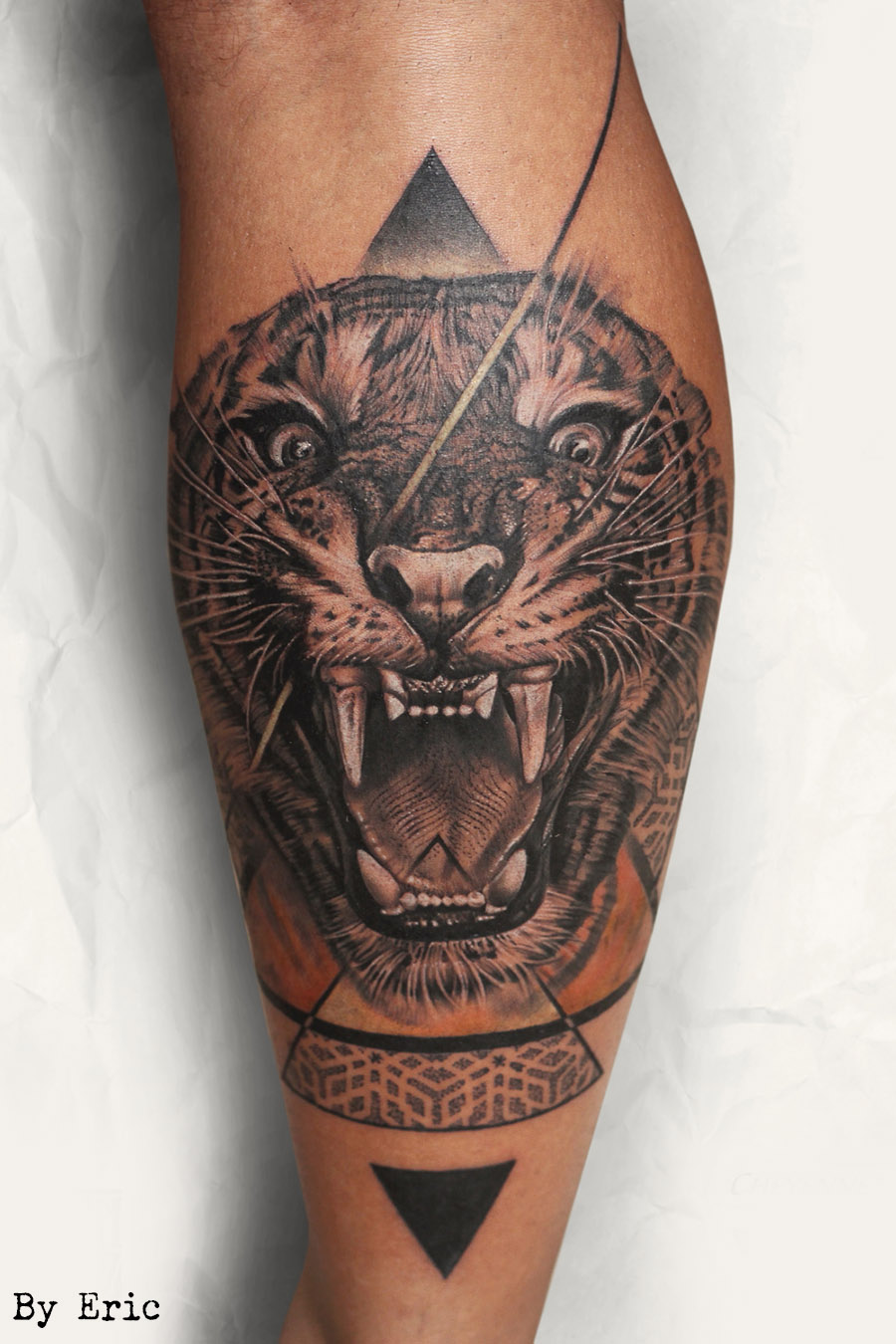
Sameer remembers Eric’s beginnings, who had just finished his first apprenticeship with Vikas Malani (Body Canvas): "Eric was my most sincere student, assiduous ... and super popular with girls. It was good for the shop! ". Eric stayed with Kraayonz Tattoo for five years. "At the time we had never been to a tattoo convention, so the Internet was our main source of inspiration. Sameer looked at the portfolios of artists from around the world and then taught us the lines. The style I started with was black and gray shading, then I moved on to traditional and finally realism, my specialty today. »

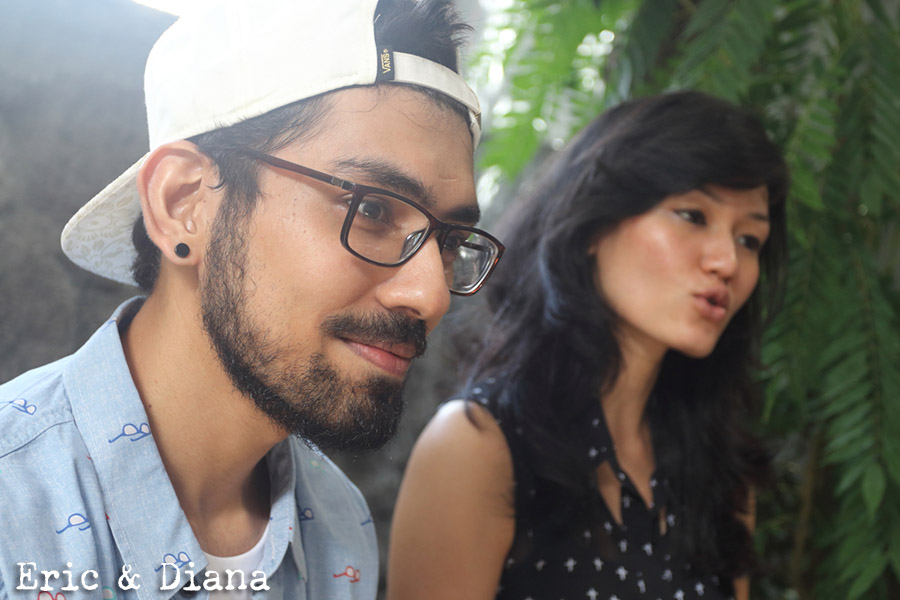
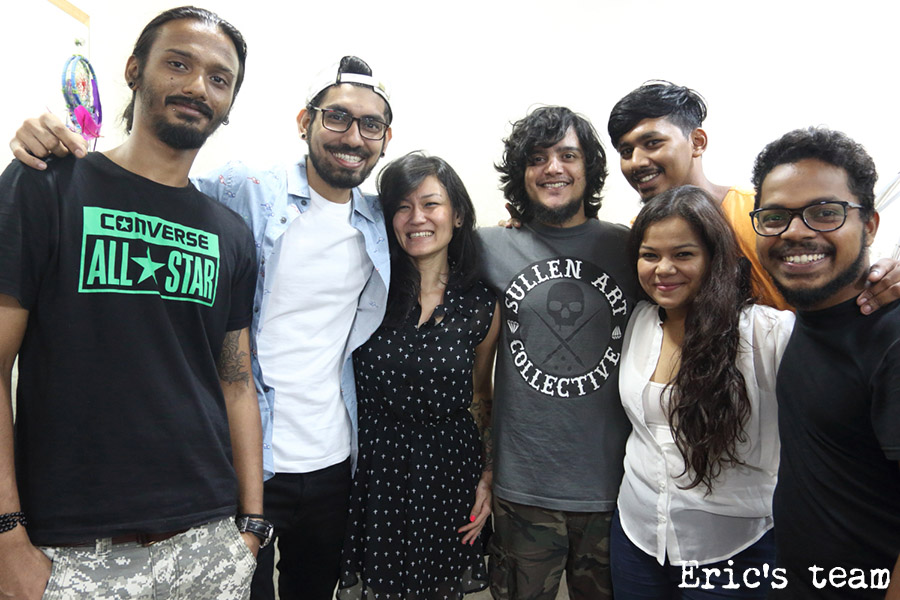
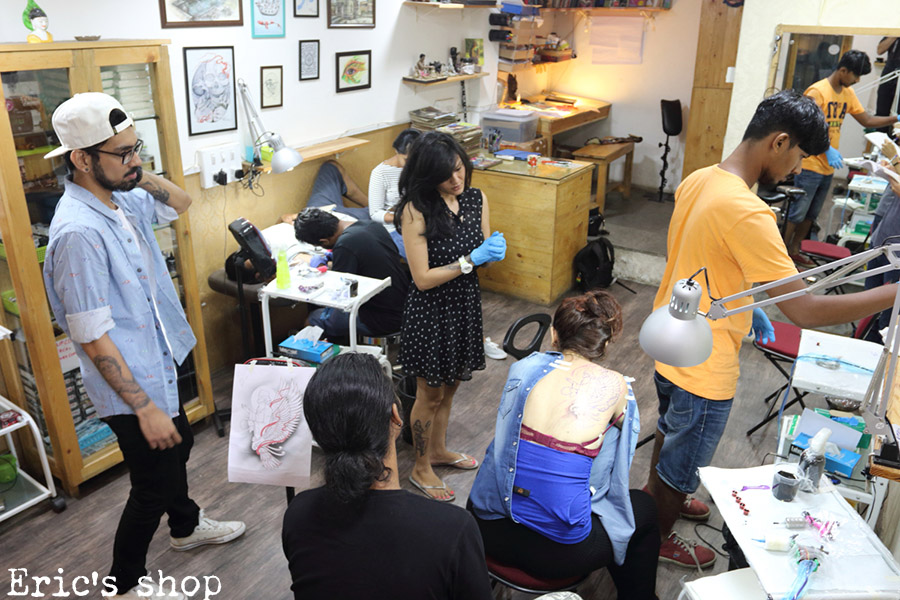
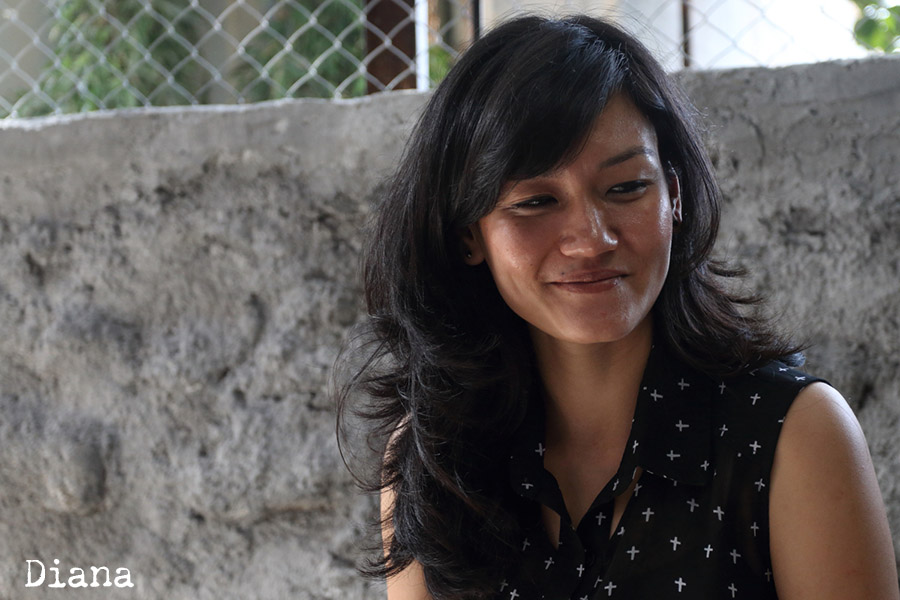
In Sameer’s shop in Pune, Eric met Aishin Diana Chang, who had been the manager of another tattoo shop in this student city since 2008. The young couple returned to Mumbai in 2013 and opened Iron Buzz Tattoos. Diana, a 33-year-old granddaughter of immigrants from Hong Kong, believes strongly in the promises of the "Dream City", Mumbai’s nickname: "If you work hard, you will make it," she says. The young couple work six to seven days a week to pay the $ 2,500 rent for the small building that serves as both their shop and apartment. Mumbai, Maximum City, is India’s financial capital and therefore the country’s most expensive city where the simple issue of housing strangles a generation of ambitious young people. But Eric and Diana stood firm and announced the opening of their second shop in Pune in June 2016.

The Mumbai Boys want to make the scene that has given them so much more professional. Things really fell into place at the Kathmandu convention in 2015, where some thirty Indian tattooists had made the trip: "Nepal, this tiny, poor and dysfunctional country has been organizing a brilliant convention for seven years now, and that has been a great inspiration for us and pushed us to move to organize a quality event purselves," Sameer explains.
A tattoo supplier has been organizing a convention in Delhi since 2011, but the accompanying burlesque show with half-naked girls didn't go down well.
"Too early for India!" Eric shouts. "New Delhi is a political and orthodox city, it was too daring." People were demonstrating in front of the convention, holding up billboards with messages like "Stop this dirty dancing!" It was chaotic.”

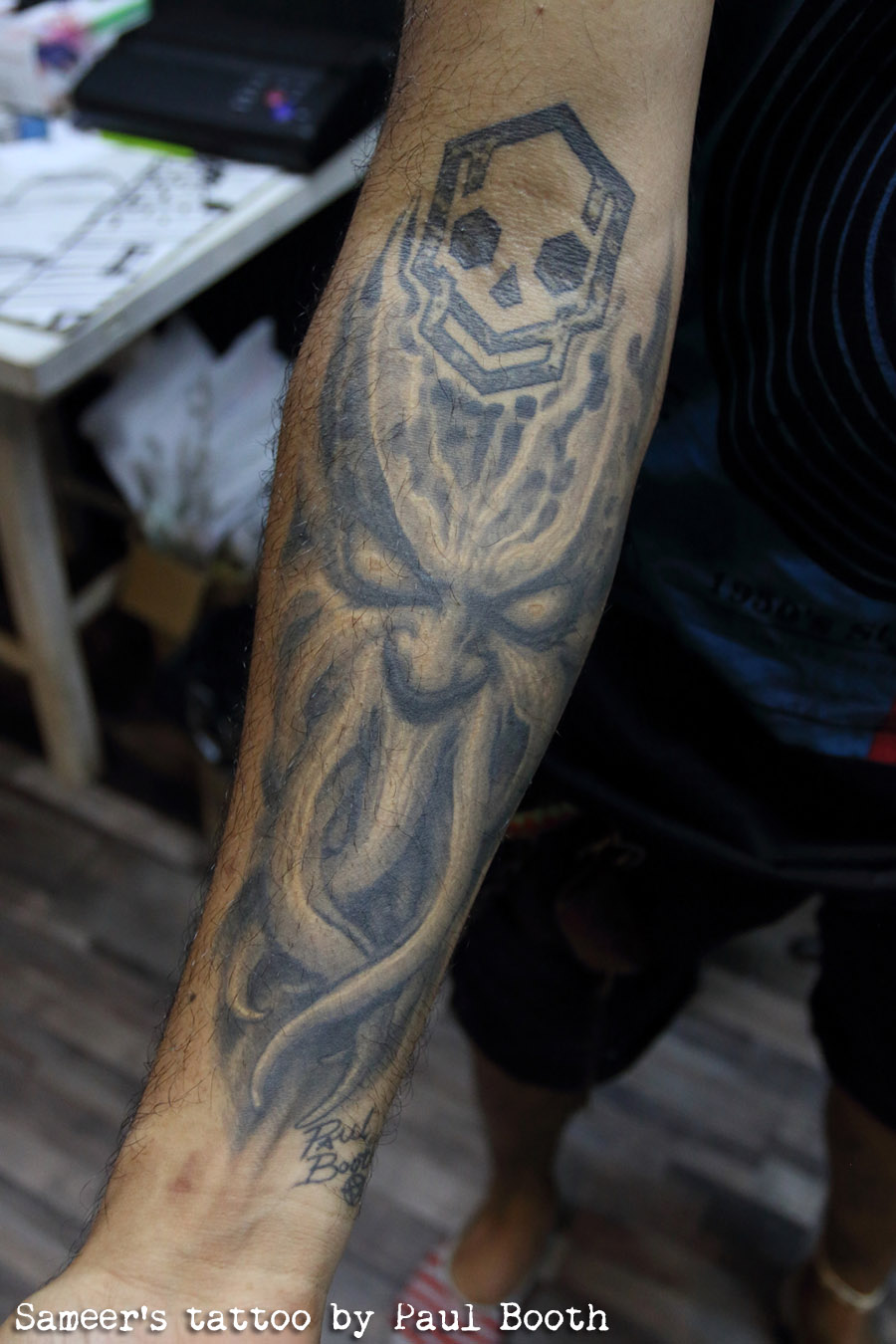
For Sameer, the journey really began at the Singapore convention in 2010. He watched Bob Tyrell work, a key moment in his life, and became friends with Paul Booth. In December 2015, Booth, the pope of black and gray, accepted an invitation to the Delhi Convention, co-organized by Kraayonz, Devil'z Tattooz (Delhi) and Tattoo Gizmo. "He wanted to take the opportunity to visit India and see the Taj Mahal. He loved it, he even offered us a tattoo on the forearm to thank us. »
The convention was a great success: "This city is much more conservative than Mumbai but paradoxically it is also home to India’s fashion industry. If a guy has paid 10,000 rupees for his tattoo, his neighbor will want the same one but pay 20,000 rupees. Delhi is a city in which people do stuff to be seen. That may be for all the wrong reasons but not a single artist sat around arms dangling over the weekend. "
Sameer remembers less glorious days: "I stayed up until 3-4 in the morning to call Europeans or Americans and invite them to our convention, most of them were laughing when they heard that I was calling from India. We still have a bad reputation and it sometimes makes me bitter that we are considered as cruddy amateurs. India is certainly poor, but who can argue with the artistic profusion, we are an incredible civilization. It’s my ambition to get the West to look at India with respect.”
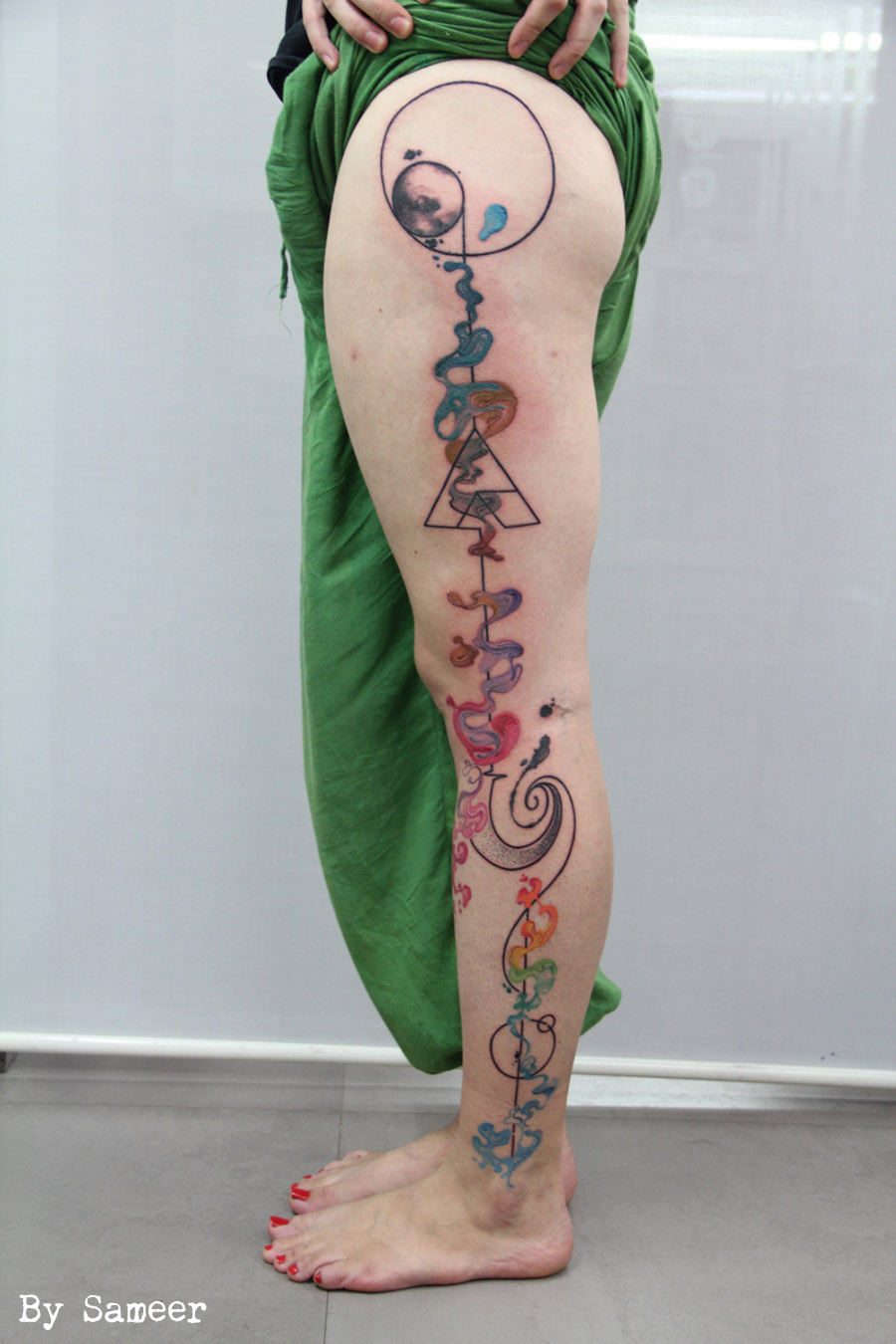
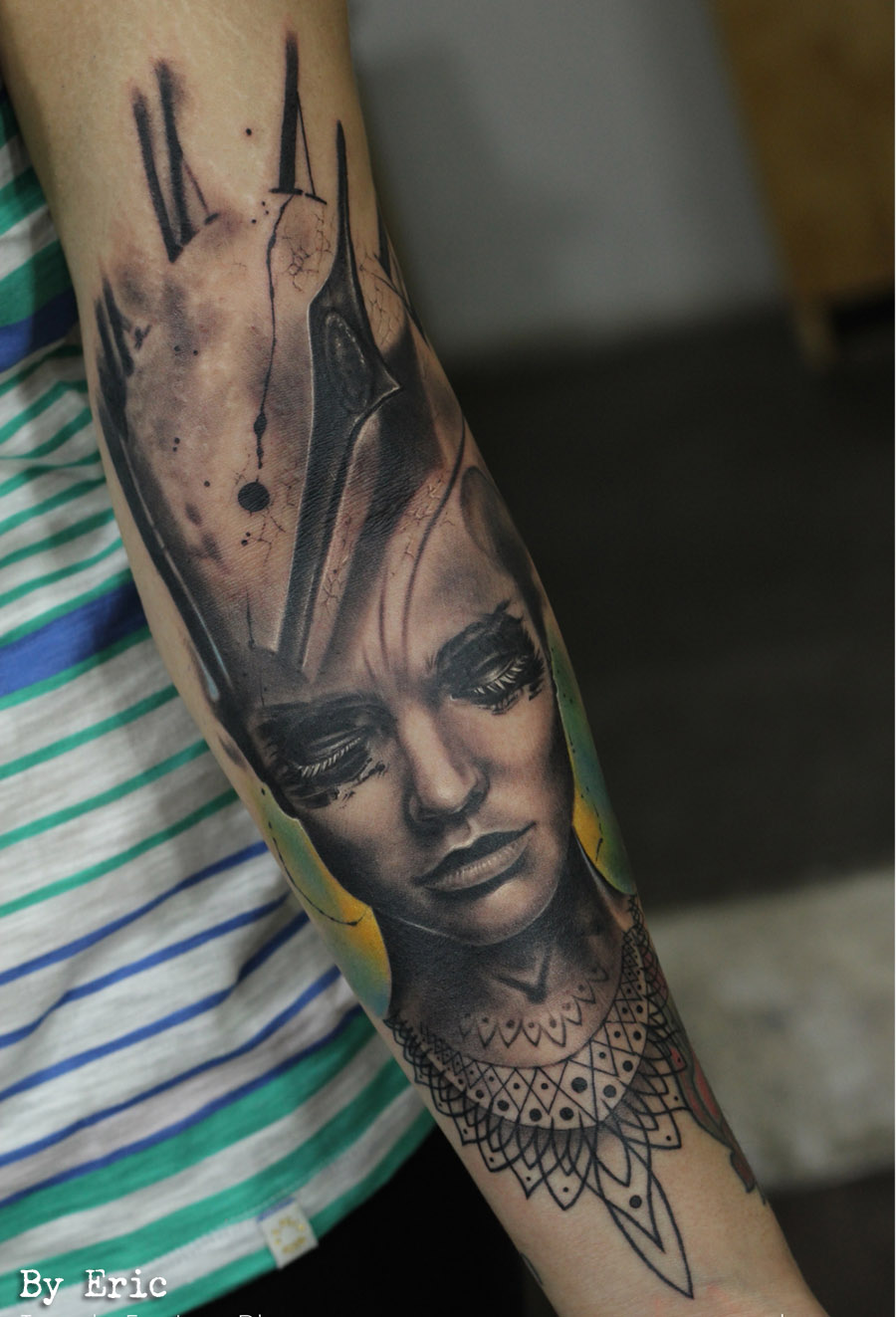
The next challenge is to bring back the India’s ethnic tattoo traditions, an obvious source of inspiration that is hardly valued. "Maybe if Angelina Jolie came to get a tattoo in Rajasthan and not in Thailand, it would be the Indian ethnic tattoo that would have experienced a boom and not the sak yant..." Sameer laughs. “A Mumbai proverb says ‘What you see is what you sell’. If people want glamor then we sell glamor. The Indian tribal tattoo will become trendy when the stars will open the way.
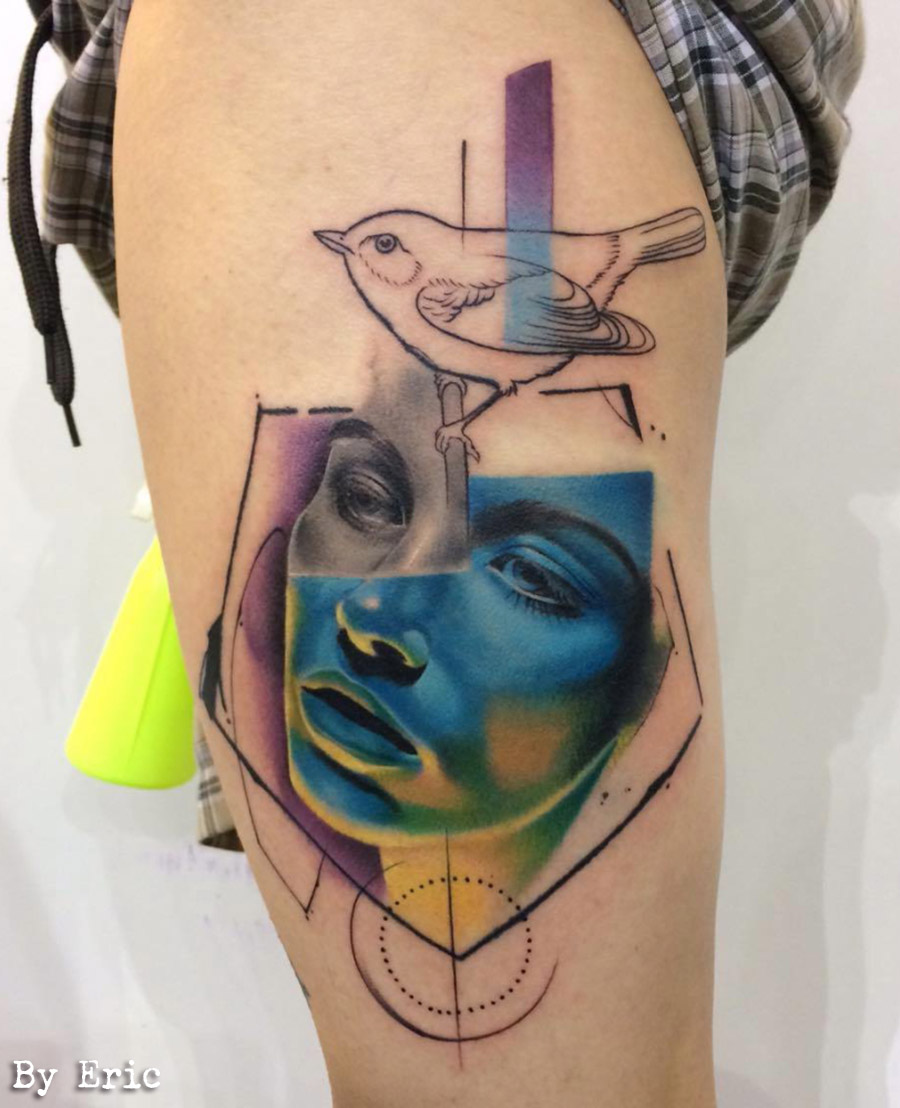
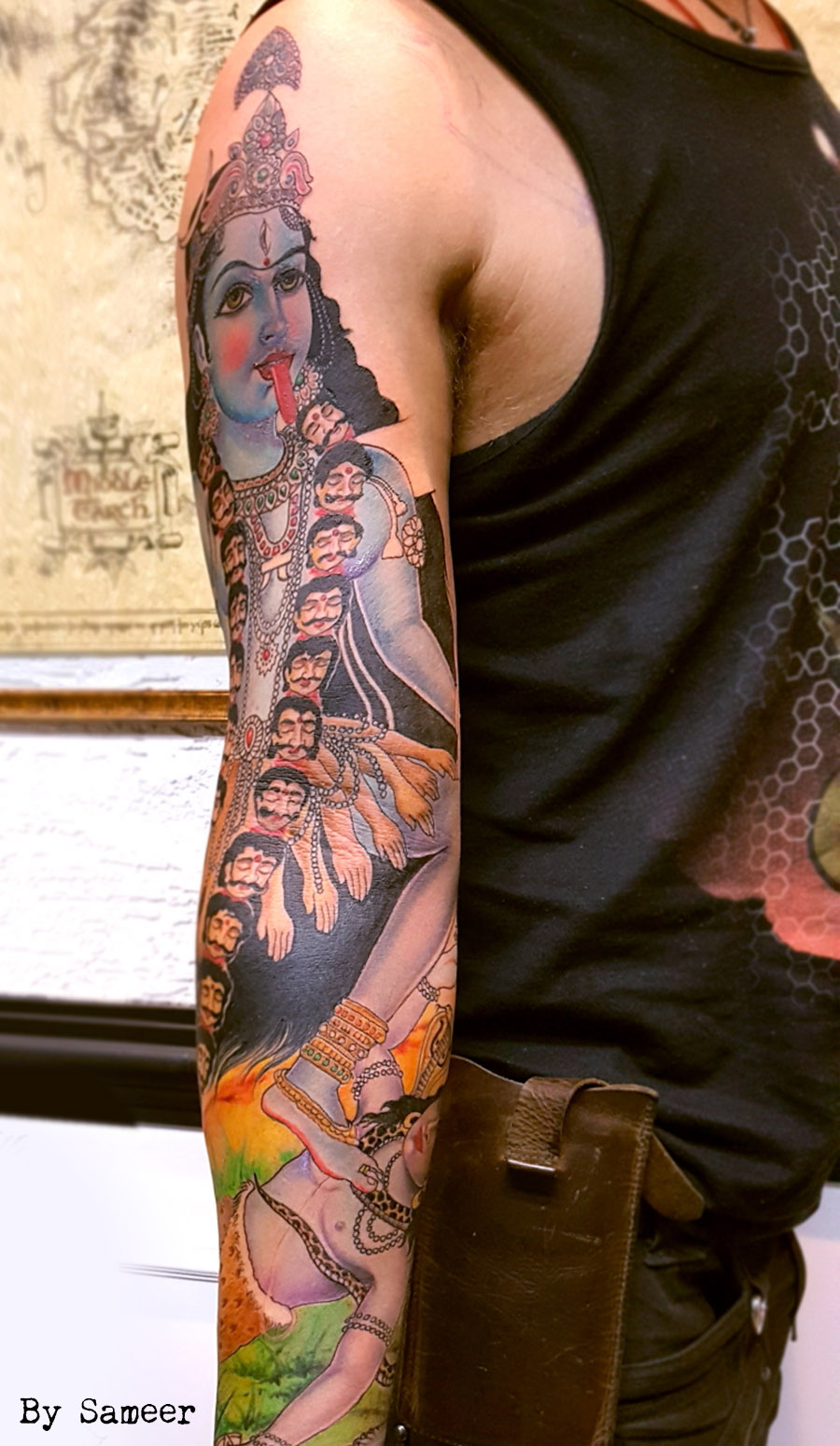
Bollywood, cricket and religion, these are the three passions of India right now ...." Sameers muses, only half-joking.
"One day I tattooed the portrait of Hrithik Roshan, an actor, on a guy who was a complete fan of him. At one point he realized that I had also tattooed Hrithik Roshan so he prostrated himself in front of me and clung to my legs, moaning "Oh my God, you touched him, it's incredible!"
No doubt, in India’s cities, the tattoo has definitely entered popular culture. This, according to the Tattoo Cultur blog, ensures work for the 15,000 professional tattoo artists who were working in the country in 2016.




FIND MORE ABOUT ARTICLE IN FULL VERSION, PHOTOGRAPHS AND TATTOOS, ON THE APPLICATION
ATC TATTOO

Indian Ink : Chapter 4 - Kondh Cultures
Texte : Laure Siegel / Photographies : Tom Vater
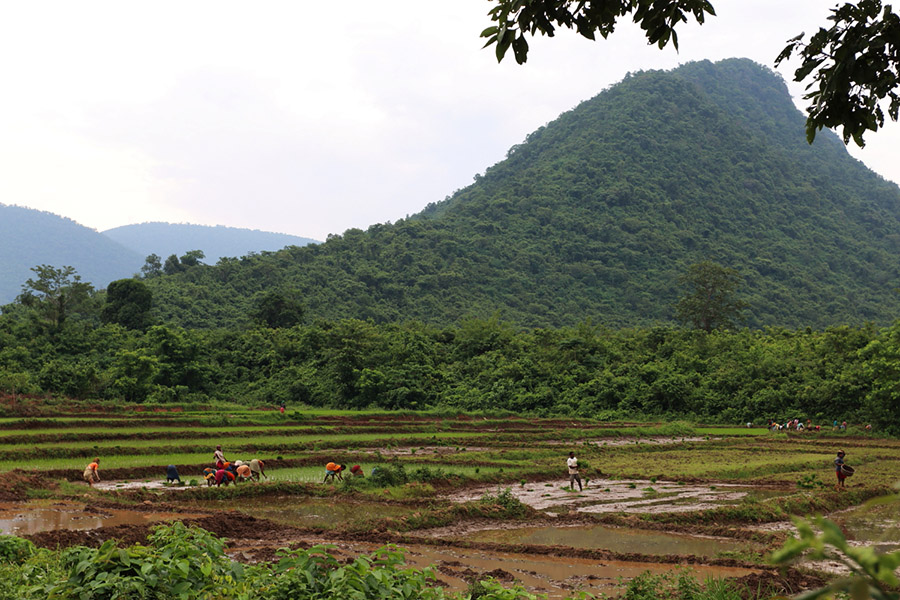
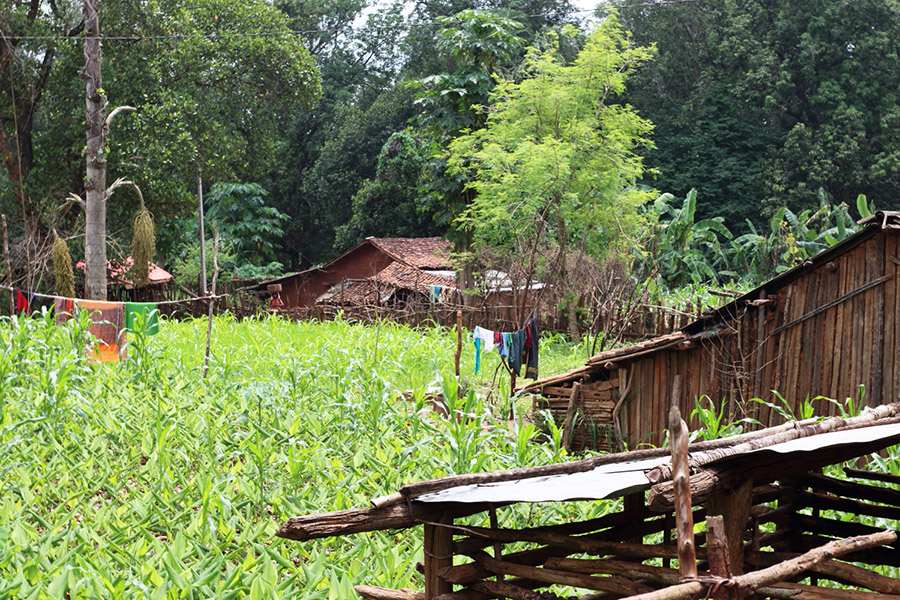
In the ancient Indian kingdom of Kalinga, history was written on women's bodies: religious designs, love charms, tribal symbols soothed the gods and forge identity. This is a journey into the Kondh cultures, the heart of the extraordinary ethnic diversity of rural to meet communities who try to preserve their land and customs in an India caught in uncompromising development.
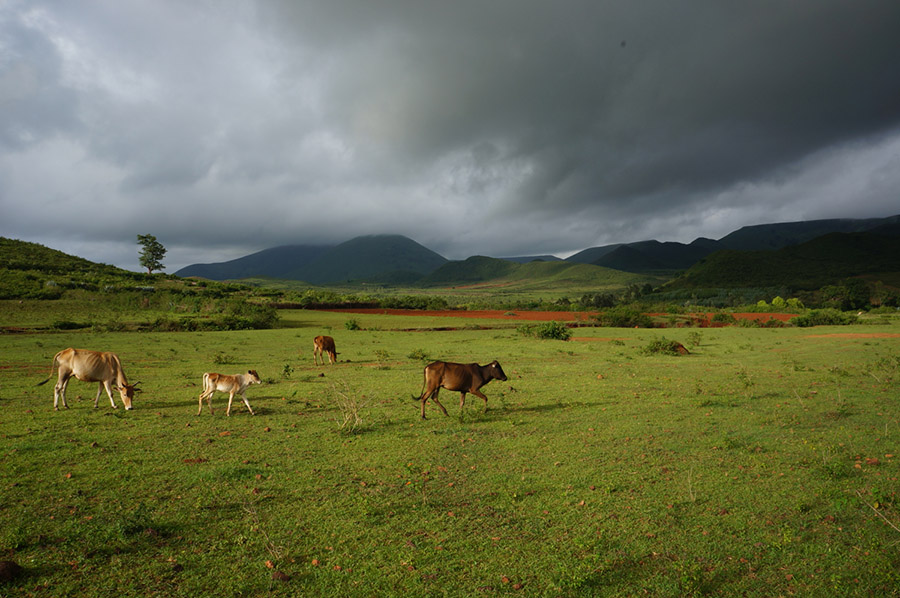
In South Asia, tribes and some Hindu castes have been developing their own tattoo traditions for centuries - from the Kalash in Pakistan to the Newari in Nepal to the Nagas in India. The practice of gudna ('burning the needle' in Hindi) makes it possible to create eternal jewelry that resists all the misfortunes of life and has been particularly appropriated by India’s indigenous peoples. The Adivasi, literally the "original inhabitants", represent a quarter of the population of Orissa, a state of rolling hills and beaches in the east of India, stretching along the Bay of Bengal. Orissa is a region full of resources - minerals, forests, fertile land - but plagued by natural scourges - cyclones, floods, droughts - and serious economic problems - poverty, lack of education, large scale industrial exploitation and infrastructure.
Spiritual ritual
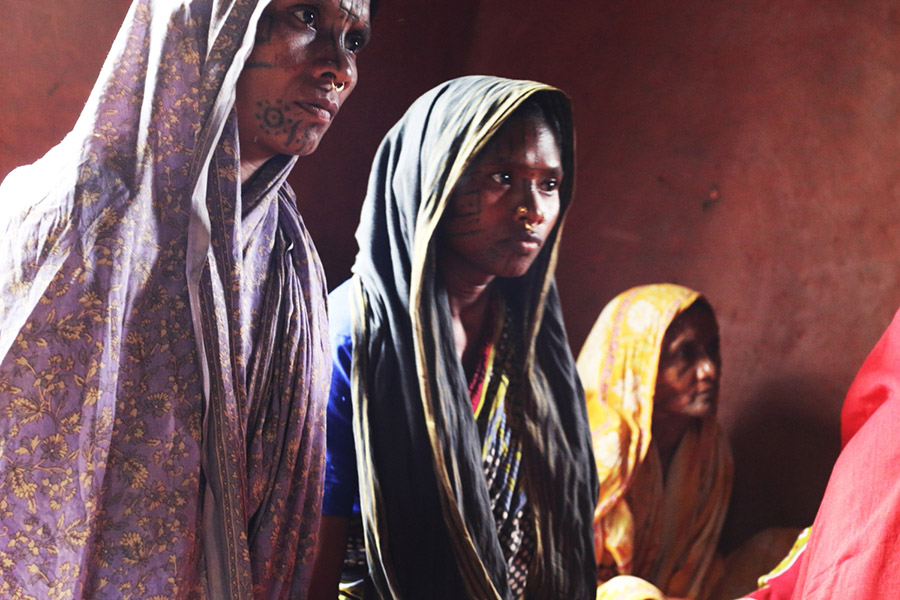
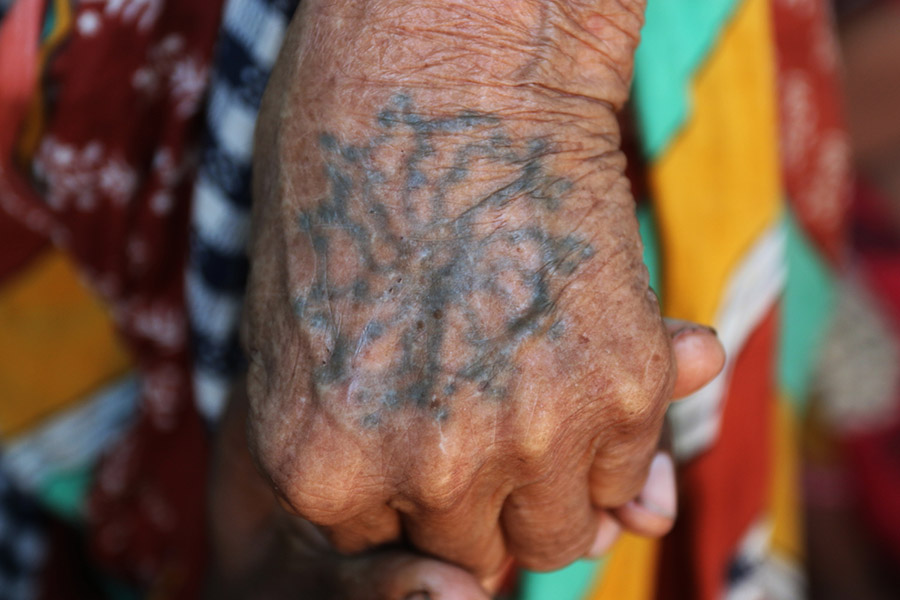
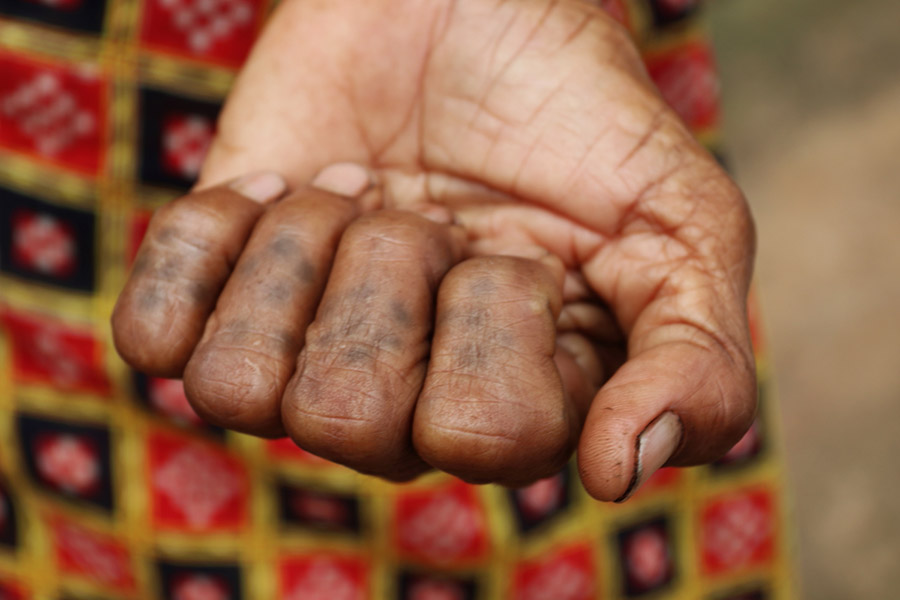
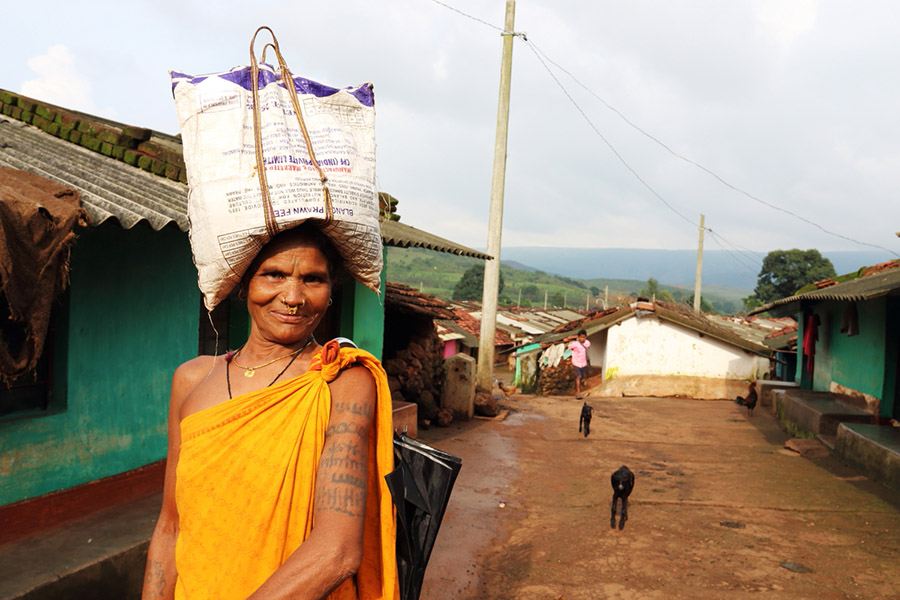
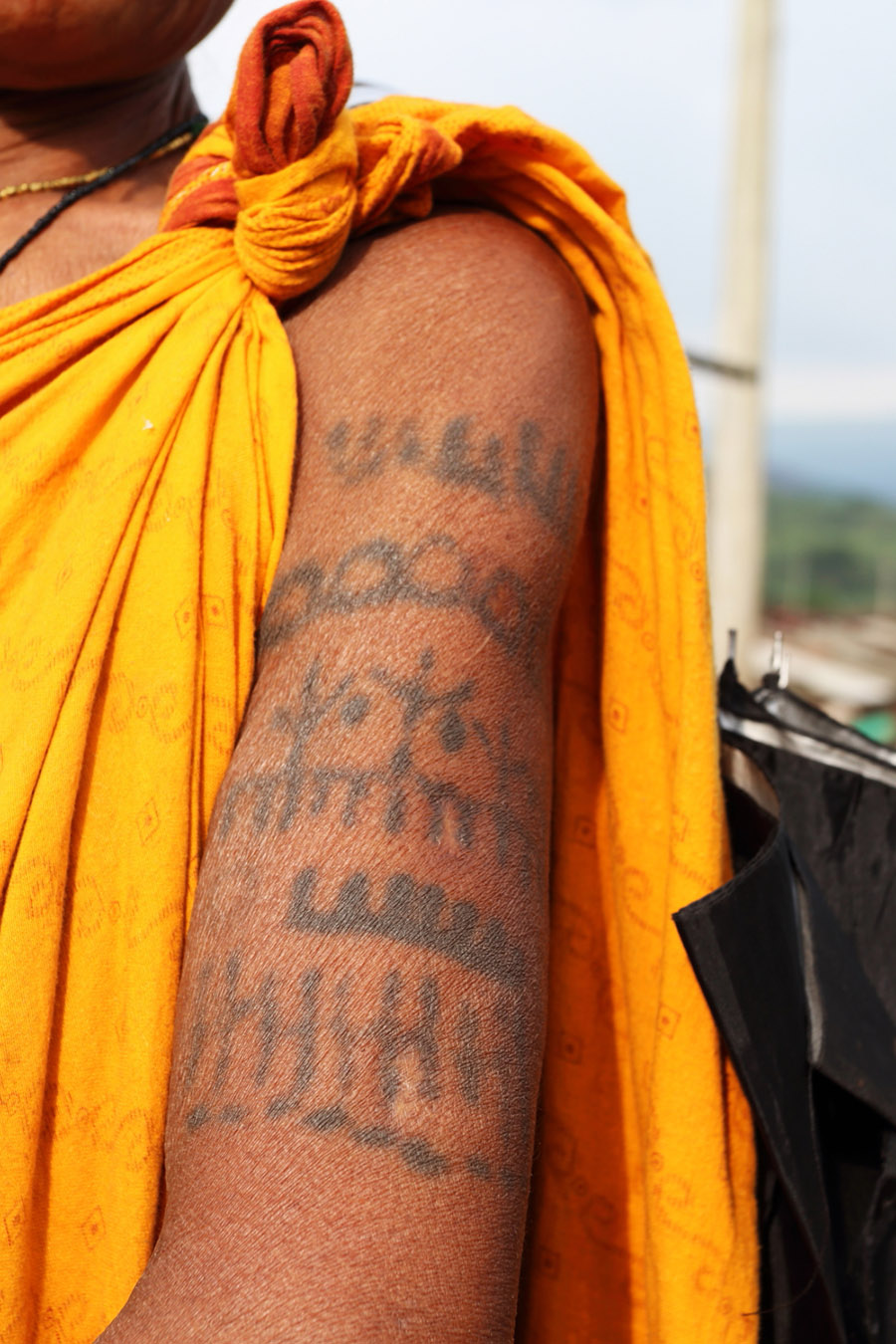
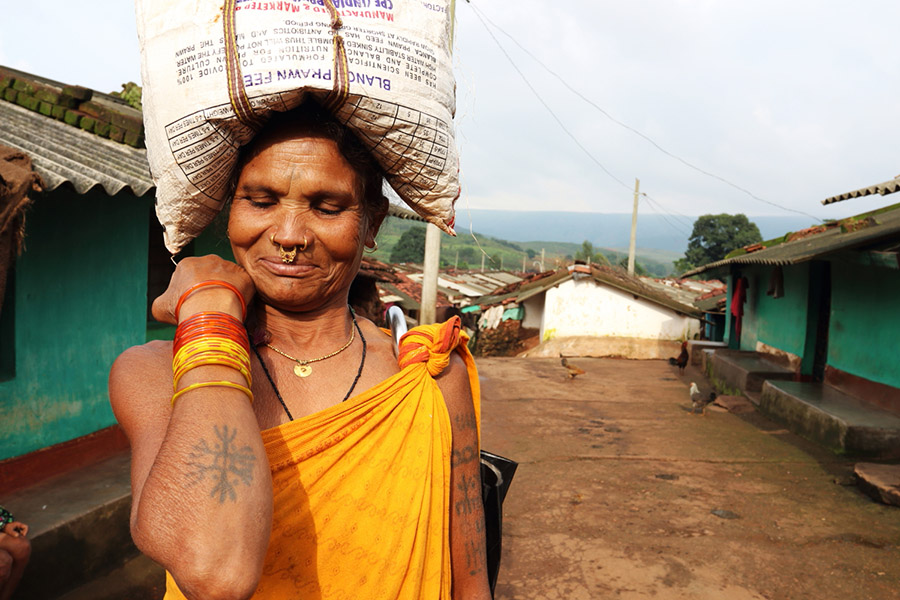
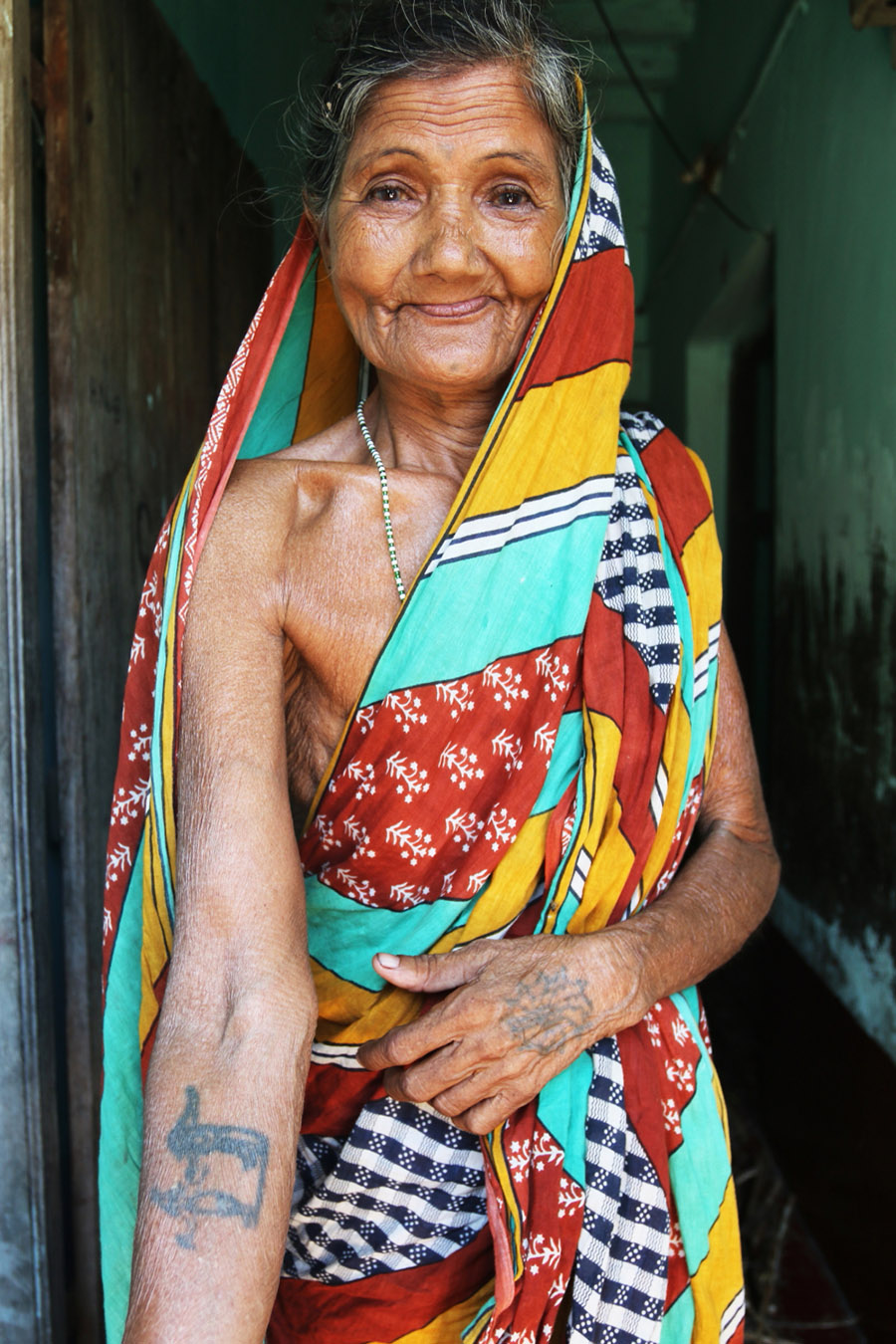
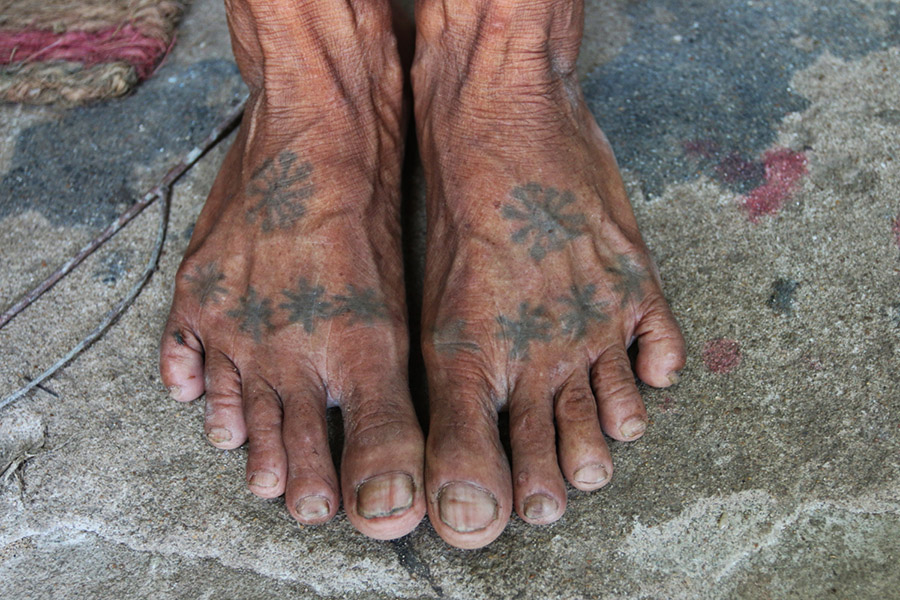
Noyen, 35, lives on fishing and odd jobs on the shores of Lake Chilika. She had a small swastika tattooed on her hand when she was eight years old. It is a design that also adorns the pots containing sacred water during pūjās, ritual prayers conducted to honor the gods, during the sacred baths to the river in the morning to the birth of a child or the launching of a business. These marks are made to protect children from ghosts and evil spirits. First, one rubs the skin with an stinging leaf until the flesh is raw, then the tattoo is applied with a nail. For a few days, the skin is swollen and an infection spreads the lines under the skin. "When some girls had trouble coping with the pain and were too agitated, their legs and arms were tied to the bed," recalls Noyen.
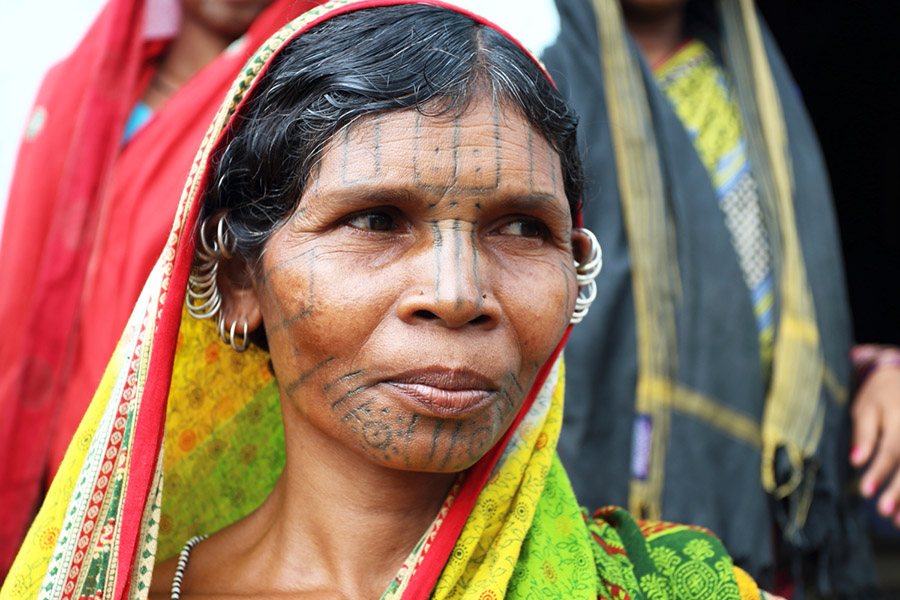
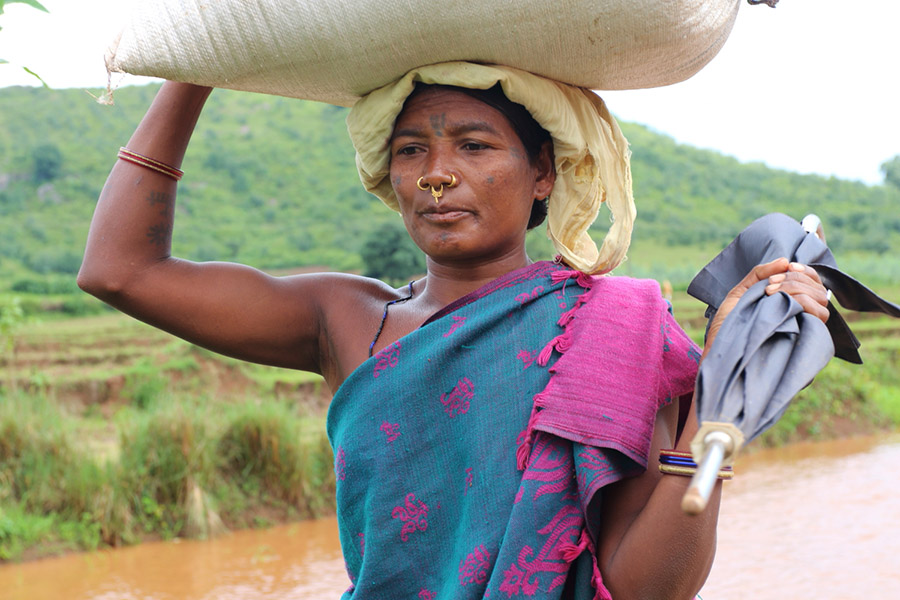
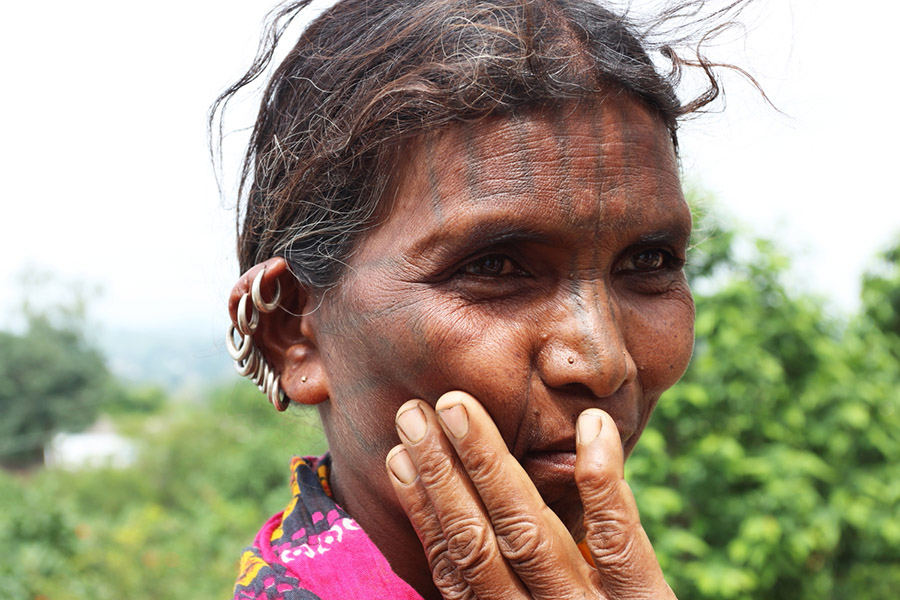
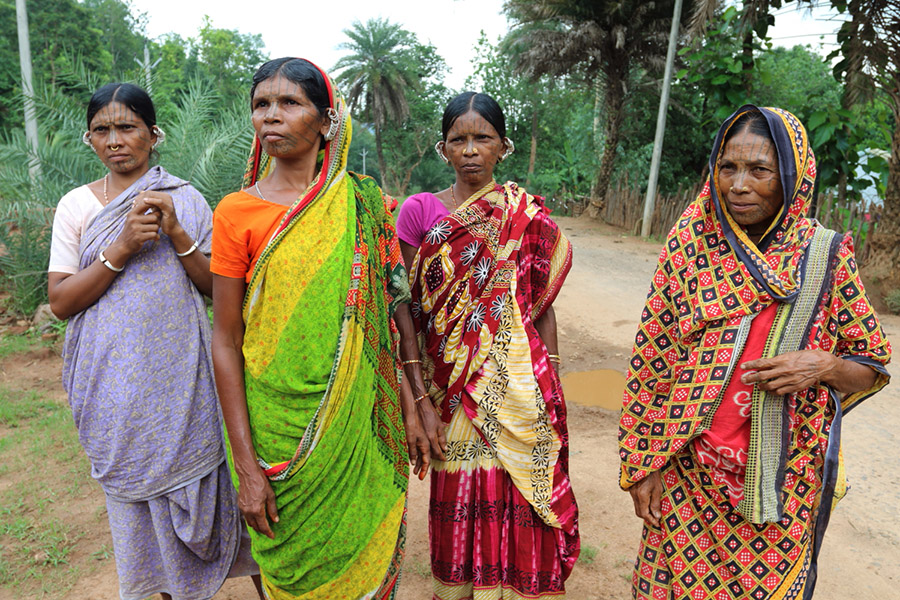
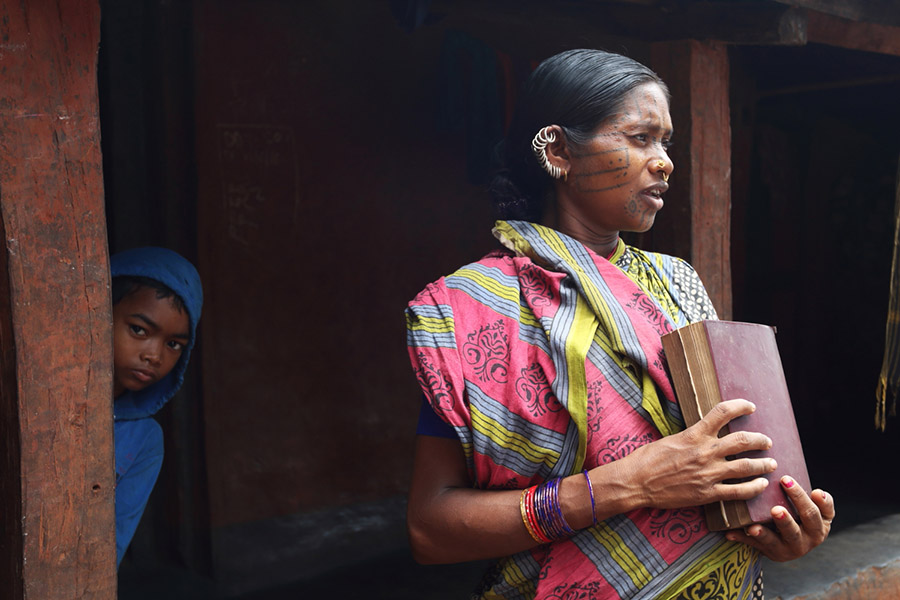
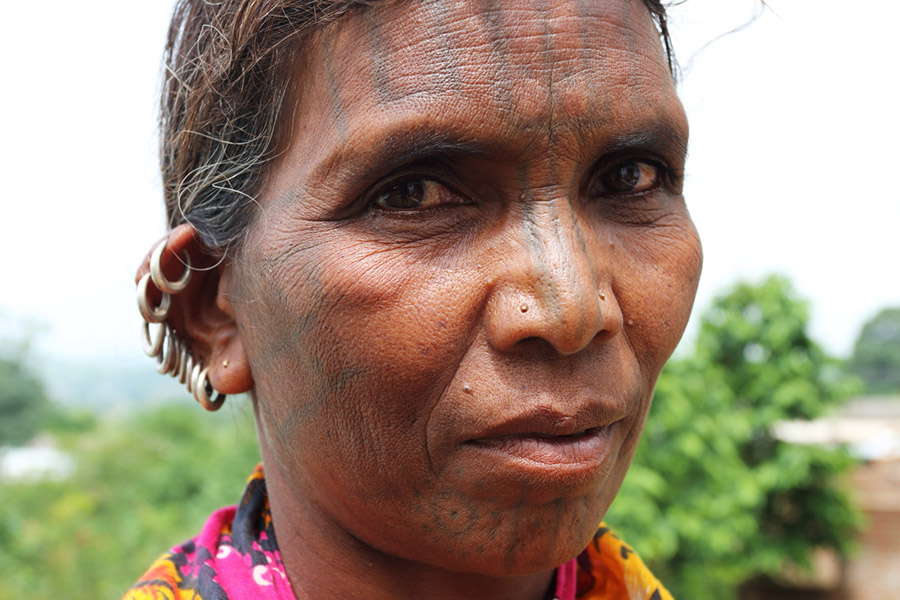
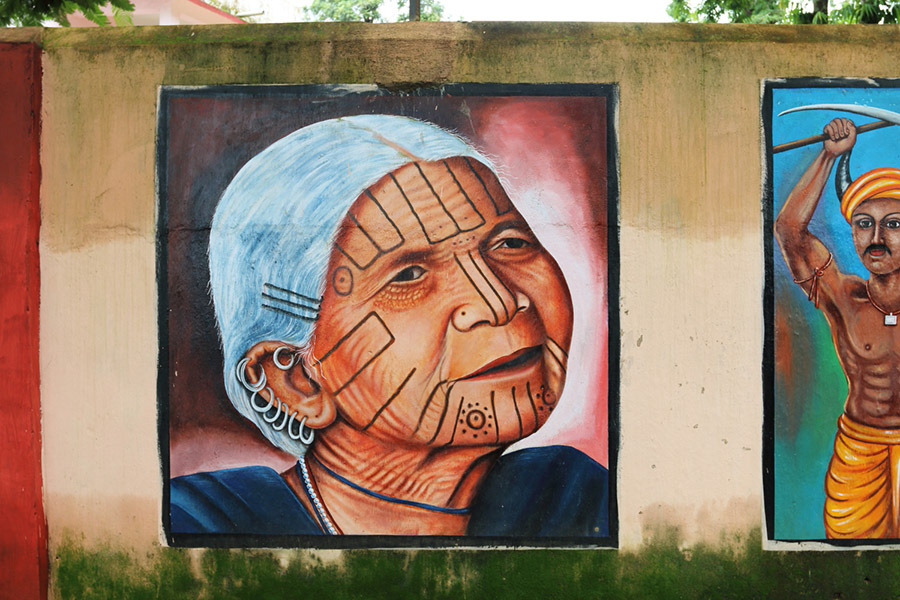
It’s market day for Nibajina Pradhan, 50, who has come down from the hills to sell her agricultural products. When she was ten years old, her parents took her to the tattooist. "I was scared but I had no choice, it was the rule in the village. No stepmother would have wanted me, if I had not had the face tattooed." Indeed, if the custom was not respected, future parents-in-law saw themselves entitled to insult the parents of any bride as poor, and to complain that the young woman had been brought to them as a man. The geometric facial tattoo are also seen as a way to frighten off man-eating tigers, who were lurking in the Indian countryside not so long ago. And among the lower castes, being tattooed was considered a necessity to escape the punishment of the land of darkness, because it is believed that the demons of Yama, the god of death, devour only those who are unmarked.
Jour de marché pour Nibajina Pradhan, 50 ans, qui est descendue des collines pour vendre ses produits agricoles. Quand elle a eu dix ans, ses parents l'ont emmenée chez la tatoueuse. "J'étais effrayée mais je n'avais pas le choix, c'était la règle au village. Aucune belle-mère n'aurait voulu de moi si je n'avais pas eu le visage tatoué." En effet si la coutume n'était pas respectée, les beaux-parents se voyaient le droit de traiter les parents de la fille de pauvres et de se plaindre qu'elle ait été amenée à eux comme un homme. Ce tatouage facial géométrique est aussi vu comme un moyen d'effrayer les tigres mangeurs d'hommes, qui rôdaient encore il n'y a pas si longtemps dans les campagnes indiennes. Et parmi les castes inférieures, se faire tatouer était considéré comme une nécessité pour échapper au châtiment du pays des ténèbres, car les démons de Yama, dieu de la mort, ne dévorent que ceux qui ne sont pas marqués.

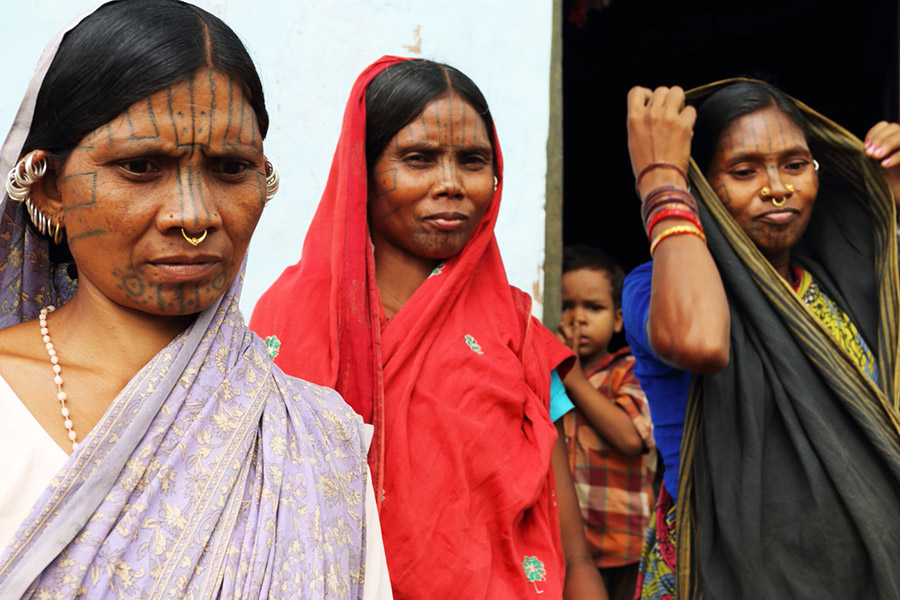
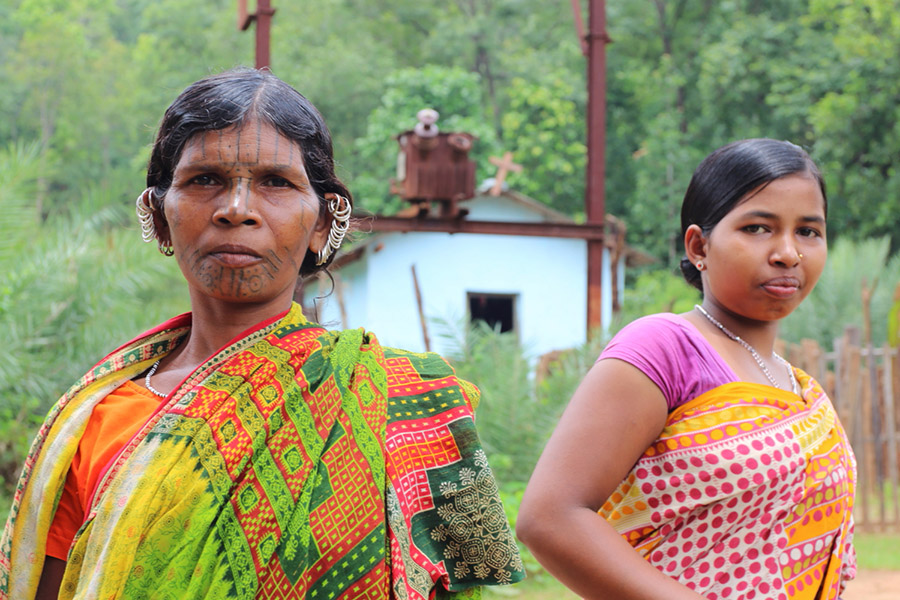
In Nibajina’s village, women get tattooed when they are between seven and twelve years old, the face first, sometimes followed by the arms and legs. Three to four girls are tattooed per day during one-hour sessions, mainly in winter, the climate being more conducive to healing than during the monsoon. "I was tattooed with six needles tied together, soaked in a mixture of soot and banana sap." explains Nibajina Pradhan. Other mixtures contain betel juice or breast milk.
 Desia Kondh
 Desia Kondh
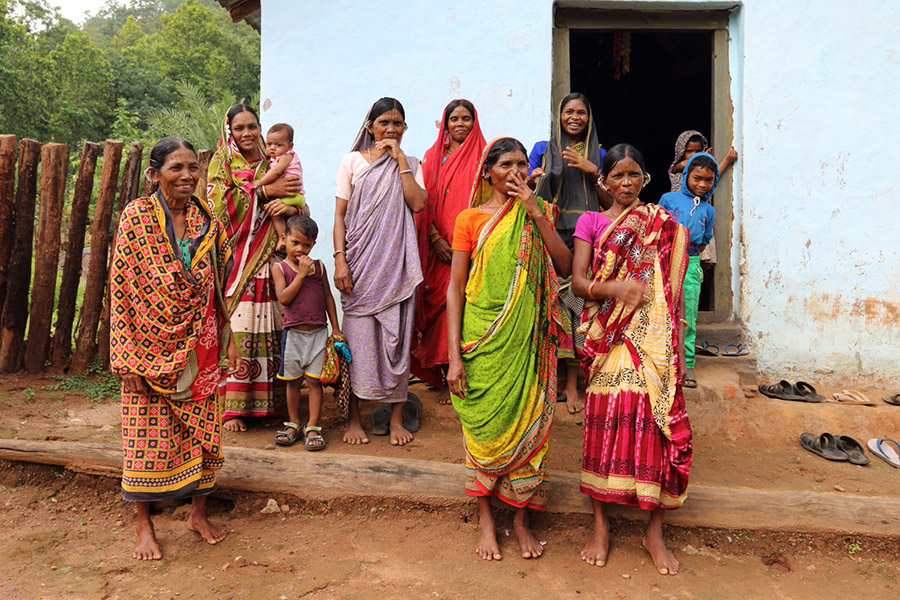
The journey continues to the village of Siliki, populated by Desia Kondh, one of the three major subcategories that make up the Kondh ethnic group who live in Orissa. Eighteen families live in Siliki, and they have all welcomed the Virgin Mary in their homes. In Orissa, Protestantism is spreading amongst the indigenous peoples. Today is Sunday and it’s time for the mass.


The devotees have brought their school notebooks, covered in newspaper to protect the cover, which contain the main prayers written in Kuvi, the language of the Kondh.
"Johari, Johari!" The parishioners intone this word in chorus, a term used by all the indigenous tribes of Orissa and the neighboring state of Chhattisgarh to greet and express thanks.
Tour guides who visit their villages are keen to present them as joyful people who like to dance and sing. But the Adivasi have less and less faith and energy to celebrate.
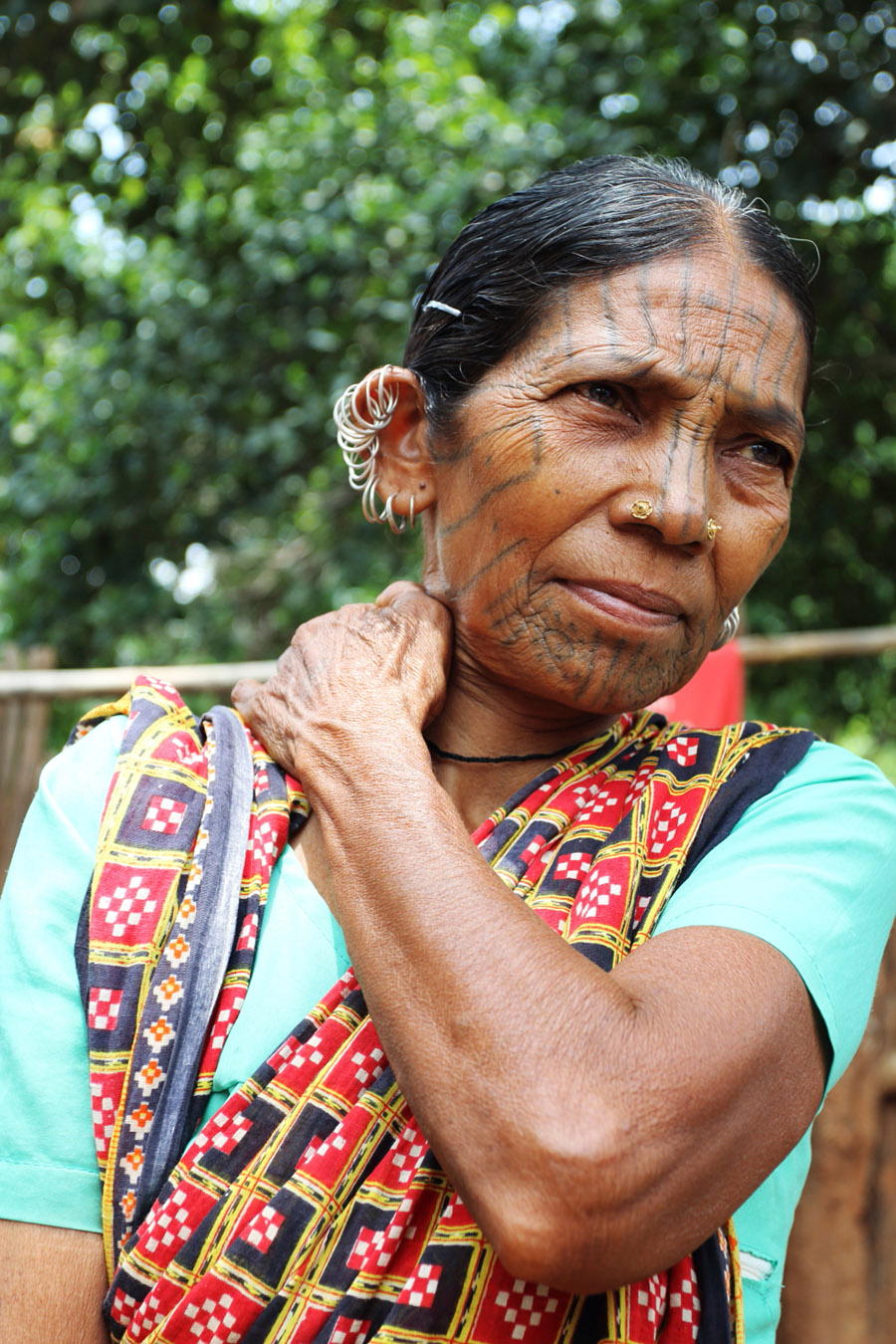
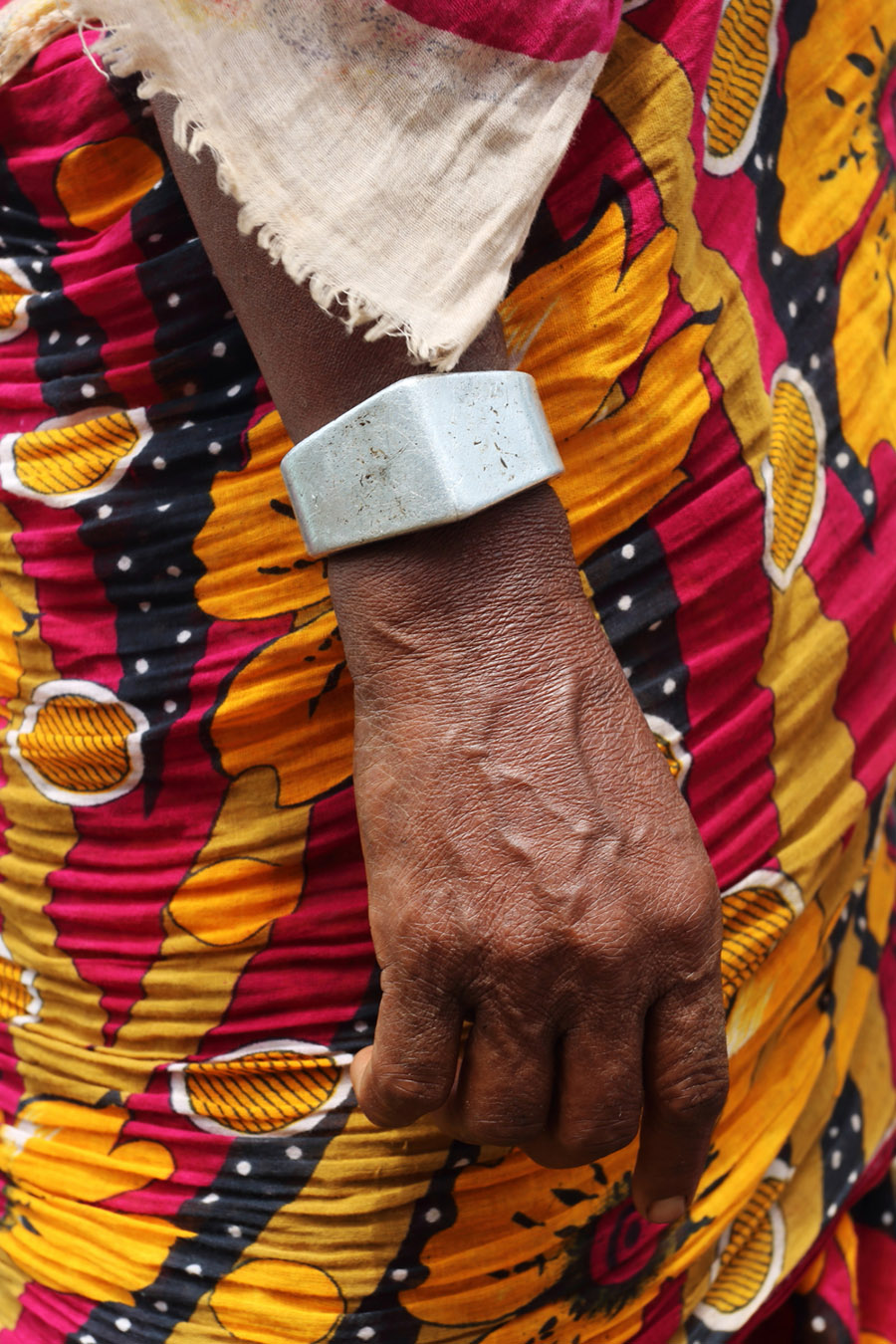
Marnali Maji, who is, as she says, more than 60 years old, has four daughters, all of them tattooed, and two sons. She remembers her childhood: "When we were kids, with my female friends, we pierced our ears and we tattooed small dots on our arms to get used to the pain and pass the time." The Kondh believe that the brutal experience of facial tattooing prepares girls for maternity while giving them the strength and courage to face the challenges of life.
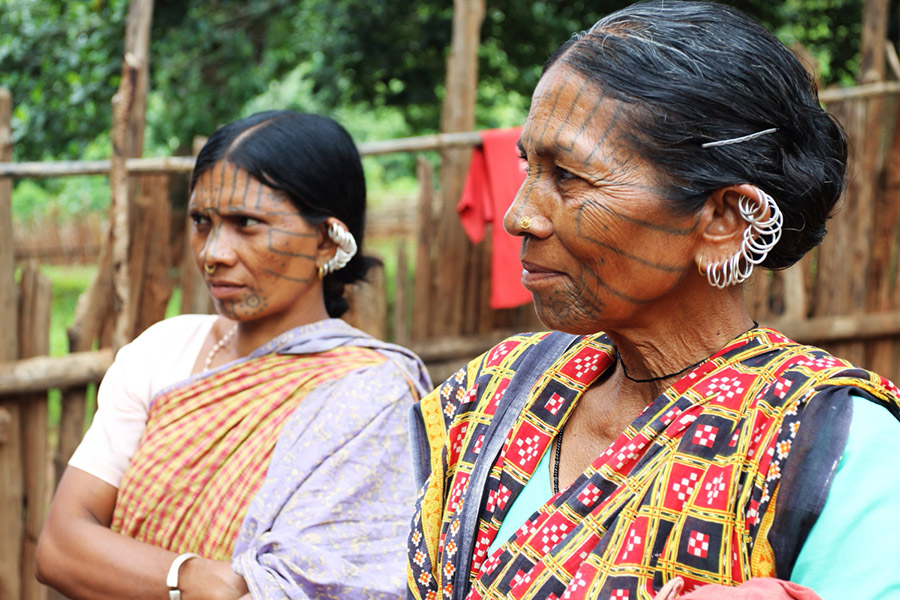
"Nous aimerions beaucoup continuer cette tradition et portons beaucoup d'intérêt à notre histoire du tatouage mais des officiels patrouillent dans le village en nous disant ce qu'il faut faire et pas faire..." soupire Marnali Maji. Cette pression condescendante des autorités, politiques et religieuses, couplé à la disparition des dernières tatoueuses de village explique pourquoi il est devenu rare de croiser des jeunes femmes tatouées dans le visage de moins de 30 ans. Le gouvernement a proclamé l'interdiction de ces tatouages ancestraux dans les années 70 mais c'est davantage la volonté désespérée de se fondre dans la masse de la grande nation indienne que le respect de la loi qui a mis un terme à cette pratique.
"We would love to continue this tradition and have a lot of interest in our history of tattooing but officials are patrolling the villages telling us what to do and not to do ..." sighs Marnali Maji. This condescending pressure from political and religious authorities coupled with the disappearance of the last village tattooists explains why it has become rare to meet women with face tattoos younger then 30. The government banned ancestral tattoos in the 1970s, but it was the desperate desire to blend into the mass of the great Indian nation, rather than respect of the law that put an end to the practice.
Political tensions between Hindu Indians and animist or Christian minorities are strong, aggravated by a Maoist insurrection that continues to destabilize the region. In July 2016, six people of the Kondh ethnic group were killed by the police. These women and children were returning from the market where they had gone to sell their products. On their way home, their tuk-tuk was machine-gunned by the military, who confused them with the Maoist fighters that are known as Naxalites, a regional guerilla movement using violent means to combat wide-spread discrimination and exploitation of India’s have-nots. The authorities often see indigenous people as accomplices of the Naxalites, as the fighters sometimes find refuge in the remote villages of ethnic minorities. A ghoulish photoraph of the face of one of the victims, tattooed and bloody, made the front pages of the local newspapers, a symbol of the suffering of the Adivasi and the extinction of their culture.
"Our facial tattoos are our identity, they allow us to recognize ourselves among ourselves in the afterlife, once we enter the world of spirits, they are what we are, and if this peculiarity is taken away from us, we will become part of the majority and will be like all the others. " Marnali Maji says.

TROUVER PLUS D'ARTICLES SUR LE TATOUAGE EN INDE
FIND MORE ABOUT ARTICLE IN FULL VERSION, PHOTOGRAPHS AND TATTOOS, ON THE APPLICATION
ATC TATTOO
Indian Ink : Chapter 3 - Getting inked in Hell – Delhi’s Palika Bazaar
Text et photograph by Laure Siegel and Tom Vater
Naraka is the underworld, hell for Hindus, where souls are tormented. The nearest earthly equivalent might be Palika Bazaar in New Delhi, a sprawling, unsavoury underground market of almost 400 stalls selling counterfeit fashion, pornography and stolen goods, located beneath Connaught Place, the city’s main commercial area during the Raj and now a collection of western brand shops, banks and overpriced coffee shops.
Palika Bazaar
The air below ground is heavy with the smell of sweat, pan, urine, detergent, spices, fried food, cheap alcohol and exhaustion. Police raids are common. For the past decade, the long, barely neon-lit corridors and stalls have also been home to some one hundred tattoo shops – many cubicle size with just barely enough space for the tattooist and the client – making Palika Bazaar quite possibly the largest permanent tattoo market in the world. Prior to its existence, Delhi’s commercial tattooists often worked out of barber shops, much as the sailors who opened the first small tattoo booths in the back of hairdressers in 19th century USA.


Street artists and improvised tattooer
Today, Delhi’s hip youngsters descend below the city to get inked for as little as 300 Rupees. Palika Bazaar is a weekend hang-out. Hell is almost fashionable.
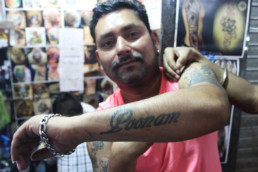
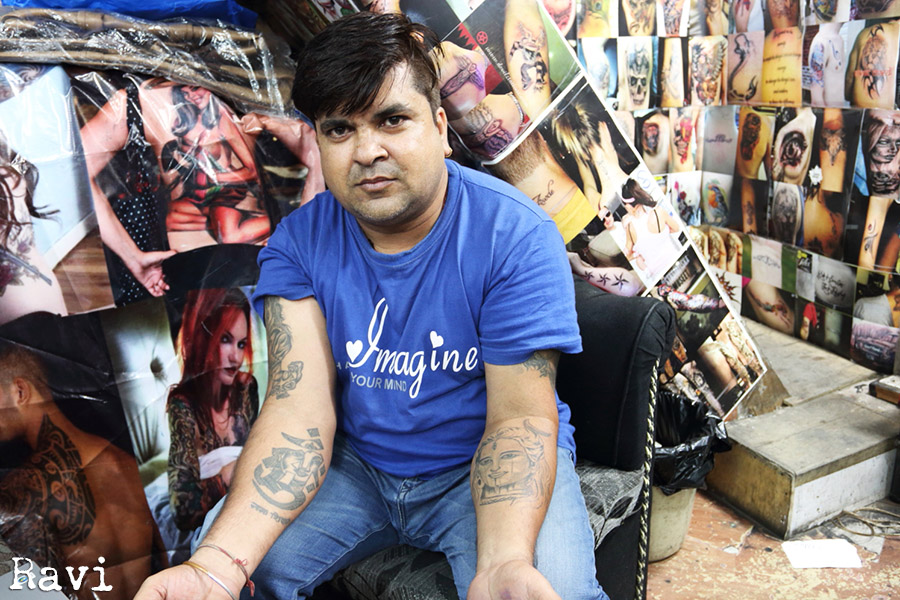
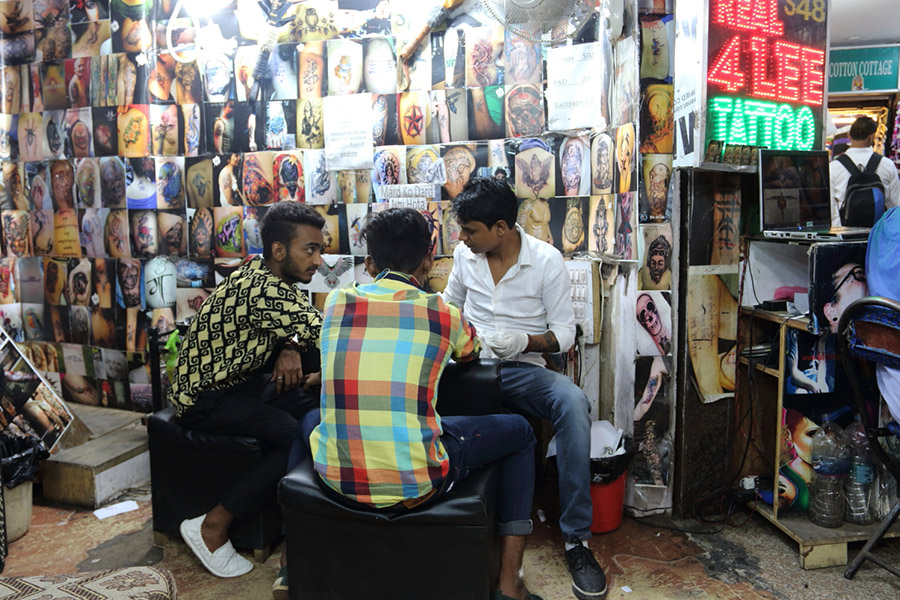
Ravi runs the Real 4 Lee Tattoo Shop.
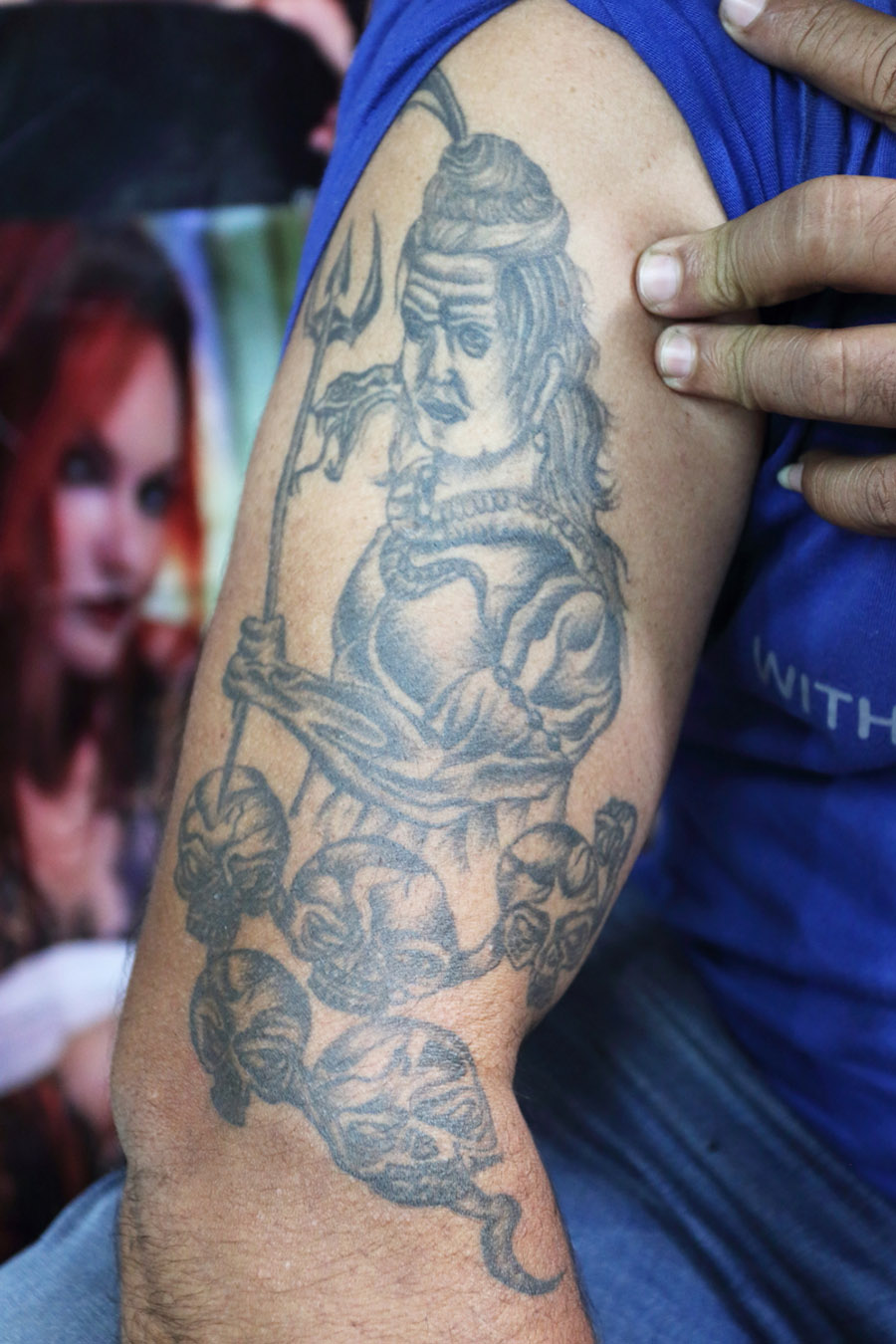
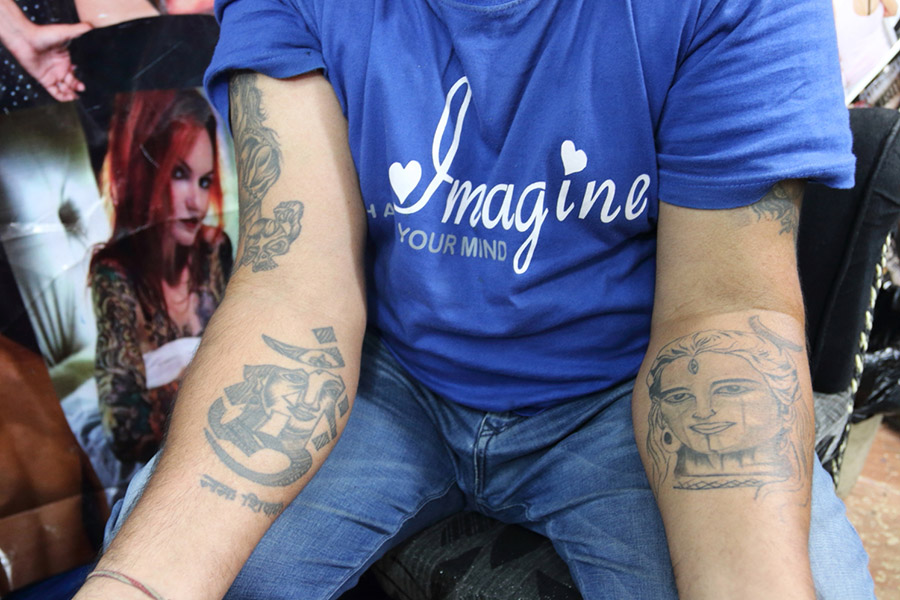
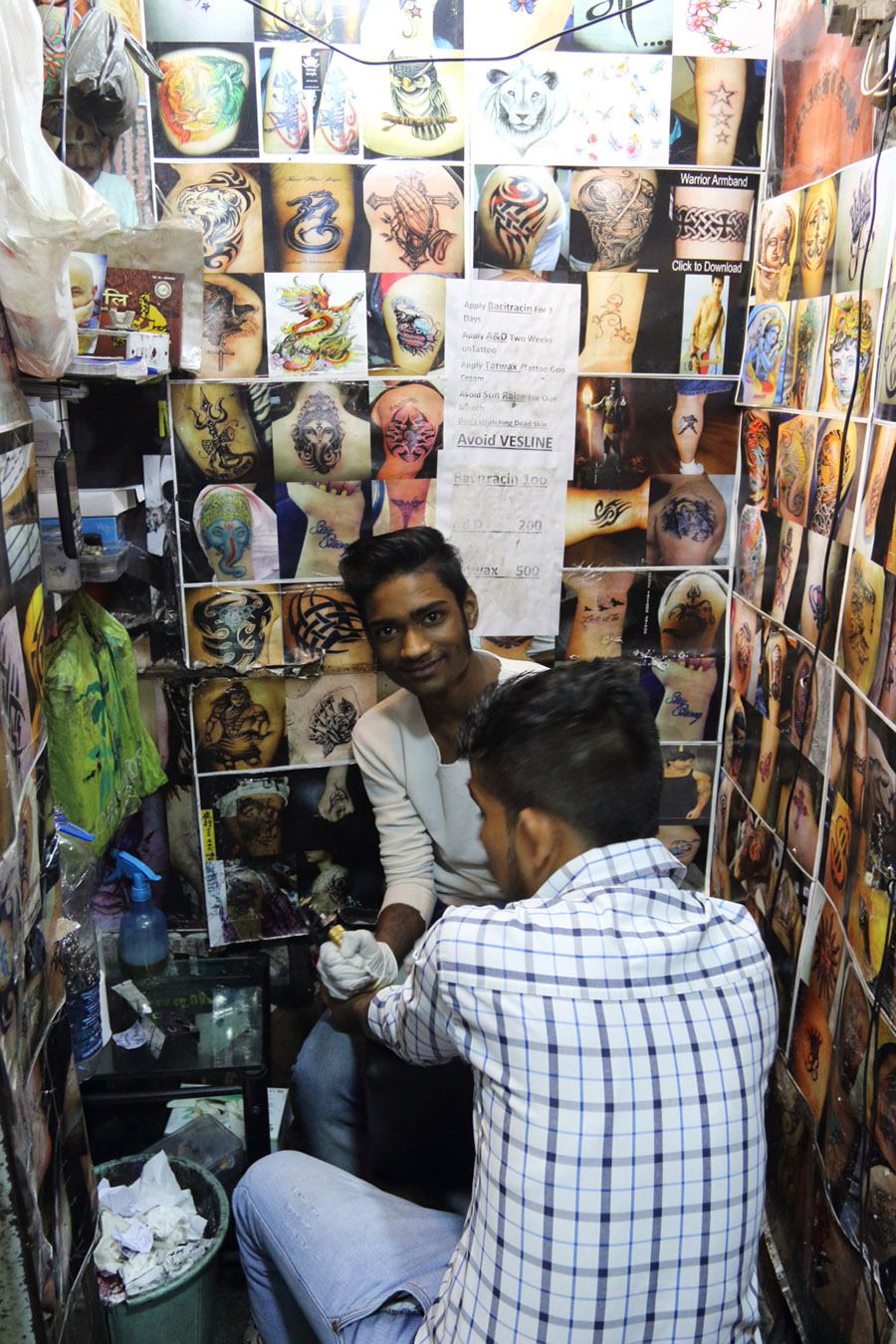
The walls are covered with hundreds of photographs of terribly dated, clichéd tattoos lifted from the pages of tattoo magazines. Ravi sports tattoos of Shiva, creator and destroyer of the universe, somehow appropriate in this world of shadows and pain.
“Most of our clients come here with an idea they have seen on the Internet. We do a lot of cover-ups because people can’t afford laser removal.”
One of Ravi’s tattooists is busy putting the crude outline of the Statue of Liberty on the arm of a customer who’s barely out of his teens and too shy to tell us why he’s picked this particular icon as his first tattoo. Hygiene here is better than on the street, the artists all use gloves and fresh needles, but the general environment is grim.
Indian Ink : Ravi
Becoming a shop tattooist in India is no mean feat and involves a five month apprenticeship, for which a show owner will collect some 50.000 Rupees from his charge. This system weeds out the undecided, but it creates phenomenal challenges for poor artists who spend years saving up money to pay the fees to their mentors.
Outside the Real 4 Lee Tattoo Shop, a man in white alligator shoes and a loud shirt counts through a thick bundle of Rupee notes with movie bad guy flourish. He won’t tell us his name, but he’s the boss and he’s collecting, not just from Ravi’s shop. Welcome to Naraka, the underworld.

Indian Ink Chapter 3




TROUVER PLUS D'ARTICLES SUR LE TATOUAGE EN INDE
FIND MORE ABOUT ARTICLE IN FULL VERSION, PHOTOGRAPHS AND TATTOOS, ON THE APPLICATION
ATC TATTOO
Indian subcontinent: the guide of the tattooed traveler
Text and photograph : Laure Siegel & Tom Vater
One and a half billion people, hundreds of languages, a multitude of beliefs and religions, climates, geographies, cultures and politics: welcome to the Indian subcontinent, a whirlwind of ideas and colors, flavors and odors and probably the most visually stimulating place in the world. Since the dawn of time, India has been tattooed. Let's discover this India, travellers guide.
We slalom between the street tattooers of the Madurai temple, met with political activists ready to get tattooed the face of their champion, discovered the world's largest tattoo center in an underground car park in New Delhi, paced the markets in eastern India held by proud women wearing facial tattoos, celebrated Ramadan in Mumbai with artists Sameer Patange and Eric Jason D'Souza and documented the beginnings of the Sri Lankan scene in the middle of the jungle.
On the Street
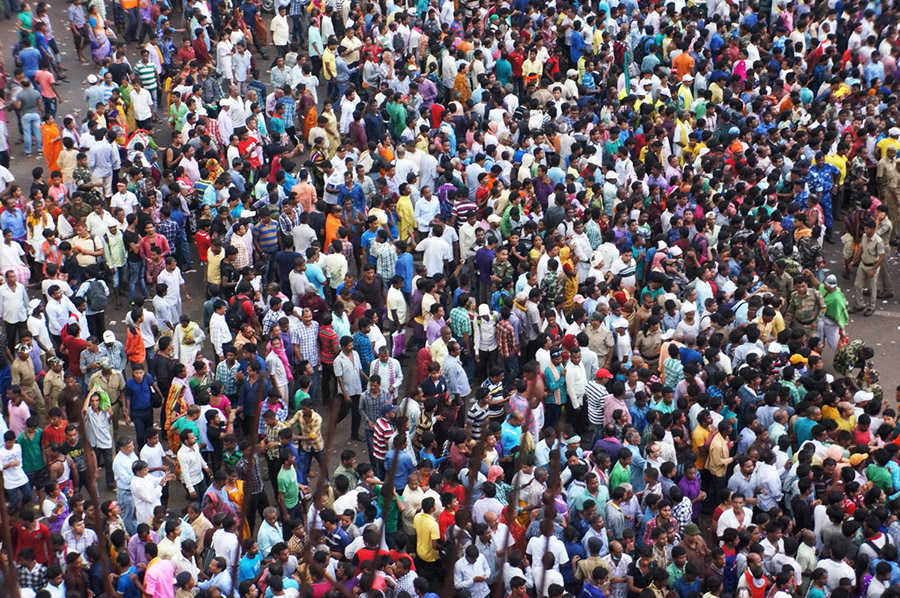
The vast population of India gets tattooed in the streets for a handful of rupees
or during major religious, political or cultural events. However the offer aimed at the wealthy classes has grown in recent years. In big cities such as Mumbai and Pune, young artists are investing in modern shops, while international tattoo conventions attract crowds in Kathmandu, Goa and Delhi.
Between these two extremes, the emerging middle class is getting inked in dives that multiply in the basements of shopping malls, a phenomenon which more or less gracefully accompanied the explosion of contemporary tattoo in India.
Chapter 1 - The Tattoo Gypsies of Meenakshi Amman
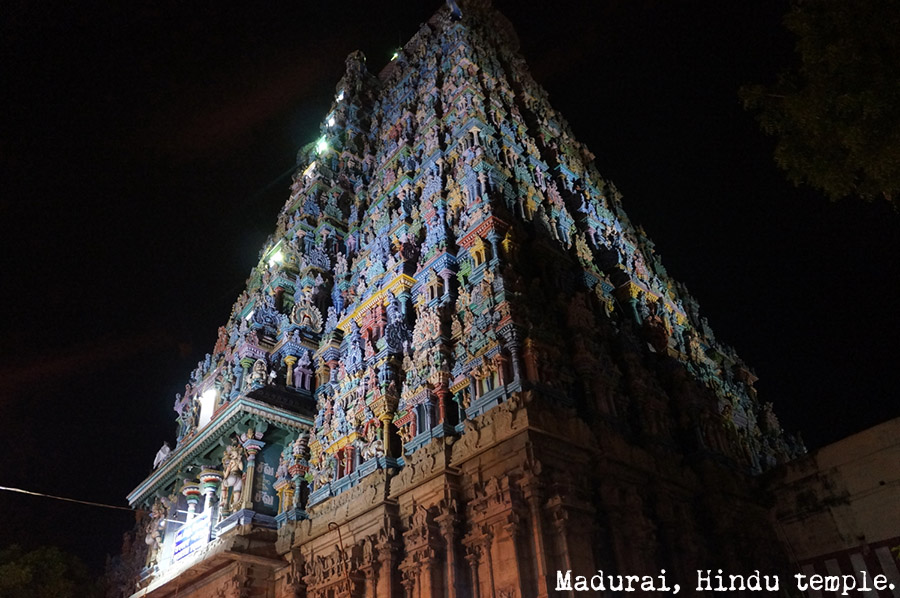
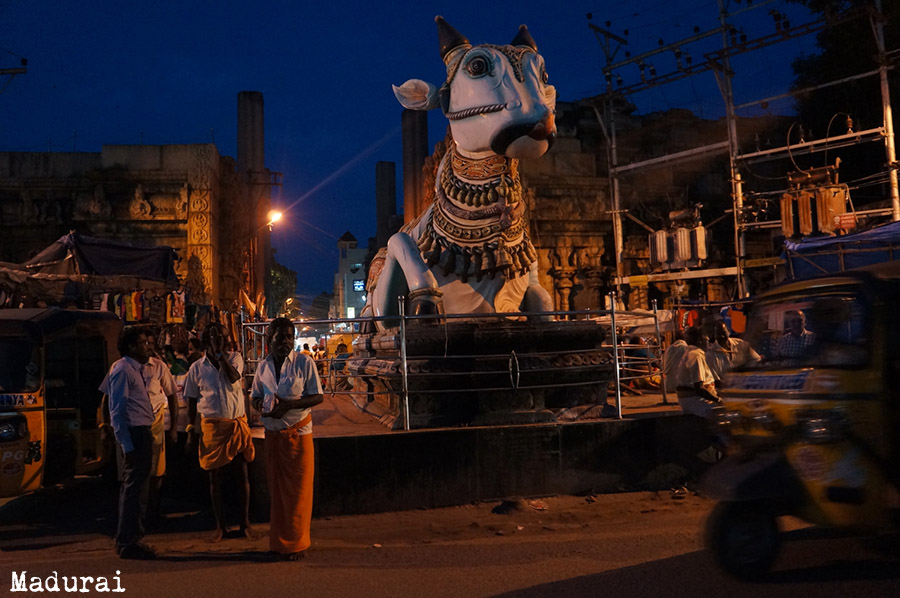
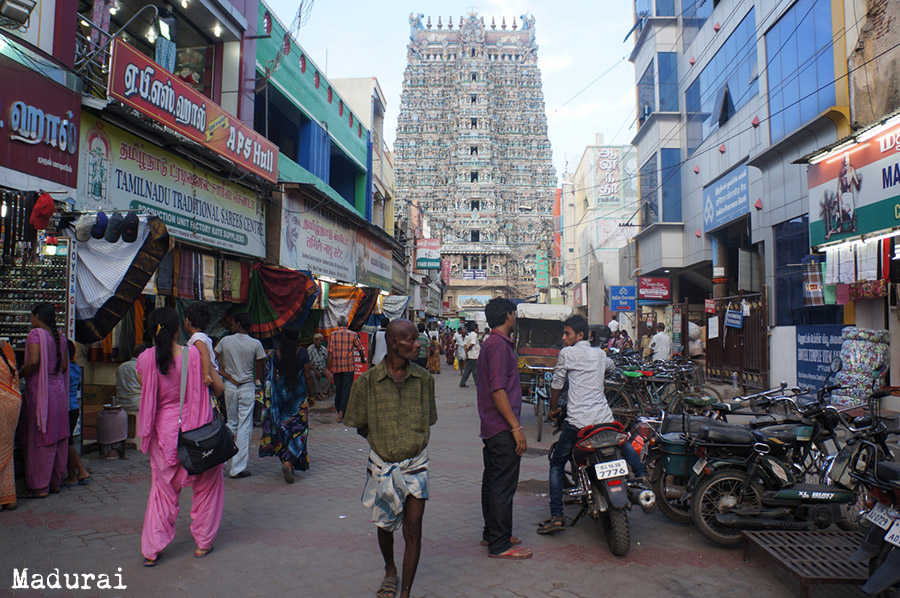
Every night, the traffic-free lanes surrounding Madurai's most important Hindu temple, the Meenakshi Amman, a mela, a festive market springs up, catering to thousands of pilgrims. Household goods, Chinese toys, textiles, temple souvenirs, snacks and sweets, and have-your-name-carved-onto-plastic-hearts are sold from countless stalls.
India : tattooed traveler's guide
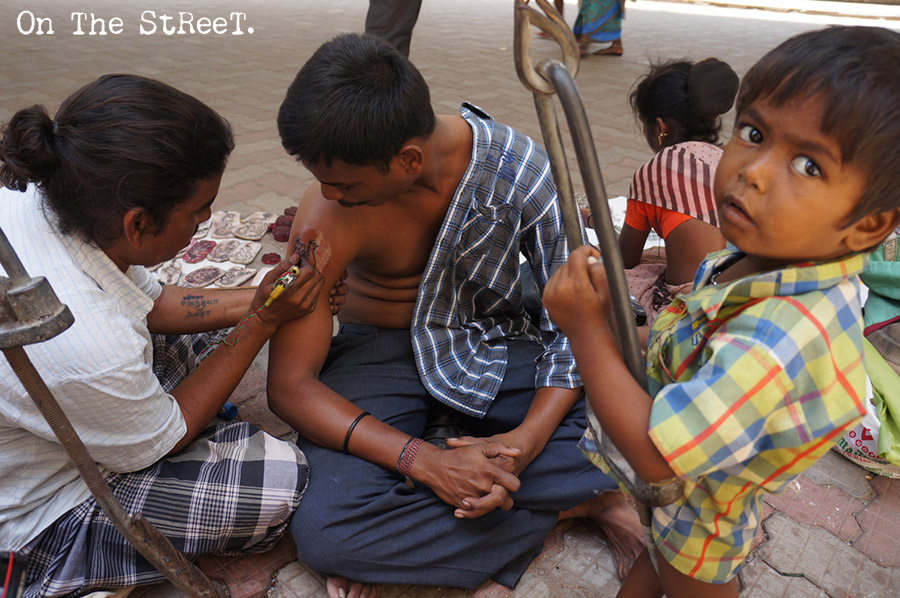
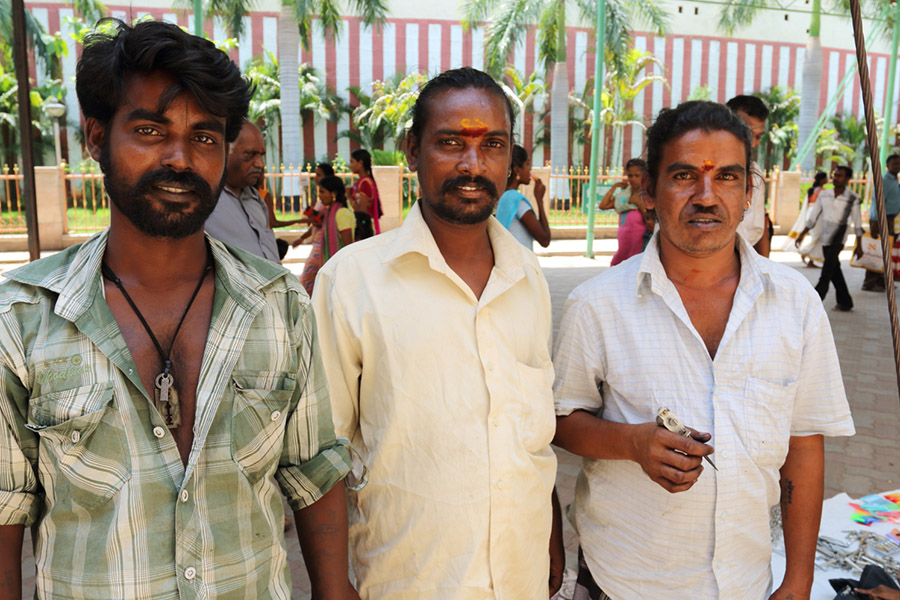
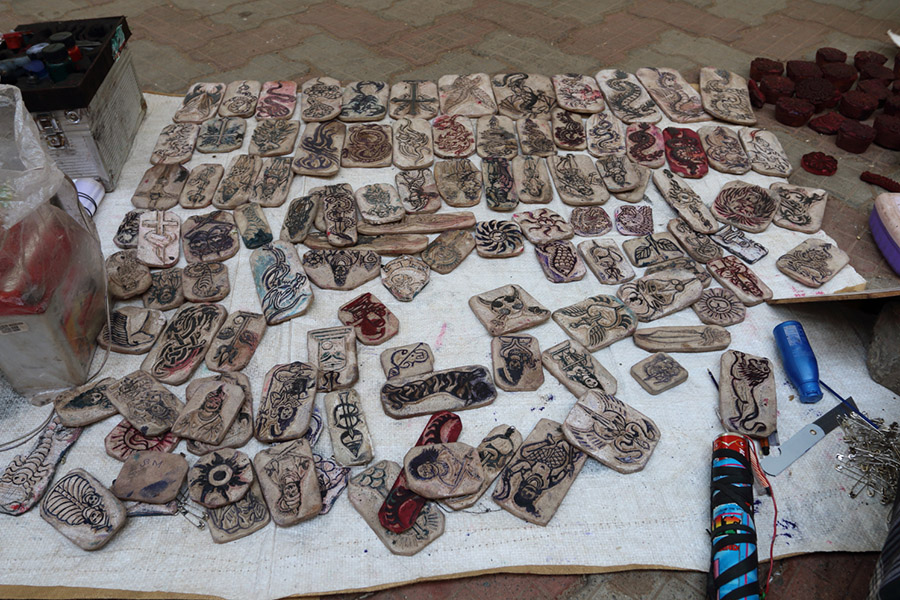
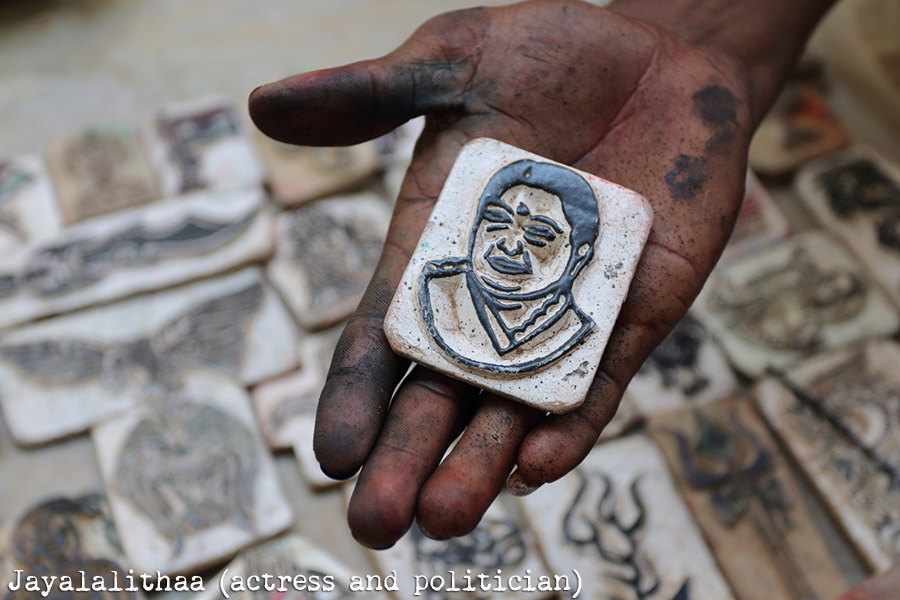
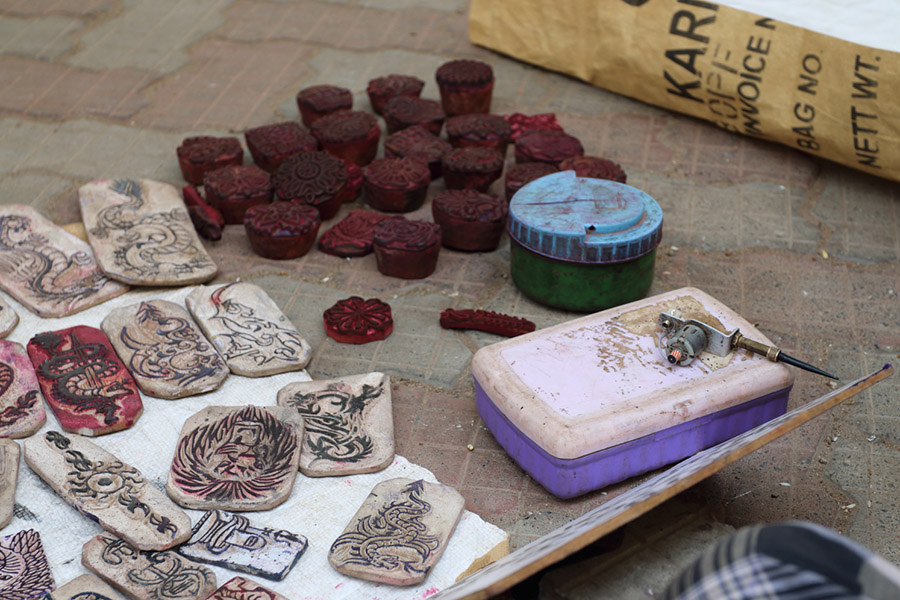
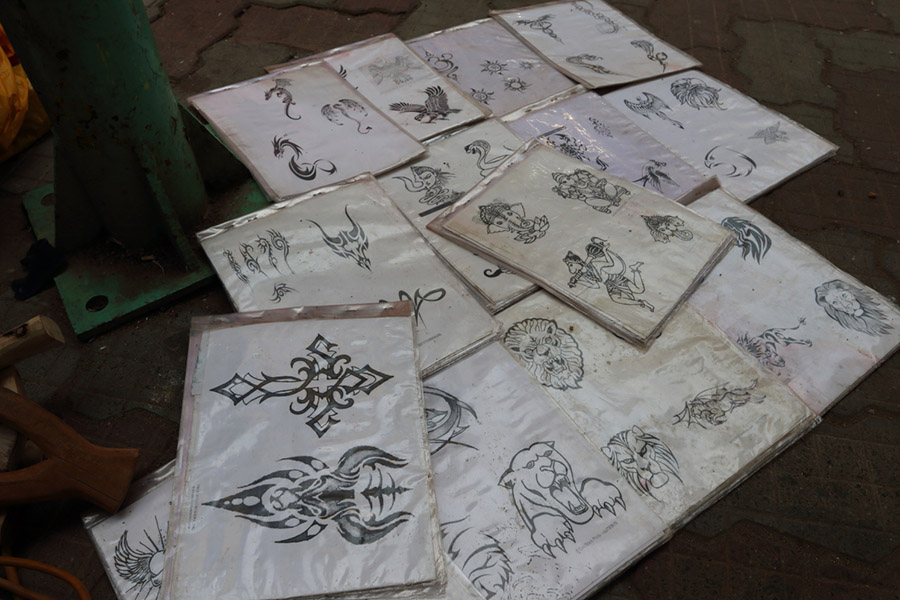
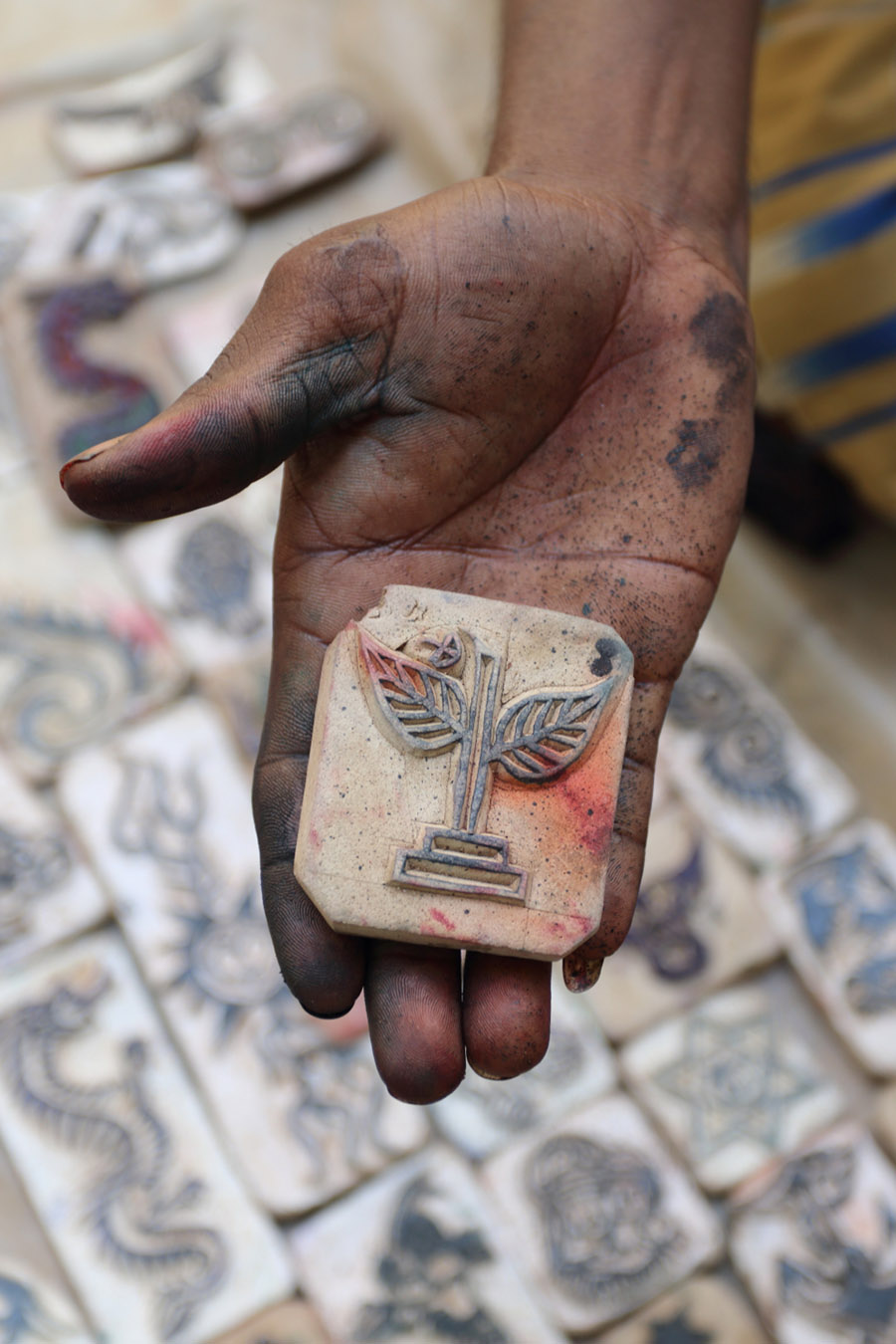
Right in front of the temple’s main gate, a family of itinerant street tattooists has spread crudely hand-carved plastic stamps on the pavement - religious images, tribal patterns, political party emblems and the faces of actors and politicians.
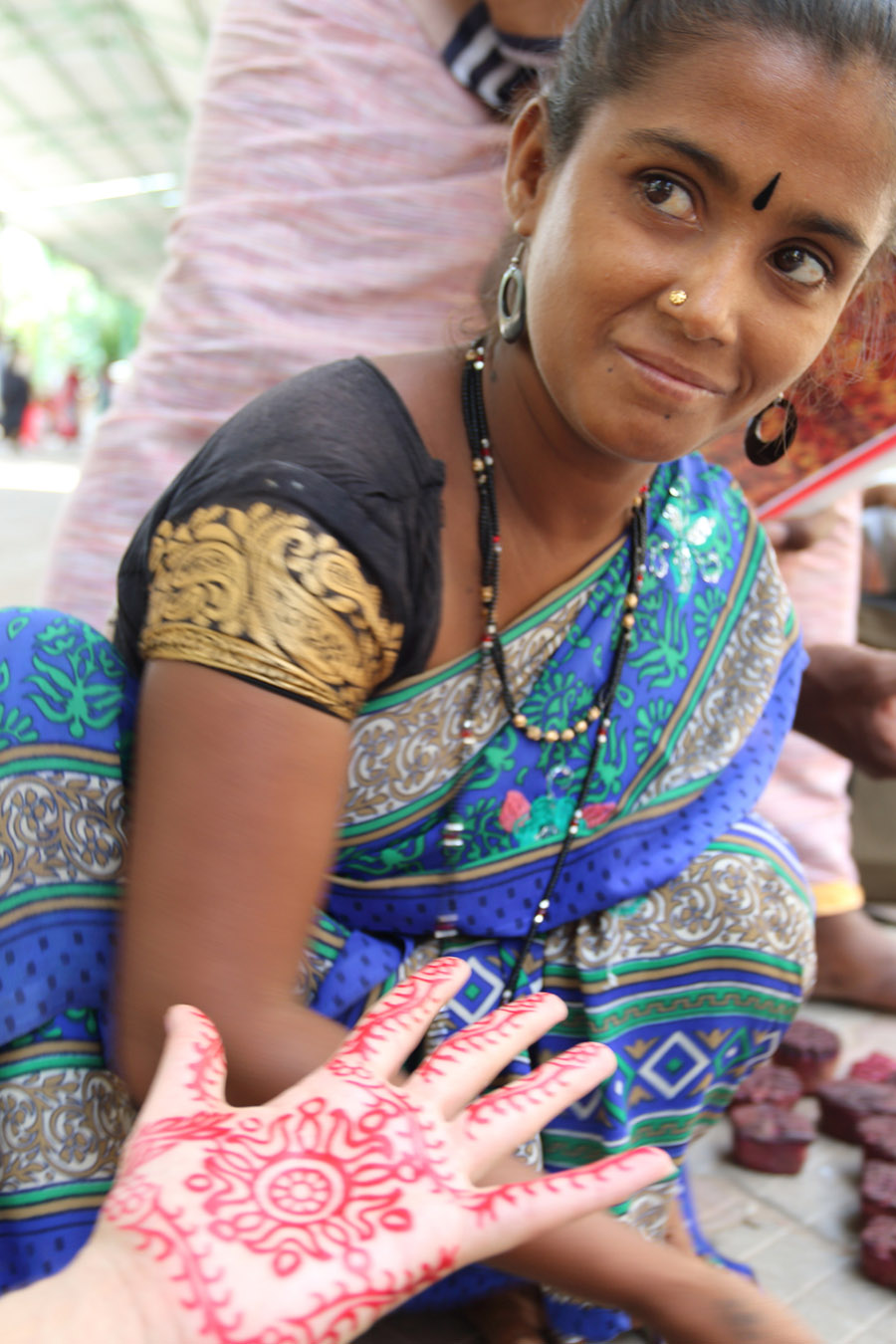
Twenty-something and recently married Navaneetha is here to have the name of his wife, Jothi tattooed on his chest. The bride has come along to lend moral support. Cinemaguru, the head of the family, his brother Jagannath and his cousin Cinemani, have been working pavements around the country for years. Cinemaguru’s sister applies non-permanent henna skin dye patterns to female clients. Several children entertain themselves around the family camp cum office.
India, travellers guide
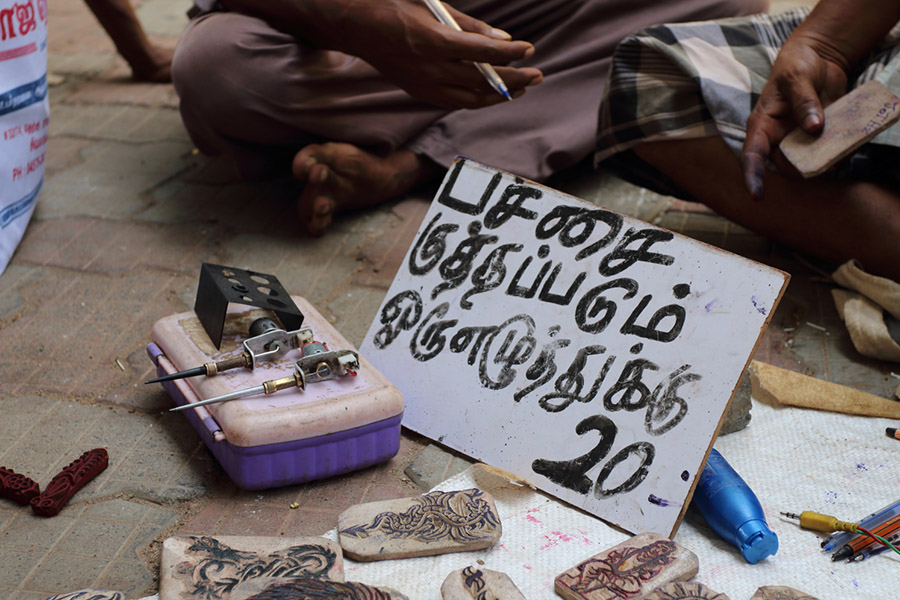
Client and artist agree on a price of fifty Rupees and Cinemaguru gets his equipment ready: a crude, unsterilized ink-smeared machine powered by a motorbike battery in a plastic bag. The ink has been purchased from an office supplies shop. Navaneetha doesn’t ask for a fresh needle and Cinemaguru doesn’t offer one.
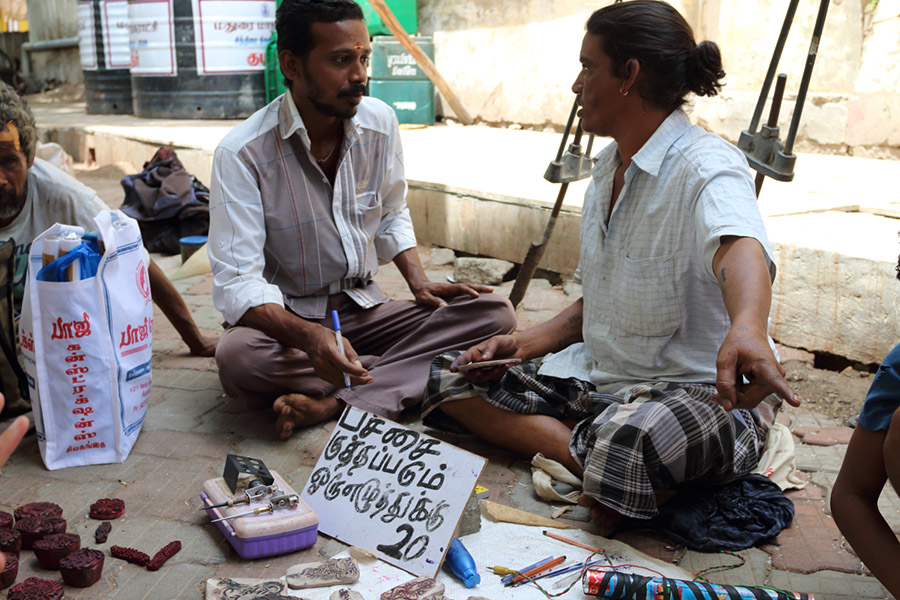
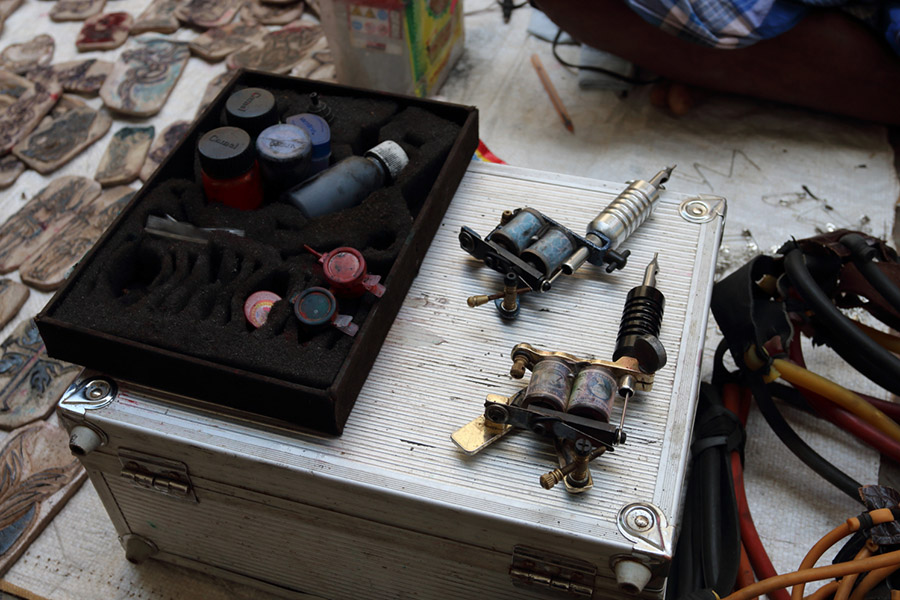
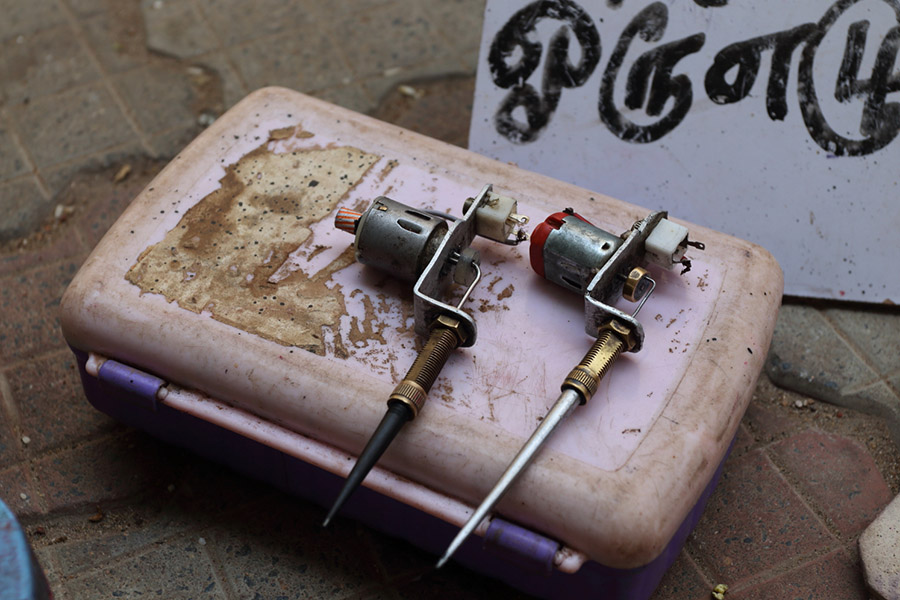
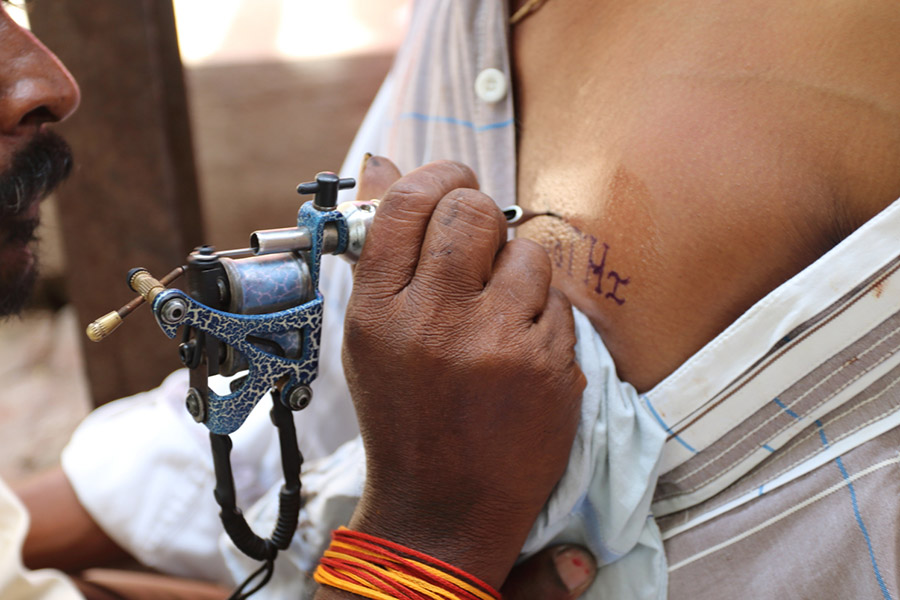
With a flowery font, he draws Jothi’s name onto Navaneetha’s chest with a pen. Then he raises his needle and begins to attack the young man’s skin. Two minutes into the procedure, and tears drop from his face, as Jothi puts a comforting hand on his shoulder.
Dermatologists and tattooists who work in international standard shops bemoan the existence of tattooists like Cinemaguru. The lack of sanitation hugely increases the risk of contracting a number of skin infections along with Hepatitis B, Tetanus and HIV.
Five minutes later, Cinemaguru is done, Navaneetha is ecstatic and the couple happily pay their fee. Cinemaguru applies coconut oil to disinfect the wound and gets ready for his next customer.
Most Indians can’t afford to step into a shop with better equipment and hygiene and street tattooists like Cinemaguru will remain in high demand.
“My tattoos are popular because I start at twenty Rupees,” he said, “It’s a way for the low wage earners to express themselves.”
FIND THIS ARTICLE IN FULL, PHOTOGRAPHS AND TATTOOS, ON THE APPLICATION
ATC TATTOO
Lea Nahon
Text and pictures : ©P-mod
Translation: Armelle Boussidan
Léa Nahon has been at the helm of her ship for fifteen years. Sailing with raw lines, she intertwines raw eroticism with spontaneous instants in her universe, transposed all the way from her sketchbooks to her clients' skin.
Over a passage on her rowboat, the "blackworker" tells us about her Belgium, her experience and her numerous future projects which are just like her: unique and authentic.
You seem to have withdrawn for a while before you came back full power, is there a particular reason for this?
Withdrawn may not be the right word for it, but I had to slow down indeed. I had been on the road for years, in trains, planes and cars, sleeping in hotels and on friends' sofas, never really taking it easy at home. I was tired. Tattooing demands constant work and being on the road is great but I didn't have much time for friends and family. My mother had to book appointments with me to have lunch and my brothers and sisters were getting birthday presents via the Los Angeles post. It did not replace physical presence. So I decided to slow down. I stopped going to conventions for a year or two. I had to make a clear cut or else I would have made an exception out of every event. I re-discovered the pleasures of reading a book, watching a movie without drawing at the same time or going for walks. I also slowed down on appointments. I did not need to work that much, I was just scared of disappointing my clients. Tattoos and clients took priority over my relationships and even my health. One has to get out of the spiral to realise how mistaken they are. Since then I have started conventions again, I work less but better, and I have learnt to take time for myself and my family and friends.
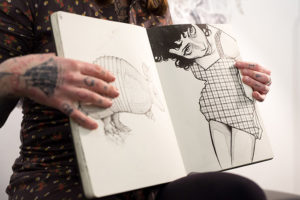
Throughout your sketchbooks and tattoos, you grasp instants that could be found in Nan Goldin's photography or in Egon Schiele's self portraits for instance, what touches you in the works of these artists?
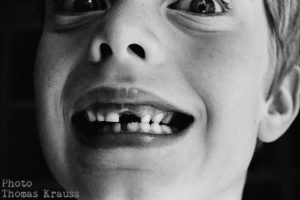
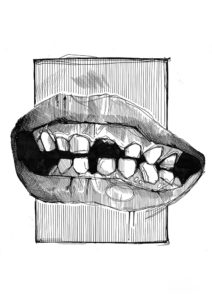
Their spontaneous aspect, precisely. Goldon's pictures freeze a moment that has not been chosen by the model, a bit like Schiele's portraits, as if no one was posing, or as if the models were not aware that they were being pictured or drawn. I work from photos, and apart from pictures by Thomas Krauss and a few others, I use my own pictures as a basis. Which means my friends and family. I take pictures all the time, and some, which could look like bad pictures, give me a great working basis. It is the absence of pose that I liked in those two artists and that I reproduced without really realising.
I also like mistakes that lead to great things. But I have to admit that this technique is convenient, for tattoos in any case. If my client moves, no problem, we draw a line aside and here it is, it looks great! There is at least 50% of laziness, but I like the result better than if I were making it all polished, and my clients seem to appreciate it, so everybody wins!
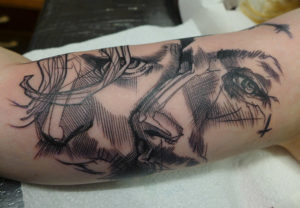
You have been collaborating with Thomas Krauss for a while, could you tell us what touches you in his photographs and what nourished your collaboration?
I met Thomas posing for him and seeing the result of his pictures with other tattooists. It's weird, even though he asks people to pose, he still manages to obtain a spontaneous feeling, as if the model was about to say or do something. It is never frozen. I like it even more when he takes pictures on the spot, when he hangs out for hours until we don't see him in the room and he comes back with fragments of life of which we were not aware. These pictures are hard to draw, but they are gold to me!
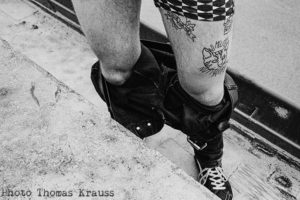
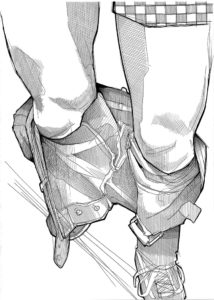
Do your clients generally see the intention you have put in your sketches when they choose a tattoo?
No, that's precisely what I like. I never put a lot of intention in my drawings, there is nothing thought out, it all depends on the picture I find. That's why it's hard for me to follow a guideline for my drawings, because the theme does not really depend on me... If I see a picture pass by, whether it's in a book or online, and I like it (the angle, the person's expression, the position, etc...), I put it aside and I draw it. My clients sometimes find very deep things in my drawings because they remind them of something, someone, whatever it is. I prefer to let them come up with their own interpretation, their story will certainly be more interesting than mine!
What's your outlook on the tattoo world and its evolution since you started 15 years ago?
I come from the old school where you have to know how to do everything to survive in this job. A good tattooist should be able to answer all types of requests. We did not come to tattoos because it was cool and made money. It was rather the opposite. Years of cleaning without getting a cent, hours welding needles, inhaling acid fumes, doing the dishes, sterilizing tubes, and after all that, hours of drawing, in all styles. No time to work on one's own style or draw one's desires. It was hard as hell, nothing to do with the glamorous side associated to it today!
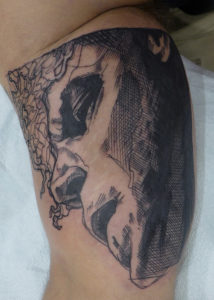
I'd like to think that I contributed to the fact that tattoo artists dare to get out of imposed codes and try new things on people's skin. I managed to develop this sketch "style" after having drawn a lot, after having studied various objects, animals and human bodies, in all styles.
I have only been tattooing my own drawings for two years. Colleagues like Yann Black and Joe Moo (to name but a few) are great designers, and they decided to come back to this clean style that we are familiar with. I think that a lot of young tattooists do what they know how to do and call that their style, out of disappointment rather than choice. But paradoxically, crazier and crazier styles come out of these new tattoo artists' work, ideas that nobody had before because they were too stuck in a "tattoo" set of mind, and I think this is great. I am surprised everyday by new things I see online and I ask myself what they will come up with next, how far it will go?
Tattoo has completely changed these past ten years, but in a good way. And people get more and more tattoos because they were waiting to be offered such things, not just because tattoo is on TV.
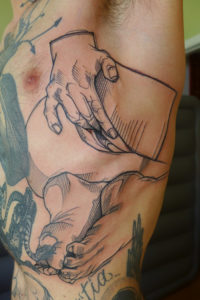
What aspects of your experience have comforted you in your choices, and what things won't you do again?
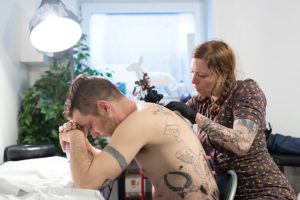
I am comforted by the idea that hard work pays off. I am not talking about money but about standard of living. All these years on the road not knowing where I was going, meeting a maximum number of people and attempting to gain recognition in a quite peculiar universe, have shaped me. I can afford to work a little less (I went down from 4 to 2 tattoos a day, yesss!) I can (almost) only tattoo my drawings, I work with people I admire a lot, all of this would not have been possible without all these years of continuous work. And I have a lifetime of memories!
There is nothing I would not do again, let's say that in some cases I am happy that ridicule never did anyone harm!
Could you talk about your link with Belgium?
It is a strong link I entertain with Belgium! During years of travelling, every time I came back to Paris, I was telling myself it was still the most beautiful city in the world and I had never found anywhere where I felt better. Until I went to Brussels.
I grew up in Belleville, a very popular neighbourhood. But cities change. And I found in the Marolles (the old Brussels where the Boucherie Moderne is), the atmosphere of the Belleville of my childhood, with the old market and the grandpas' drinking white wine at 8 am. Through going there back and forth, I ended up settling there.
And then the city also changed, and I followed my bloke to Liège where I found this outdated atmosphere, with cobblestones, old factories and an incorrigible punk atmosphere that make Liège the city of all dangers if you have a tendency for alcohol and drugs. It's not called ToxCity for nothing!
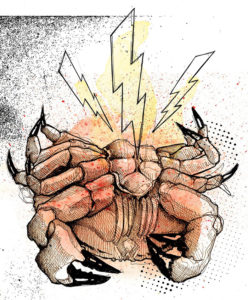
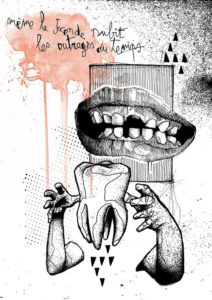
Between your boat, the Factory and England, you have lots of new projects in store, could you tell us about them?
Yes, a lot of projects indeed!!!
Let's take them in order. First the boat: I have bought a superb "small" 18.5 yard tug last may. The initial project was to have a tattoo shop in it, since I didn't have a shop to work in, in Liège. But the works may last at least another year hence the next project of the Factory. We worked on it all summer, having barbecues on the docks (bathing in the canal to freshen up), so I can't wait for warm weather to start again.
I haven't abandoned the project of tattooing in there. I really want to do some mobile tattooing with it as soon as it will be in water, but first around Amsterdam and this area.
And then the Factory will open its doors in June 2016. When I saw the place for rent with my friend Sabina [editor's note : Sabina Patiperra - Psychodermo, Namur] who tattooes in Liège, we had a crush on it. If it were an umpteenth tattoo shop in Liège we wouldn't have done it, but this place comprises a gallery separate from the tattoo space and that is what we really liked about it. So from June onwards, exhibitions every two months, tattoos, and finally a bit of stability!
And as soon as stability won't be a novelty any more, I intend to cross the channel to settle in Brighton for a while, where I regularly work. There, the boat will become a home. But we are not there yet...
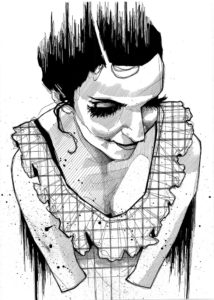
So, a new challenge with the management of a gallery. What are your objectives with this opening? What would you like to defend?
I think we are going to take things as they come. Logistic problems will come soon (communication, repainting the walls after the artists have ruined them, etc.). But indeed there are things that are important to us. We will put on an exhibition every two months (our agenda of conventions does not allow us to have them more often). A small percentage will be taken on the sale of artworks, and it will be entirely donated to a different charity each time.
This side of things is very important to us. I find that the world of tattoo makes enough money so that we can make things change, even at our little scale. We have walls, and therefore a space open to free speech, which is already a powerful weapon, if we can also lift people out of poverty while partying, everybody wins.
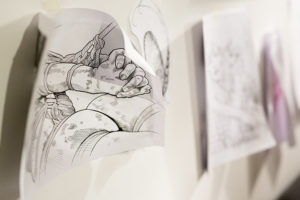
You are signing the opening exhibition with Köfi, who are you planning on inviting next? Artists from the new generation?
After this exhibition, there will be another one in August with lots of artists from Liège, tattooists or not. A big melting pot of all that is made here, in all styles. And from the beginning of the school year, Piet du Congo, Franky Baloney from the Requins Marteaux, and Elzo Durt. It takes us to 2017, so after that we'll see. So everybody is welcome, new and old generation. And if we can make people discover new talents, even better!
With all these projects, are you going to keep on exhibiting in Europe in an intensive way, as you have done over the past years?
Yes, sure! The fact I'm based in Liège will allow me to draw more, so I intend on continuing with exhibitions and guest tattoos a bit everywhere. It's the perk with being two to open the Factory, we can take turns. The next exhibitions will arrive quite quickly after the opening, I will be in Nantes at Turbo Zero in October, and then in Toulouse at the Dispensary (probably in collaboration with Thomas Krauss) in December, and in Portsmouth, England, at Play Dead in January. And after, we'll see!
What can we wish you for the future?
Let's talk about it when the shop is open? At the moment, nothing more, please!